Hyperparameters tuning and features selection are two common steps in every machine learning pipeline.

Overview

shap-hypetune

A python package for simultaneous Hyperparameters Tuning and Features Selection for Gradient Boosting Models.
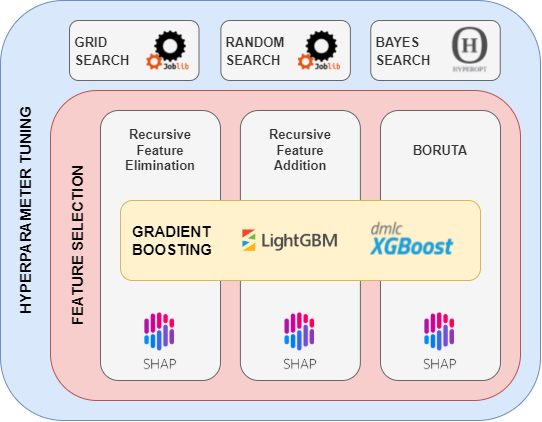
shap-hypetune diagram

Overview

Hyperparameters tuning and features selection are two common steps in every machine learning pipeline. Most of the time they are computed separately and independently. This may result in suboptimal performances and in a more time expensive process.

shap-hypetune aims to combine hyperparameters tuning and features selection in a single pipeline optimizing the optimal number of features while searching for the optimal parameters configuration. Hyperparameters Tuning or Features Selection can also be carried out as standalone operations.

shap-hypetune main features:

  • designed for gradient boosting models, as LGBModel or XGBModel;
  • developed to be integrable with the scikit-learn ecosystem;
  • effective in both classification or regression tasks;
  • customizable training process, supporting early-stopping and all the other fitting options available in the standard algorithms api;
  • ranking feature selection algorithms: Recursive Feature Elimination (RFE); Recursive Feature Addition (RFA); or Boruta;
  • classical boosting based feature importances or SHAP feature importances (the later can be computed also on the eval_set);
  • apply grid-search, random-search, or bayesian-search (from hyperopt);
  • parallelized computations with joblib.

Installation

pip install --upgrade shap-hypetune

lightgbm, xgboost are not needed requirements. The module depends only on NumPy, shap, scikit-learn and hyperopt. Python 3.6 or above is supported.

Media

Usage

from shaphypetune import BoostSearch, BoostRFE, BoostRFA, BoostBoruta

Hyperparameters Tuning

BoostSearch(
    estimator,                              # LGBModel or XGBModel
    param_grid=None,                        # parameters to be optimized
    greater_is_better=False,                # minimize or maximize the monitored score
    n_iter=None,                            # number of sampled parameter configurations
    sampling_seed=None,                     # the seed used for parameter sampling
    verbose=1,                              # verbosity mode
    n_jobs=None                             # number of jobs to run in parallel
)

Feature Selection (RFE)

BoostRFE(  
    estimator,                              # LGBModel or XGBModel
    min_features_to_select=None,            # the minimum number of features to be selected  
    step=1,                                 # number of features to remove at each iteration  
    param_grid=None,                        # parameters to be optimized  
    greater_is_better=False,                # minimize or maximize the monitored score  
    importance_type='feature_importances',  # which importance measure to use: default or shap  
    train_importance=True,                  # where to compute the shap feature importance  
    n_iter=None,                            # number of sampled parameter configurations  
    sampling_seed=None,                     # the seed used for parameter sampling  
    verbose=1,                              # verbosity mode  
    n_jobs=None                             # number of jobs to run in parallel  
)  

Feature Selection (BORUTA)

BoostBoruta(
    estimator,                              # LGBModel or XGBModel
    perc=100,                               # threshold used to compare shadow and real features
    alpha=0.05,                             # p-value levels for feature rejection
    max_iter=100,                           # maximum Boruta iterations to perform
    early_stopping_boruta_rounds=None,      # maximum iterations without confirming a feature
    param_grid=None,                        # parameters to be optimized
    greater_is_better=False,                # minimize or maximize the monitored score
    importance_type='feature_importances',  # which importance measure to use: default or shap
    train_importance=True,                  # where to compute the shap feature importance
    n_iter=None,                            # number of sampled parameter configurations
    sampling_seed=None,                     # the seed used for parameter sampling
    verbose=1,                              # verbosity mode
    n_jobs=None                             # number of jobs to run in parallel
)

Feature Selection (RFA)

BoostRFA(
    estimator,                              # LGBModel or XGBModel
    min_features_to_select=None,            # the minimum number of features to be selected
    step=1,                                 # number of features to remove at each iteration
    param_grid=None,                        # parameters to be optimized
    greater_is_better=False,                # minimize or maximize the monitored score
    importance_type='feature_importances',  # which importance measure to use: default or shap
    train_importance=True,                  # where to compute the shap feature importance
    n_iter=None,                            # number of sampled parameter configurations
    sampling_seed=None,                     # the seed used for parameter sampling
    verbose=1,                              # verbosity mode
    n_jobs=None                             # number of jobs to run in parallel
)

Full examples in the notebooks folder.

Comments
  • Suppress warnings

    Suppress warnings

    Hi,

    While running BoostBoruta according to the notebook toturial I'm getting the following warnings which I would like to suppress:

    'early_stopping_rounds' argument is deprecated and will be removed in a future release of LightGBM. Pass 'early_stopping()' callback via 'callbacks' argument instead.
    'verbose' argument is deprecated and will be removed in a future release of LightGBM. Pass 'log_evaluation()' callback via 'callbacks' argument instead.
    

    Any ideas on how to do that?

    Thank you

    opened by Rane90 4
  • Can BoostBoruta be used in a scikit-pipeline?

    Can BoostBoruta be used in a scikit-pipeline?

    Hello, First of all, thank you for this great repo. It looks very promising. I'd like to use BoostBoruta within a scikit-pipeline. Is it possible?

    For now, here is the code I've tried with no success :

    # get the categorical and numeric column names
    num_cols = X_train.select_dtypes(exclude=['object']).columns.tolist()
    cat_cols = X_train.select_dtypes(include=['object']).columns.tolist()
    
    # pipeline for numerical columns
    num_pipe = make_pipeline(
        StandardScaler()
    )
    # pipeline for categorical columns
    cat_pipe = make_pipeline(
        OneHotEncoder(handle_unknown='ignore', sparse=False)
    )
    
    # combine both the pipelines
    full_pipe = ColumnTransformer([
        ('num', num_pipe, num_cols),
        ('cat', cat_pipe, cat_cols)
    ])
    
    model = BoostBoruta(
        clf_lgbm, param_grid=param_dist_hyperopt, n_iter=8, sampling_seed=0, importance_type="shap", train_importance=True,n_jobs=-1, verbose=2
    )
    
    pipeline_hypetune = make_pipeline(full_pipe, model)
    model_selection = RepeatedStratifiedKFold(n_splits=10, n_repeats=2, random_state=2022)
    
    results = cross_validate(pipeline_hypetune, X_train, y, scoring='accuracy', cv=model_selection, return_estimator=True)
    

    No exception is thrown but no model is learned either... Any ideas why?

    Thanks in advance

    opened by YoannPitarch 4
  • ExplainerError

    ExplainerError

    For my dataset I'm getting this error:

    ExplainerError: Additivity check failed in TreeExplainer! Please ensure the data matrix you passed to the explainer is the same
    shape that the model was trained on. If your data shape is correct then please report this on GitHub. Consider retrying with the 
    feature_perturbation='interventional' option. This check failed because for one of the samples the sum of the SHAP values was 
    -0.577556, while the model output was -0.540311. If this difference is acceptable you can set check_additivity=False to disable 
    this check.
    

    I'm using it like this:

    model = BoostRFE(regr_xgb, param_grid=param_dist, 
                                   min_features_to_select=10, 
                                   step=20, 
                                   importance_type='shap_importances',
                                   n_iter=5
                                   )
    

    Any suggestion how to solve this?

    opened by hasan-sayeed 3
  • great software! wonder if it supports for custom CVs?

    great software! wonder if it supports for custom CVs?

    Hello,

    Great package! very easy to use, and it is very effective! :)

    I was wondering if it is possible to use custom CVs for random search + feature selection

    Thanks!

    opened by GalaxyNight-day 3
  • Feature Immportance chart with selected feature names with scores

    Feature Immportance chart with selected feature names with scores

    Hi @cerlymarco ,

    1. How do I get feature names with scores like this? (Traditional Xg-Boost)
    2. And what will be the X-axis scoring scale for that?

    image img-src : https://user-images.githubusercontent.com/42869040/162376574-03869b81-f11e-4d1f-8bea-eddb714d39b0.png

    Thanks

    Originally posted by @VinayChaudhari1996 in https://github.com/cerlymarco/shap-hypetune/issues/4#issuecomment-1092483163

    opened by VinayChaudhari1996 2
  • List of the important features?

    List of the important features?

    Hi, I apologize if this is a dumb question ,but I can't find where to get the list of important features from the trained model? Thanks for any pointers.

    opened by jmrichardson 2
  • Support for state of art hyperparameter optimization packages

    Support for state of art hyperparameter optimization packages

    It would be nice to have options to select some state of art technique for hyperparameter optimization. Such as: https://scikit-optimize.github.io/stable/ https://github.com/optuna/optuna or maybe the best (should be drop in replacement for scikit Grid/Random search, but support advanced techniques from packages above) https://github.com/ray-project/tune-sklearn

    opened by oldrichsmejkal 2
  • Erratic behaviour

    Erratic behaviour

    Hi,

    I am still running a series of experiments with shap-hypertune. Some sort of cross-validation with a number of stratified K-fold splits.

    For each split, I generate random seeds like this: np.random.randint(4294967295).

    A typical run goes like this (there is one for each split):

    11 trials detected for ('num_leaves', 'n_estimators', 'max_depth', 'learning_rate')
    
    trial: 0001 ### iterations: 00008 ### eval_score: 0.94737
    trial: 0002 ### iterations: 00018 ### eval_score: 0.92481
    trial: 0003 ### iterations: 00020 ### eval_score: 0.99248
    trial: 0004 ### iterations: 00017 ### eval_score: 0.97744
    trial: 0005 ### iterations: 00025 ### eval_score: 0.98496
    trial: 0006 ### iterations: 00012 ### eval_score: 0.97744
    trial: 0007 ### iterations: 00020 ### eval_score: 0.99248
    trial: 0008 ### iterations: 00012 ### eval_score: 0.98496
    trial: 0009 ### iterations: 00021 ### eval_score: 0.98496
    trial: 0010 ### iterations: 00018 ### eval_score: 0.98496
    trial: 0011 ### iterations: 00025 ### eval_score: 0.98496
    
    11 trials detected for ('num_leaves', 'n_estimators', 'max_depth', 'learning_rate')
    
    trial: 0001 ### iterations: 00025 ### eval_score: 0.96241
    trial: 0002 ### iterations: 00038 ### eval_score: 0.97744
    trial: 0003 ### iterations: 00037 ### eval_score: 0.97744
    trial: 0004 ### iterations: 00015 ### eval_score: 0.96241
    trial: 0005 ### iterations: 00002 ### eval_score: 0.81203
    trial: 0006 ### iterations: 00018 ### eval_score: 0.96241
    trial: 0007 ### iterations: 00016 ### eval_score: 0.96241
    trial: 0008 ### iterations: 00011 ### eval_score: 0.91729
    trial: 0009 ### iterations: 00038 ### eval_score: 0.97744
    trial: 0010 ### iterations: 00022 ### eval_score: 0.96241
    trial: 0011 ### iterations: 00021 ### eval_score: 0.96992
    

    However, sometimes the eval_score drops dramatically.

    But this does not seem to be your typical stochastic behaviour.

    For instance, normally, f it drops for one split it will drop for all the subsequent splits. In spite of the fact that a new seed is (pseudo) randomly generated for each split at each stage:

    skf = StratifiedKFold(n_splits=5, shuffle=True, random_state=np.random.randint(4294967295))
    
    	clf_lgbm = LGBMClassifier(boosting_type='rf',
                             random_state=np.random.randint(4294967295),
    
    	model = BoostRFA(    
        sampling_seed=np.random.randint(4294967295),	


    In other cases the number of iterations stays constant for each run:

    11 trials detected for ('num_leaves', 'n_estimators', 'max_depth', 'learning_rate')
    
    trial: 0001 ### iterations: 00001 ### eval_score: 0.69173
    trial: 0002 ### iterations: 00001 ### eval_score: 0.7594
    trial: 0003 ### iterations: 00001 ### eval_score: 0.69173
    trial: 0004 ### iterations: 00001 ### eval_score: 0.69173
    trial: 0005 ### iterations: 00001 ### eval_score: 0.79699
    trial: 0006 ### iterations: 00001 ### eval_score: 0.69173
    trial: 0007 ### iterations: 00001 ### eval_score: 0.69173
    trial: 0008 ### iterations: 00001 ### eval_score: 0.7594
    trial: 0009 ### iterations: 00001 ### eval_score: 0.69173
    trial: 0010 ### iterations: 00001 ### eval_score: 0.69173
    trial: 0011 ### iterations: 00001 ### eval_score: 0.69173
    
    11 trials detected for ('num_leaves', 'n_estimators', 'max_depth', 'learning_rate')
    
    trial: 0001 ### iterations: 00001 ### eval_score: 0.82707
    trial: 0002 ### iterations: 00001 ### eval_score: 0.82707
    trial: 0003 ### iterations: 00001 ### eval_score: 0.82707
    trial: 0004 ### iterations: 00001 ### eval_score: 0.82707
    trial: 0005 ### iterations: 00001 ### eval_score: 0.81955
    trial: 0006 ### iterations: 00001 ### eval_score: 0.82707
    trial: 0007 ### iterations: 00001 ### eval_score: 0.81955
    trial: 0008 ### iterations: 00001 ### eval_score: 0.81955
    trial: 0009 ### iterations: 00001 ### eval_score: 0.82707
    trial: 0010 ### iterations: 00001 ### eval_score: 0.82707
    trial: 0011 ### iterations: 00001 ### eval_score: 0.82707
    

    If you re-run the script, you typically observe the normal behaviour again.

    opened by mirix 1
  • Issue with custom scorer

    Issue with custom scorer

    Hello,

    I have an unbalanced dataset and I am trying to create a custom scorer that finds the best possible recall above a given precision for the minority class.

    The opposite seems to work well. When I feed the following score to shap-hypertune, it produces consistent results for the precision:

    def precision_at_recall(y_true, y_hat):
    	precision, recall, thresholds = precision_recall_curve(y_true, y_hat, pos_label=1)
    	ix = np.argmax(precision[recall >= .9])
    	return 'precision_at_recall', precision[ix], True
    

    The recall and precision for the minority class at a threshold of 0.5 are both around 0.85. If we set a recall above 0.9, the precision decreases accordingly, as expected.

    However, the following does not work:

    def recall_at_precision(y_true, y_hat):
    	precision, recall, thresholds = precision_recall_curve(y_true, y_hat, pos_label=1)
    	ix = np.argmax(recall[precision >= .9])
    	return 'recall_at_precision', recall[ix], True
    

    It always produces a perfect recall (1), regardless of the precision, even if the precision is set to 1.

    opened by mirix 1
  • Error in BoostBoruta

    Error in BoostBoruta

    Hi, I am getting an error while running BoostBoruta for a binary classification task.

    Size of data is: `print(X_clf_train.shape, y_clf_train.shape) print(X_clf_valid.shape, y_clf_valid.shape)

    (102, 32) (102,) (12, 32) (12,) ` and here is the code I use:

    `### BORUTA ###

    model = BoostBoruta( clf_xgb, max_iter=200, perc=100, sampling_seed=0, verbose=3, n_jobs=-1, ) model.fit(X_clf_train, y_clf_train, eval_set=[(X_clf_valid, y_clf_valid)], early_stopping_rounds=6, verbose=3) print(model.n_features_)

    `

    and the error:

    Iterantion: 1 / 200

    XGBoostError Traceback (most recent call last) /tmp/ipykernel_4016678/3155018104.py in <cell line: 11>() 9 n_jobs=-1, 10 ) ---> 11 model.fit(X_clf_train, 12 y_clf_train, 13 eval_set=[(X_clf_valid, y_clf_valid)],

    ~/myvenv/mykears3.9/lib/python3.9/site-packages/shaphypetune/_classes.py in fit(self, X, y, trials, **fit_params) 163 164 if self.param_grid is None: --> 165 results = self._fit(X, y, fit_params) 166 167 for v in vars(results['model']):

    ~/myvenv/mykears3.9/lib/python3.9/site-packages/shaphypetune/_classes.py in _fit(self, X, y, fit_params, params) 66 model = self._build_model(params) 67 if isinstance(model, _BoostSelector): ---> 68 model.fit(X=X, y=y, **fit_params) 69 else: 70 with contextlib.redirect_stdout(io.StringIO()):

    ~/myvenv/mykears3.9/lib/python3.9/site-packages/shaphypetune/_classes.py in fit(self, X, y, **fit_params) 521 _X = self._create_X(X, feat_id_real) 522 with contextlib.redirect_stdout(io.StringIO()): --> 523 estimator.fit(_X, y, **_fit_params) 524 525 # get coefs

    ~/myvenv/mykears3.9/lib/python3.9/site-packages/xgboost/core.py in inner_f(*args, **kwargs) 434 for k, arg in zip(sig.parameters, args): 435 kwargs[k] = arg --> 436 return f(**kwargs) 437 438 return inner_f

    ~/myvenv/mykears3.9/lib/python3.9/site-packages/xgboost/sklearn.py in fit(self, X, y, sample_weight, base_margin, eval_set, eval_metric, early_stopping_rounds, verbose, xgb_model, sample_weight_eval_set, base_margin_eval_set, feature_weights, callbacks) 1174 ) 1175 -> 1176 self._Booster = train( 1177 params, 1178 train_dmatrix,

    ~/myvenv/mykears3.9/lib/python3.9/site-packages/xgboost/training.py in train(params, dtrain, num_boost_round, evals, obj, feval, maximize, early_stopping_rounds, evals_result, verbose_eval, xgb_model, callbacks) 187 Booster : a trained booster model 188 """ --> 189 bst = _train_internal(params, dtrain, 190 num_boost_round=num_boost_round, 191 evals=evals,

    ~/myvenv/mykears3.9/lib/python3.9/site-packages/xgboost/training.py in _train_internal(params, dtrain, num_boost_round, evals, obj, feval, xgb_model, callbacks, evals_result, maximize, verbose_eval, early_stopping_rounds) 79 if callbacks.before_iteration(bst, i, dtrain, evals): 80 break ---> 81 bst.update(dtrain, i, obj) 82 if callbacks.after_iteration(bst, i, dtrain, evals): 83 break

    ~/myvenv/mykears3.9/lib/python3.9/site-packages/xgboost/core.py in update(self, dtrain, iteration, fobj) 1497 1498 if fobj is None: -> 1499 _check_call(_LIB.XGBoosterUpdateOneIter(self.handle, 1500 ctypes.c_int(iteration), 1501 dtrain.handle))

    ~/myvenv/mykears3.9/lib/python3.9/site-packages/xgboost/core.py in _check_call(ret) 208 """ 209 if ret != 0: --> 210 raise XGBoostError(py_str(_LIB.XGBGetLastError())) 211 212

    XGBoostError: [12:37:22] ../src/data/data.cc:583: Check failed: labels_.Size() == num_row_ (102 vs. 160) : Size of labels must equal to number of rows. Stack trace: [bt] (0) /home/zeydabadi/myvenv/mykears3.9/lib/python3.9/site-packages/xgboost/lib/libxgboost.so(+0x9133f) [0x7fe8df99b33f] [bt] (1) /home/zeydabadi/myvenv/mykears3.9/lib/python3.9/site-packages/xgboost/lib/libxgboost.so(+0x110fcc) [0x7fe8dfa1afcc] [bt] (2) /home/zeydabadi/myvenv/mykears3.9/lib/python3.9/site-packages/xgboost/lib/libxgboost.so(+0x1b90e7) [0x7fe8dfac30e7] [bt] (3) /home/zeydabadi/myvenv/mykears3.9/lib/python3.9/site-packages/xgboost/lib/libxgboost.so(+0x1b99bc) [0x7fe8dfac39bc] [bt] (4) /home/zeydabadi/myvenv/mykears3.9/lib/python3.9/site-packages/xgboost/lib/libxgboost.so(XGBoosterUpdateOneIter+0x50) [0x7fe8df98aed0] [bt] (5) /lib64/libffi.so.6(ffi_call_unix64+0x4c) [0x7febb4ca610e] [bt] (6) /lib64/libffi.so.6(ffi_call+0x36f) [0x7febb4ca5abf] [bt] (7) /home/zeydabadi/mykeras/bin/usr/local/lib/python3.9/lib-dynload/_ctypes.cpython-39-x86_64-linux-gnu.so(+0x11235) [0x7febb4eba235] [bt] (8) /home/zeydabadi/mykeras/bin/usr/local/lib/python3.9/lib-dynload/_ctypes.cpython-39-x86_64-linux-gnu.so(+0xaa66) [0x7febb4eb3a66]

    opened by zeydabadi 1
  • only 10 features show in the BoostBoruta, without any feature labels/ranks/indexes

    only 10 features show in the BoostBoruta, without any feature labels/ranks/indexes

    I have a dataset with >2000 features. After I run BoostBoruta, 10 features show in the results, but they have no label/ind. information. How can I retrieve feature importances and the original ind./labels mapping to the original feature set?

    opened by raqueldias 1
  • Eval Metric directionality?

    Eval Metric directionality?

    Hi,

    If I use a custom metric like the brier score where lower is better, does this package support looking to minimize the eval metric? or is it by default trying to maximize?

    Thank You

    opened by ericvoots 0
  • Any plan to write a publication or preprint.

    Any plan to write a publication or preprint.

    This is an excellent repo to do the hyper-parameter tuning, and an approach to use SHAP measurement. A publication or preprint helps the practitioners to understand the repo deeper. Thus, I'm curious, do you have any plan to do this?

    opened by JiaxiangBU 0
Releases(v0.2.6)
Owner
Marco Cerliani
Statistician Hacker & Data Scientist
Marco Cerliani
PyTorch implementation for OCT-GAN Neural ODE-based Conditional Tabular GANs (WWW 2021)

OCT-GAN: Neural ODE-based Conditional Tabular GANs (OCT-GAN) Code for reproducing the experiments in the paper: Jayoung Kim*, Jinsung Jeon*, Jaehoon L

BigDyL 7 Dec 27, 2022
Official PyTorch code for Hierarchical Conditional Flow: A Unified Framework for Image Super-Resolution and Image Rescaling (HCFlow, ICCV2021)

Hierarchical Conditional Flow: A Unified Framework for Image Super-Resolution and Image Rescaling (HCFlow, ICCV2021) This repository is the official P

Jingyun Liang 159 Dec 30, 2022
A Differentiable Recipe for Learning Visual Non-Prehensile Planar Manipulation

A Differentiable Recipe for Learning Visual Non-Prehensile Planar Manipulation This repository contains the source code of the paper A Differentiable

Bernardo Aceituno 2 May 05, 2022
Code for 2021 NeurIPS --- Towards Multi-Grained Explainability for Graph Neural Networks

ReFine: Multi-Grained Explainability for GNNs We are trying hard to update the code, but it may take a while to complete due to our tight schedule rec

Shirley (Ying-Xin) Wu 47 Dec 16, 2022
Linear Variational State Space Filters

Linear Variational State Space Filters To set up the environment, use the provided scripts in the docker/ folder to build and run the codebase inside

0 Dec 13, 2021
Multiple types of NN model optimization environments. It is possible to directly access the host PC GUI and the camera to verify the operation. Intel iHD GPU (iGPU) support. NVIDIA GPU (dGPU) support.

mtomo Multiple types of NN model optimization environments. It is possible to directly access the host PC GUI and the camera to verify the operation.

Katsuya Hyodo 24 Mar 02, 2022
[NeurIPS 2021 Spotlight] Aligning Pretraining for Detection via Object-Level Contrastive Learning

SoCo [NeurIPS 2021 Spotlight] Aligning Pretraining for Detection via Object-Level Contrastive Learning By Fangyun Wei*, Yue Gao*, Zhirong Wu, Han Hu,

Yue Gao 139 Dec 14, 2022
Woosung Choi 63 Nov 14, 2022
Toontown: Galaxy, a new Toontown game based on Disney's Toontown Online

Toontown: Galaxy The official archive repo for Toontown: Galaxy, a new Toontown

1 Feb 15, 2022
A solution to ensure Crowd Management with Contactless and Safe systems.

CovidTrack A Solution to ensure Crowd Management with Contactless and Safe systems. ML Model Mask Detection Social Distancing Detection Analytics Page

Om Khare 1 Nov 10, 2021
DiscoBox: Weakly Supervised Instance Segmentation and Semantic Correspondence from Box Supervision

The Official PyTorch Implementation of DiscoBox: Weakly Supervised Instance Segmentation and Semantic Correspondence from Box Supervision

Shiyi Lan 3 Oct 15, 2021
QHack—the quantum machine learning hackathon

Official repo for QHack—the quantum machine learning hackathon

Xanadu 72 Dec 21, 2022
Optimized Gillespie algorithm for simulating Stochastic sPAtial models of Cancer Evolution (OG-SPACE)

OG-SPACE Introduction Optimized Gillespie algorithm for simulating Stochastic sPAtial models of Cancer Evolution (OG-SPACE) is a computational framewo

Data and Computational Biology Group UNIMIB (was BI*oinformatics MI*lan B*icocca) 0 Nov 17, 2021
I created My own Virtual Artificial Intelligence named genesis, He can assist with my Tasks and also perform some analysis,,

Virtual-Artificial-Intelligence-genesis- I created My own Virtual Artificial Intelligence named genesis, He can assist with my Tasks and also perform

AKASH M 1 Nov 05, 2021
Code for the TASLP paper "PSLA: Improving Audio Tagging With Pretraining, Sampling, Labeling, and Aggregation".

PSLA: Improving Audio Tagging with Pretraining, Sampling, Labeling, and Aggregation Introduction Getting Started FSD50K Recipe AudioSet Recipe Label E

Yuan Gong 84 Dec 27, 2022
Contrastive Learning for Metagenomic Binning

CLMB A simple framework for CLMB - a novel deep Contrastive Learningfor Metagenomic Binning Created by Pengfei Zhang, senior of Department of Computer

1 Sep 14, 2022
Uni-Fold: Training your own deep protein-folding models

Uni-Fold: Training your own deep protein-folding models. This package provides an implementation of a trainable, Transformer-based deep protein foldin

DP Technology 187 Jan 04, 2023
EMNLP'2021: SimCSE: Simple Contrastive Learning of Sentence Embeddings

SimCSE: Simple Contrastive Learning of Sentence Embeddings This repository contains the code and pre-trained models for our paper SimCSE: Simple Contr

Princeton Natural Language Processing 2.5k Dec 29, 2022
This provides the R code and data to replicate results in "The USS Trustee’s risky strategy"

USSBriefs2021 This provides the R code and data to replicate results in "The USS Trustee’s risky strategy" by Neil M Davies, Jackie Grant and Chin Yan

1 Oct 30, 2021
This repository contains the data and code for the paper "Diverse Text Generation via Variational Encoder-Decoder Models with Gaussian Process Priors" ([email protected])

GP-VAE This repository provides datasets and code for preprocessing, training and testing models for the paper: Diverse Text Generation via Variationa

Wanyu Du 18 Dec 29, 2022