Pytorch code for our paper Beyond ImageNet Attack: Towards Crafting Adversarial Examples for Black-box Domains)

Overview

Beyond ImageNet Attack: Towards Crafting Adversarial Examples for Black-box Domains (ICLR'2022)

This is the Pytorch code for our paper Beyond ImageNet Attack: Towards Crafting Adversarial Examples for Black-box Domains). In this paper, with only the knowledge of the ImageNet domain, we propose a Beyond ImageNet Attack (BIA) to investigate the transferability towards black-box domains (unknown classification tasks).

Requirement

  • Python 3.7
  • Pytorch 1.8.0
  • torchvision 0.9.0
  • numpy 1.20.2
  • scipy 1.7.0
  • pandas 1.3.0
  • opencv-python 4.5.2.54
  • joblib 0.14.1
  • Pillow 6.1

Dataset

images

  • Download the ImageNet training dataset.

  • Download the testing dataset.

Note: After downloading CUB-200-2011, Standford Cars and FGVC Aircraft, you should set the "self.rawdata_root" (DCL_finegrained/config.py: lines 59-75) to your saved path.

Target model

The checkpoint of target model should be put into model folder.

  • CUB-200-2011, Stanford Cars and FGVC AirCraft can be downloaded from here.
  • CIFAR-10, CIFAR-100, STL-10 and SVHN can be automatically downloaded.
  • ImageNet pre-trained models are available at torchvision.

Pretrained-Generators

framework Adversarial generators are trained against following four ImageNet pre-trained models.

  • VGG19
  • VGG16
  • ResNet152
  • DenseNet169

After finishing training, the resulting generator will be put into saved_models folder. You can also download our pretrained-generator from here.

Train

Train the generator using vanilla BIA (RN: False, DA: False)

python train.py --model_type vgg16 --train_dir your_imagenet_path --RN False --DA False

your_imagenet_path is the path where you download the imagenet training set.

Evaluation

Evaluate the performance of vanilla BIA (RN: False, DA: False)

python eval.py --model_type vgg16 --RN False --DA False

Citing this work

If you find this work is useful in your research, please consider citing:

@inproceedings{Zhang2022BIA,
  author    = {Qilong Zhang and
               Xiaodan Li and
               Yuefeng Chen and
               Jingkuan Song and
               Lianli Gao and
               Yuan He and
               Hui Xue},
  title     = {Beyond ImageNet Attack: Towards Crafting Adversarial Examples for Black-box Domains},
  Booktitle = {International Conference on Learning Representations},
  year      = {2022}
}

Acknowledge

Thank @aaron-xichen and @Muzammal-Naseer for sharing their codes.

You might also like...
Explainer for black box models that predict molecule properties

Explaining why that molecule exmol is a package to explain black-box predictions of molecules. The package uses model agnostic explanations to help us

This is the repository for paper NEEDLE: Towards Non-invertible Backdoor Attack to Deep Learning Models.

This is the repository for paper NEEDLE: Towards Non-invertible Backdoor Attack to Deep Learning Models.

Iterative Normalization: Beyond Standardization towards Efficient Whitening

IterNorm Code for reproducing the results in the following paper: Iterative Normalization: Beyond Standardization towards Efficient Whitening Lei Huan

This is the official code for the paper
This is the official code for the paper "Ad2Attack: Adaptive Adversarial Attack for Real-Time UAV Tracking".

Ad^2Attack:Adaptive Adversarial Attack on Real-Time UAV Tracking Demo video 📹 Our video on bilibili demonstrates the test results of Ad^2Attack on se

Code for the CVPR2022 paper
Code for the CVPR2022 paper "Frequency-driven Imperceptible Adversarial Attack on Semantic Similarity"

Introduction This is an official release of the paper "Frequency-driven Imperceptible Adversarial Attack on Semantic Similarity" (arxiv link). Abstrac

[CVPR 2022 Oral] Crafting Better Contrastive Views for Siamese Representation Learning
[CVPR 2022 Oral] Crafting Better Contrastive Views for Siamese Representation Learning

Crafting Better Contrastive Views for Siamese Representation Learning (CVPR 2022 Oral) 2022-03-29: The paper was selected as a CVPR 2022 Oral paper! 2

Pre-trained model, code, and materials from the paper
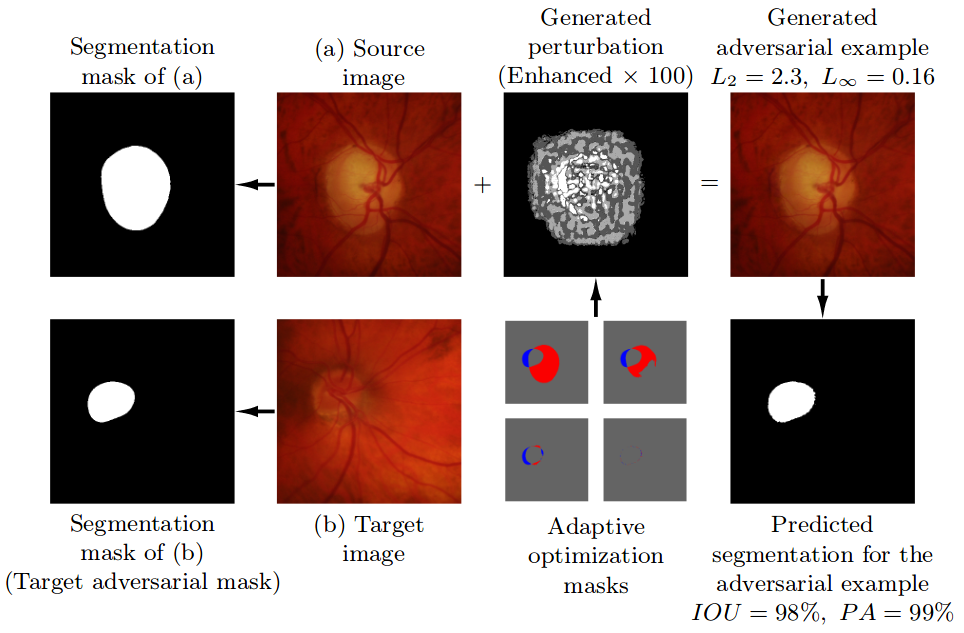
Pre-trained model, code, and materials from the paper "Impact of Adversarial Examples on Deep Learning Models for Biomedical Image Segmentation" (MICCAI 2019).

Adaptive Segmentation Mask Attack This repository contains the implementation of the Adaptive Segmentation Mask Attack (ASMA), a targeted adversarial

A PyTorch implementation of the paper Mixup: Beyond Empirical Risk Minimization in PyTorch

Mixup: Beyond Empirical Risk Minimization in PyTorch This is an unofficial PyTorch implementation of mixup: Beyond Empirical Risk Minimization. The co

Pythonic particle-based (super-droplet) warm-rain/aqueous-chemistry cloud microphysics package with box, parcel & 1D/2D prescribed-flow examples in Python, Julia and Matlab

PySDM PySDM is a package for simulating the dynamics of population of particles. It is intended to serve as a building block for simulation systems mo

Comments
  • About the comparative methods

    About the comparative methods

    Thank you for your insightful work! In Table3, I want to know that how to perform PGD or DIM on CUB with source models pretrained on ImageNet. Thank you~

    opened by lwmming 6
  • cursor already registered in Tk_GetCursor Aborted (core dumped)

    cursor already registered in Tk_GetCursor Aborted (core dumped)

    python train.py --model_type vgg16 --RN False --DA False

    I tried the above default training, but the error occurred at the end of the batch (epoch 1) training. Can you help debug this please?

    opened by hoonsyang 2
  • missing file

    missing file

    https://github.com/Alibaba-AAIG/Beyond-ImageNet-Attack/blob/7e8b1b8ec5728ebc01723f2c444bf2d5275ee7be/DCL_finegrained/LoadModel.py#L6 NameError: name 'pretrainedmodels' is not defined`

    opened by nkv1995 2
  • when computing cosine similarity

    when computing cosine similarity

    Hi! this is more of a question for the elegant work you have here but less of an issue.

    So when you take cosine similarity (which is to be decreased during training) between two feature maps, you take,

    loss = torch.cosine_similarity((adv_out_slice*attention).reshape(adv_out_slice.shape[0], -1), 
                                (img_out_slice*attention).reshape(img_out_slice.shape[0], -1)).mean()
    

    and that's to compare two flatten vectors, each of which is the flattened feature maps of size (N feature channels, width, height).

    I wonder why not comparing the flattened feature maps with respect to each channel, and then take the average across channels? To me, you're comparing two vectors that are (Nwidthheight)-dimensional, which is not so straightforward to me. Thanks in advance for any intuition behind!

    opened by juliuswang0728 1
Releases(pretrained_models)
Owner
Alibaba-AAIG
Alibaba Artificial Intelligence Governance Laboratory
Alibaba-AAIG
Video Frame Interpolation with Transformer (CVPR2022)

VFIformer Official PyTorch implementation of our CVPR2022 paper Video Frame Interpolation with Transformer Dependencies python = 3.8 pytorch = 1.8.0

DV Lab 63 Dec 16, 2022
Stacked Hourglass Network with a Multi-level Attention Mechanism: Where to Look for Intervertebral Disc Labeling

⚠️ ‎‎‎ A more recent and actively-maintained version of this code is available in ivadomed Stacked Hourglass Network with a Multi-level Attention Mech

Reza Azad 14 Oct 24, 2022
Code and real data for the paper "Counterfactual Temporal Point Processes", available at arXiv.

counterfactual-tpp This is a repository containing code and real data for the paper Counterfactual Temporal Point Processes. Pre-requisites This code

Networks Learning 11 Dec 09, 2022
Instant neural graphics primitives: lightning fast NeRF and more

Instant Neural Graphics Primitives Ever wanted to train a NeRF model of a fox in under 5 seconds? Or fly around a scene captured from photos of a fact

NVIDIA Research Projects 10.6k Jan 01, 2023
Team Enigma at ArgMining 2021 Shared Task: Leveraging Pretrained Language Models for Key Point Matching

Team Enigma at ArgMining 2021 Shared Task: Leveraging Pretrained Language Models for Key Point Matching This is our attempt of the shared task on Quan

Manav Nitin Kapadnis 12 Jul 08, 2022
Repo for CReST: A Class-Rebalancing Self-Training Framework for Imbalanced Semi-Supervised Learning

CReST in Tensorflow 2 Code for the paper: "CReST: A Class-Rebalancing Self-Training Framework for Imbalanced Semi-Supervised Learning" by Chen Wei, Ki

Google Research 75 Nov 01, 2022
An implementation of the Contrast Predictive Coding (CPC) method to train audio features in an unsupervised fashion.

CPC_audio This code implements the Contrast Predictive Coding algorithm on audio data, as described in the paper Unsupervised Pretraining Transfers we

8 Nov 14, 2022
Official PyTorch implementation of "Preemptive Image Robustification for Protecting Users against Man-in-the-Middle Adversarial Attacks" (AAAI 2022)

Preemptive Image Robustification for Protecting Users against Man-in-the-Middle Adversarial Attacks This is the code for reproducing the results of th

2 Dec 27, 2021
This repository contains the code and models necessary to replicate the results of paper: How to Robustify Black-Box ML Models? A Zeroth-Order Optimization Perspective

Black-Box-Defense This repository contains the code and models necessary to replicate the results of our recent paper: How to Robustify Black-Box ML M

OPTML Group 2 Oct 05, 2022
QueryDet: Cascaded Sparse Query for Accelerating High-Resolution SmallObject Detection

QueryDet-PyTorch This repository is the official implementation of our paper: QueryDet: Cascaded Sparse Query for Accelerating High-Resolution Small O

Chenhongyi Yang 276 Dec 31, 2022
SIEM Logstash parsing for more than hundred technologies

LogIndexer Pipeline Logstash Parsing Configurations for Elastisearch SIEM and OpenDistro for Elasticsearch SIEM Why this project exists The overhead o

146 Dec 29, 2022
Sample Code for "Pessimism Meets Invariance: Provably Efficient Offline Mean-Field Multi-Agent RL"

Sample Code for "Pessimism Meets Invariance: Provably Efficient Offline Mean-Field Multi-Agent RL" This is the official codebase for Pessimism Meets I

3 Sep 19, 2022
A repo with study material, exercises, examples, etc for Devnet SPAUTO

MPLS in the SDN Era -- DevNet SPAUTO Get right to the study material: Checkout the Wiki! A lab topology based on MPLS in the SDN era book used for 30

Hugo Tinoco 67 Nov 16, 2022
Retinal vessel segmentation based on GT-UNet

Retinal vessel segmentation based on GT-UNet Introduction This project is a retinal blood vessel segmentation code based on UNet-like Group Transforme

Kent0n 27 Dec 18, 2022
code for paper "Does Unsupervised Architecture Representation Learning Help Neural Architecture Search?"

Does Unsupervised Architecture Representation Learning Help Neural Architecture Search? Code for paper: Does Unsupervised Architecture Representation

39 Dec 17, 2022
RRxIO - Robust Radar Visual/Thermal Inertial Odometry: Robust and accurate state estimation even in challenging visual conditions.

RRxIO - Robust Radar Visual/Thermal Inertial Odometry RRxIO offers robust and accurate state estimation even in challenging visual conditions. RRxIO c

Christopher Doer 64 Dec 29, 2022
A rough implementation of the paper "A Steering Algorithm for Redirected Walking Using Reinforcement Learning"

A rough implementation of the paper "A Steering Algorithm for Redirected Walking Using Reinforcement Learning"

Somnus `Chen 2 Jun 09, 2022
Pytorch Implementation of the paper "Cross-domain Correspondence Learning for Exemplar-based Image Translation"

CoCosNet Pytorch Implementation of the paper "Cross-domain Correspondence Learning for Exemplar-based Image Translation" (CVPR 2020 oral). Update: 202

Lingbo Yang 38 Sep 22, 2021
Semi-Supervised Learning for Fine-Grained Classification

Semi-Supervised Learning for Fine-Grained Classification This repo contains the code of: A Realistic Evaluation of Semi-Supervised Learning for Fine-G

25 Nov 08, 2022
Human Dynamics from Monocular Video with Dynamic Camera Movements

Human Dynamics from Monocular Video with Dynamic Camera Movements Ri Yu, Hwangpil Park and Jehee Lee Seoul National University ACM Transactions on Gra

215 Jan 01, 2023