An algorithm that handles large-scale aerial photo co-registration, based on SURF, RANSAC and PyTorch autograd.

Overview

Stitching Historical Aerial Photos

badge DOI

The Story

In a centuries-old library at the University of Oxford, millions of aerial photographs taken in the final decades of the British Empire may help us prepare for a potential 21st-century calamity: an exodus of people driven by climate change to places that are more livable — but politically inhospitable.

Our team is studying how climate change might set off mass migrations around the world, and looking back to history for inspiration. These century-old photos, some of which taken by the British Royal Air Force, are key to this analysis because they could reveal how populations responded to natural disasters in the past — specifically, a series of extreme droughts that plagued Africa, and hurricanes that wreaked havoc in the Caribbean islands. There were such little census or survey data back then, and the earliest record of satellite images started only in the 1970s. Apart from these boxes and boxes of black-and-white photos, scholars trying to study historical mass migrations have almost nothing to work with; but now, with modern computer vision and machine learning techniques, we can paint a complete picture of human settlement patterns and how they respond to extreme weather events.

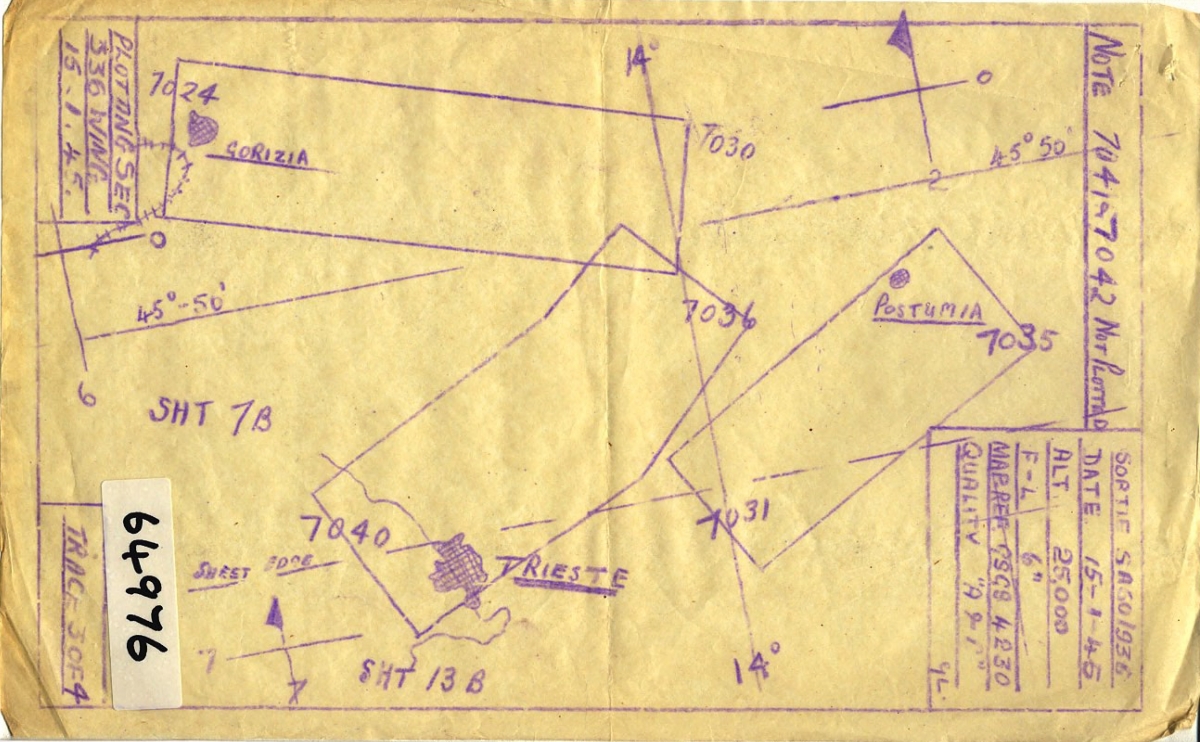
One of the first challenges in working with historical aerial photos is that it is difficult to georeference them (assigning the images to the geographical location that they cover). Unlike modern satellite imagery, historical images are not georeferenced at the time when they are collected, and the ways that experts record their locations can be pretty crude. Usually, they roughly outline the areas that the aerial photos cover by hand, and mark the image identifier numbers on them. As you can imagine, these hand-drawn maps tend to be inaccurate, and more importantly, georeferencing aerial photos solely based on hand-drawn maps is labor-intensive and quickly becomes impossible as the number of aerial photos grows. Other commercially available software such as Photoshop and OpenCV succeeded in automatically stitching a small number of images (<100), but failed miserably when scaled up.

Figure: An example sortie plot. Source: NCAP.

ExampleSortiePlot

In this project, I led a research team to develop an efficient and scalable data pipeline to digitize, process, stitch and georeference historical aerial photos; extract building footprints and road networks with deep learning models; and trace the changes in human settlement patterns over time. This repo contains codes for the image stitching process.

The Idea

We break this problem down to two steps -

  1. Given a pair of two images that overlap with each other, how do we overlay them? We take advantage of established methods in the computer vision literature - using SURF to detect features and RANSAC to estimate transformations from matched feature points robustly. These techniques were originally developed for panorama image stitching and work well in our context. This part of the codes is implemented mostly with opencv.

surf-ransac

  1. If we see all the images of interest as a graph (with each node being an image, and each edge being a relative transformation between a pair of images), how do we go from a collection of pairwise relationships to the absolute positions of all the images? We develop a "joint optimization" routine, which creates a differentiable loss given all the pairwise matches that are available, and uses back propagation to compute gradients and optimizes with Adam. This part of the codes is implemented mostly with pytorch. (No GPUs required for running the codes.)

joint-optim

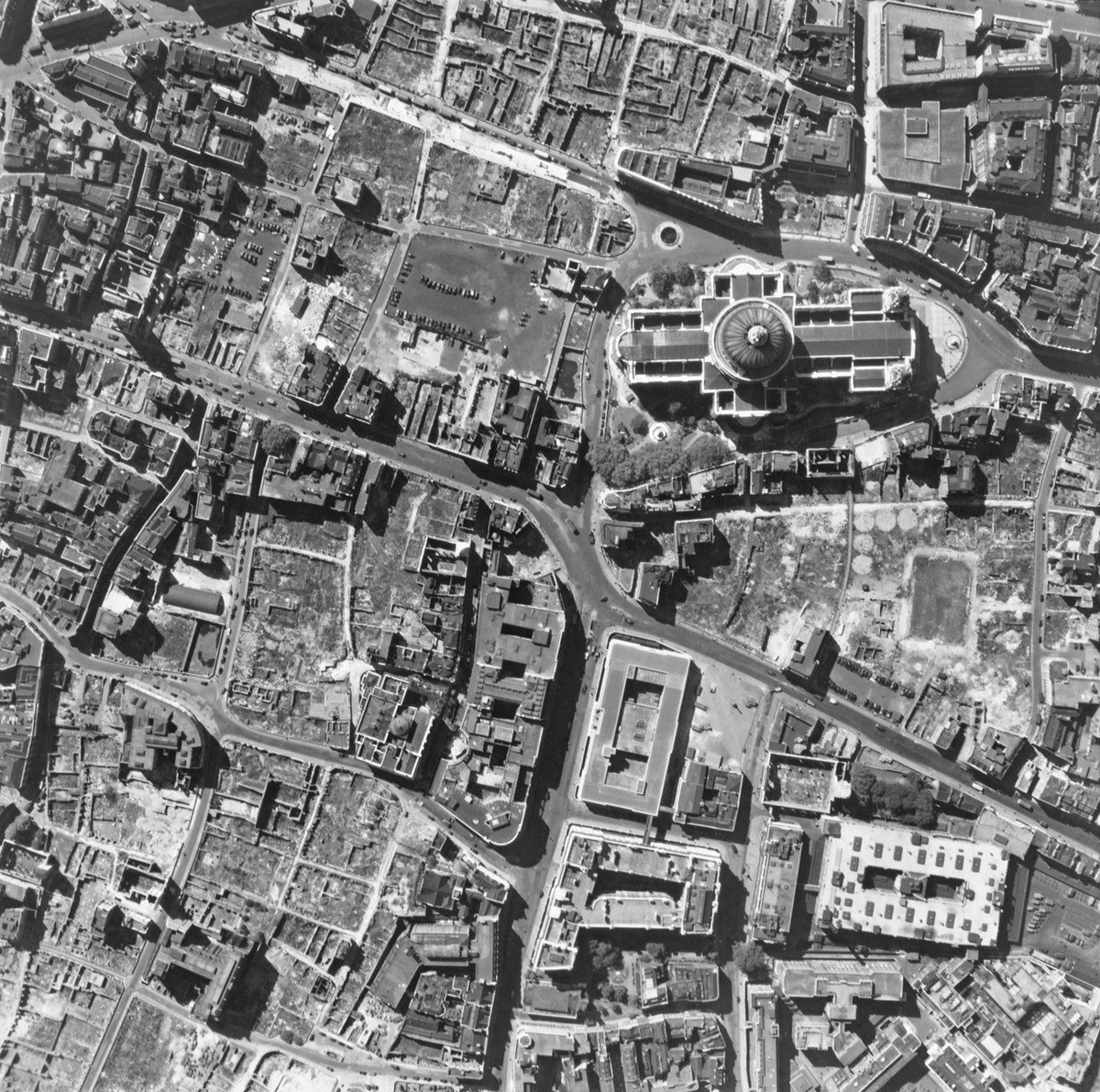
Source of the demo image: Historical England.

Play with our demo.ipynb!

In this repo, we release a simplified version of our core codebase. For legal reasons, we cannot share raw historical photos or sortie plots publicly; so we provide a "toy example" for demonstration. In practice, our codebase can handle complex scenes with tens of thousands of images. Play with our interactive demo in demo.ipynb! You can change the initialization positions for all the images, but they will always find their way back to each other.

To play with our demo, run

docker pull luna983/stitch-aerial-photos:latest
docker run -p 8888:8888 luna983/stitch-aerial-photos:latest

go to http://localhost:8888/?token=[REPLACE WITH TOKEN SHOWN] in a web browser, and open up demo.ipynb to start exploring!

demo

Note that the SURF functions are not included in the free OpenCV distributions (so pip install opencv-python would not be sufficient); the docker image contains a version of OpenCV compiled specifically for that environment.

You might also like...
DeepMetaHandles: Learning Deformation Meta-Handles of 3D Meshes with Biharmonic Coordinates

DeepMetaHandles (CVPR2021 Oral) [paper] [animations] DeepMetaHandles is a shape deformation technique. It learns a set of meta-handles for each given

Compute descriptors for 3D point cloud registration using a multi scale sparse voxel architecture

MS-SVConv : 3D Point Cloud Registration with Multi-Scale Architecture and Self-supervised Fine-tuning Compute features for 3D point cloud registration

A multi-scale unsupervised learning for deformable image registration

A multi-scale unsupervised learning for deformable image registration Shuwei Shao, Zhongcai Pei, Weihai Chen, Wentao Zhu, Xingming Wu and Baochang Zha

PyTorch reimplementation of the Smooth ReLU activation function proposed in the paper
PyTorch reimplementation of the Smooth ReLU activation function proposed in the paper "Real World Large Scale Recommendation Systems Reproducibility and Smooth Activations" [arXiv 2022].

Smooth ReLU in PyTorch Unofficial PyTorch reimplementation of the Smooth ReLU (SmeLU) activation function proposed in the paper Real World Large Scale

A 3D Dense mapping backend library of SLAM based on taichi-Lang designed for the aerial swarm.

TaichiSLAM This project is a 3D Dense mapping backend library of SLAM based Taichi-Lang, designed for the aerial swarm. Intro Taichi is an efficient d

Large-scale open domain KNOwledge grounded conVERsation system based on PaddlePaddle

Knover Knover is a toolkit for knowledge grounded dialogue generation based on PaddlePaddle. Knover allows researchers and developers to carry out eff

PointNetVLAD: Deep Point Cloud Based Retrieval for Large-Scale Place Recognition, CVPR 2018

PointNetVLAD: Deep Point Cloud Based Retrieval for Large-Scale Place Recognition PointNetVLAD: Deep Point Cloud Based Retrieval for Large-Scale Place

This is a Pytorch implementation of the paper: Self-Supervised Graph Transformer on Large-Scale Molecular Data.

This is a Pytorch implementation of the paper: Self-Supervised Graph Transformer on Large-Scale Molecular Data.

A pytorch implementation of the CVPR2021 paper "VSPW: A Large-scale Dataset for Video Scene Parsing in the Wild"

VSPW: A Large-scale Dataset for Video Scene Parsing in the Wild A pytorch implementation of the CVPR2021 paper "VSPW: A Large-scale Dataset for Video

Releases(v1.1)
  • v1.1(Aug 31, 2020)

    Two bug fixes from v1.0 for the docker environment

    1. src/optim.py: a float32 tensor was parsed as a float64 tensor in the docker environment
    2. src/graph.py: graph building relies on tuple indices; this is fixed by adding a new method that is agnostic to index types
    Source code(tar.gz)
    Source code(zip)
Owner
Luna Yue Huang
Economist + Data Scientist
Luna Yue Huang
AnimationKit: AI Upscaling & Interpolation using Real-ESRGAN+RIFE

ALPHA 2.5: Frostbite Revival (Released 12/23/21) Changelog: [ UI ] Chained design. All steps link to one another! Use the master override toggles to s

87 Nov 16, 2022
Rotation Robust Descriptors

RoRD Rotation-Robust Descriptors and Orthographic Views for Local Feature Matching Project Page | Paper link Evaluation and Datasets MMA : Training on

Udit Singh Parihar 25 Nov 15, 2022
Music Source Separation; Train & Eval & Inference piplines and pretrained models we used for 2021 ISMIR MDX Challenge.

Music Source Separation with Channel-wise Subband Phase Aware ResUnet (CWS-PResUNet) Introduction This repo contains the pretrained Music Source Separ

Lau 100 Dec 25, 2022
RNG-KBQA: Generation Augmented Iterative Ranking for Knowledge Base Question Answering

RNG-KBQA: Generation Augmented Iterative Ranking for Knowledge Base Question Answering Authors: Xi Ye, Semih Yavuz, Kazuma Hashimoto, Yingbo Zhou and

Salesforce 72 Dec 05, 2022
Learning from Synthetic Humans, CVPR 2017

Learning from Synthetic Humans (SURREAL) Gül Varol, Javier Romero, Xavier Martin, Naureen Mahmood, Michael J. Black, Ivan Laptev and Cordelia Schmid,

Gul Varol 538 Dec 18, 2022
Repo for our ICML21 paper Unsupervised Learning of Visual 3D Keypoints for Control

Unsupervised Learning of Visual 3D Keypoints for Control [Project Website] [Paper] Boyuan Chen1, Pieter Abbeel1, Deepak Pathak2 1UC Berkeley 2Carnegie

Boyuan Chen 34 Jul 22, 2022
banditml is a lightweight contextual bandit & reinforcement learning library designed to be used in production Python services.

banditml is a lightweight contextual bandit & reinforcement learning library designed to be used in production Python services. This library is developed by Bandit ML and ex-authors of Facebook's app

Bandit ML 51 Dec 22, 2022
Calculates JMA (Japan Meteorological Agency) seismic intensity (shindo) scale from acceleration data recorded in NumPy array

shindo.py Calculates JMA (Japan Meteorological Agency) seismic intensity (shindo) scale from acceleration data stored in NumPy array Introduction Japa

RR_Inyo 3 Sep 23, 2022
MAVE: : A Product Dataset for Multi-source Attribute Value Extraction

MAVE: : A Product Dataset for Multi-source Attribute Value Extraction The dataset contains 3 million attribute-value annotations across 1257 unique ca

Google Research Datasets 89 Jan 08, 2023
HDMapNet: A Local Semantic Map Learning and Evaluation Framework

HDMapNet_devkit Devkit for HDMapNet. HDMapNet: A Local Semantic Map Learning and Evaluation Framework Qi Li, Yue Wang, Yilun Wang, Hang Zhao [Paper] [

Tsinghua MARS Lab 421 Jan 04, 2023
MINIROCKET: A Very Fast (Almost) Deterministic Transform for Time Series Classification

MINIROCKET: A Very Fast (Almost) Deterministic Transform for Time Series Classification

187 Dec 26, 2022
S-attack library. Official implementation of two papers "Are socially-aware trajectory prediction models really socially-aware?" and "Vehicle trajectory prediction works, but not everywhere".

S-attack library: A library for evaluating trajectory prediction models This library contains two research projects to assess the trajectory predictio

VITA lab at EPFL 71 Jan 04, 2023
Scripts and outputs related to the paper Prediction of Adverse Biological Effects of Chemicals Using Knowledge Graph Embeddings.

Knowledge Graph Embeddings and Chemical Effect Prediction, 2020. Scripts and outputs related to the paper Prediction of Adverse Biological Effects of

Knowledge Graphs at the Norwegian Institute for Water Research 1 Nov 01, 2021
Official repository for the paper "Going Beyond Linear Transformers with Recurrent Fast Weight Programmers"

Recurrent Fast Weight Programmers This is the official repository containing the code we used to produce the experimental results reported in the pape

IDSIA 36 Nov 15, 2022
Build a medical knowledge graph based on Unified Language Medical System (UMLS)

UMLS-Graph Build a medical knowledge graph based on Unified Language Medical System (UMLS) Requisite Install MySQL Server 5.6 and import UMLS data int

Donghua Chen 6 Dec 25, 2022
An Efficient Training Approach for Very Large Scale Face Recognition or F²C for simplicity.

Fast Face Classification (F²C) This is the code of our paper An Efficient Training Approach for Very Large Scale Face Recognition or F²C for simplicit

33 Jun 27, 2021
Offical implementation for "Trash or Treasure? An Interactive Dual-Stream Strategy for Single Image Reflection Separation".

Trash or Treasure? An Interactive Dual-Stream Strategy for Single Image Reflection Separation (NeurIPS 2021) by Qiming Hu, Xiaojie Guo. Dependencies P

Qiming Hu 31 Dec 20, 2022
A hybrid framework (neural mass model + ML) for SC-to-FC prediction

The current workflow simulates brain functional connectivity (FC) from structural connectivity (SC) with a neural mass model. Gradient descent is applied to optimize the parameters in the neural mass

Yilin Liu 1 Jan 26, 2022
The official repository for "Score Transformer: Generating Musical Scores from Note-level Representation" (MMAsia '21)

Score Transformer This is the official repository for "Score Transformer": Score Transformer: Generating Musical Scores from Note-level Representation

22 Dec 22, 2022
The Unsupervised Reinforcement Learning Benchmark (URLB)

The Unsupervised Reinforcement Learning Benchmark (URLB) URLB provides a set of leading algorithms for unsupervised reinforcement learning where agent

259 Dec 26, 2022