An experiment on the performance of homemade Q-learning AIs in Agar.io depending on their state representation and available actions

Overview

Agar.io_Q-Learning_AI

An experiment on the performance of homemade Q-learning AIs in Agar.io depending on their state representation and available actions.

An image of the circle categorisation function in action. Food blobs are outlined in blue, edible cells in green and dangerous cells in red according to where our program detects them. Screen edges mess that up a bit. The agents action at this moment is labelled with the green arrow.

Circle Detection Diagram drawio

States are calculated using the shortest euclidian distance to each of the three circle types: food, edible cells and dangerous cells. These distances are measured and discretized according to which interval they fall within. The rulers in this image are to scale.
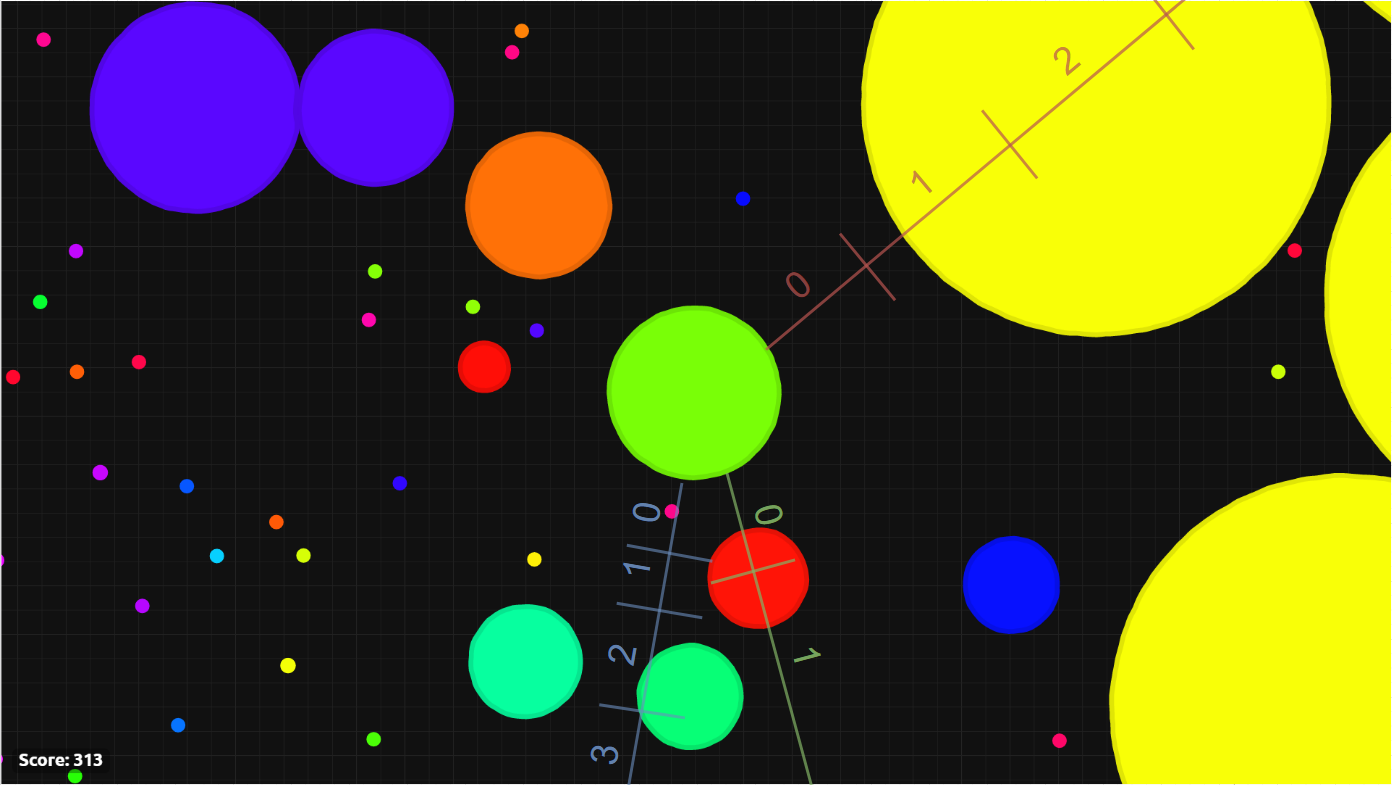
State Diagram

Currently the agent can't press any keyboard buttons, only move around using the mouse. It could be added without too much hassle, but it would require a rework of some aspects of the code and a ton training, which already takes ages. The q-learning part could also do with a proper implementation of stochastic q-learning instead of our generic iterative q-learning, if I knew how to do it. I look forward to learning that at a later point.

Feel free to ask any questions about the code or the project. I hope you enjoy!

Average score

Time alive

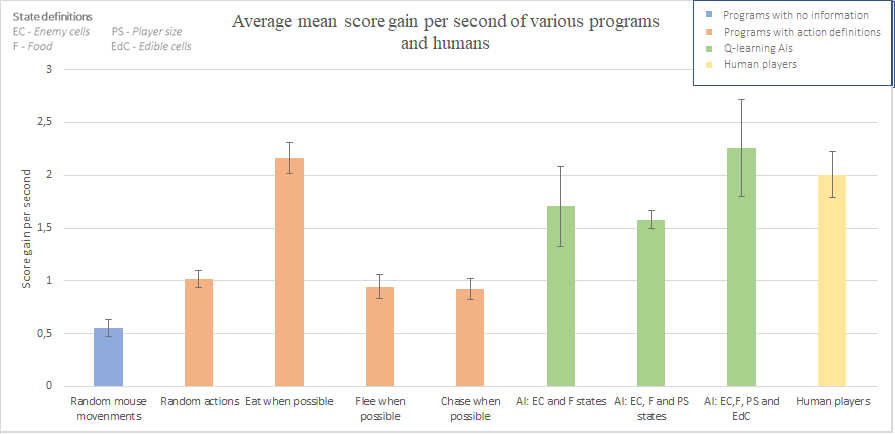
Mean score gain per second

The humans in the experiment were subject to the same move set as the bots and agents, so only mouse movement.

Rule-based Customer Segmentation

Rule-based Customer Segmentation Business Problem A game company wants to create level-based new customer definitions (personas) by using some feature

Cem Çaluk 2 Jan 03, 2022
Teaches a student network from the knowledge obtained via training of a larger teacher network

Distilling-the-knowledge-in-neural-network Teaches a student network from the knowledge obtained via training of a larger teacher network This is an i

Abhishek Sinha 146 Dec 11, 2022
Selene is a Python library and command line interface for training deep neural networks from biological sequence data such as genomes.

Selene is a Python library and command line interface for training deep neural networks from biological sequence data such as genomes.

Troyanskaya Laboratory 323 Jan 01, 2023
Classic Papers for Beginners and Impact Scope for Authors.

There have been billions of academic papers around the world. However, maybe only 0.0...01% among them are valuable or are worth reading. Since our limited life has never been forever, TopPaper provi

Qiulin Zhang 228 Dec 18, 2022
pixelNeRF: Neural Radiance Fields from One or Few Images

pixelNeRF: Neural Radiance Fields from One or Few Images Alex Yu, Vickie Ye, Matthew Tancik, Angjoo Kanazawa UC Berkeley arXiv: http://arxiv.org/abs/2

Alex Yu 1k Jan 04, 2023
Picasso: a methods for embedding points in 2D in a way that respects distances while fitting a user-specified shape.

Picasso Code to generate Picasso embeddings of any input matrix. Picasso maps the points of an input matrix to user-defined, n-dimensional shape coord

Pachter Lab 45 Dec 23, 2022
Deep Compression for Dense Point Cloud Maps.

DEPOCO This repository implements the algorithms described in our paper Deep Compression for Dense Point Cloud Maps. How to get started (using Docker)

Photogrammetry & Robotics Bonn 67 Dec 06, 2022
DNA-RECON { Automatic Web Reconnaissance Tool }

ABOUT TOOL : DNA-RECON is an automatic web reconnaissance tool written in python. This tool made for reconnaissance and information gathering with an

NIKUNJ BHATT 25 Aug 11, 2021
An Intelligent Self-driving Truck System For Highway Transportation

Inceptio Intelligent Truck System An Intelligent Self-driving Truck System For Highway Transportation Note The code is still in development. OS requir

InceptioResearch 11 Jul 13, 2022
3D detection and tracking viewer (visualization) for kitti & waymo dataset

3D detection and tracking viewer (visualization) for kitti & waymo dataset

222 Jan 08, 2023
This is a Keras-based Python implementation of DeepMask- a complex deep neural network for learning object segmentation masks

NNProject - DeepMask This is a Keras-based Python implementation of DeepMask- a complex deep neural network for learning object segmentation masks. Th

189 Nov 16, 2022
YOLOv5 + ROS2 object detection package

YOLOv5-ROS YOLOv5 + ROS2 object detection package This program changes the input of detect.py (ultralytics/yolov5) to sensor_msgs/Image of ROS2. Requi

Ar-Ray 23 Dec 19, 2022
🤗 Push your spaCy pipelines to the Hugging Face Hub

spacy-huggingface-hub: Push your spaCy pipelines to the Hugging Face Hub This package provides a CLI command for uploading any trained spaCy pipeline

Explosion 30 Oct 09, 2022
Code for our paper 'Generalized Category Discovery'

Generalized Category Discovery This repo is a placeholder for code for our paper: Generalized Category Discovery Abstract: In this paper, we consider

107 Dec 28, 2022
Seeing Dynamic Scene in the Dark: High-Quality Video Dataset with Mechatronic Alignment (ICCV2021)

Seeing Dynamic Scene in the Dark: High-Quality Video Dataset with Mechatronic Alignment This is a pytorch project for the paper Seeing Dynamic Scene i

DV Lab 21 Nov 28, 2022
Implement the Pareto Optimizer and pcgrad to make a self-adaptive loss for multi-task

multi-task_losses_optimizer Implement the Pareto Optimizer and pcgrad to make a self-adaptive loss for multi-task 已经实验过了,不会有cuda out of memory情况 ##Par

14 Dec 25, 2022
An educational tool to introduce AI planning concepts using mobile manipulator robots.

JEDAI Explains Decision-Making AI Virtual Machine Image The recommended way of using JEDAI is to use pre-configured Virtual Machine image that is avai

Autonomous Agents and Intelligent Robots 13 Nov 15, 2022
A trashy useless Latin programming language written in python.

Codigum! The first programming langage in latin! (please keep your eyes closed when if you read the source code) It is pretty useless though. Document

Bic 2 Oct 25, 2021
Multi-angle c(q)uestion answering

Macaw Introduction Macaw (Multi-angle c(q)uestion answering) is a ready-to-use model capable of general question answering, showing robustness outside

AI2 430 Jan 04, 2023
(CVPR 2022) A minimalistic mapless end-to-end stack for joint perception, prediction, planning and control for self driving.

LAV Learning from All Vehicles Dian Chen, Philipp Krähenbühl CVPR 2022 (also arXiV 2203.11934) This repo contains code for paper Learning from all veh

Dian Chen 300 Dec 15, 2022