E-RAFT: Dense Optical Flow from Event Cameras
Related tags

Deep LearningE-RAFT
Overview

E-RAFT: Dense Optical Flow from Event Cameras

E-RAFT

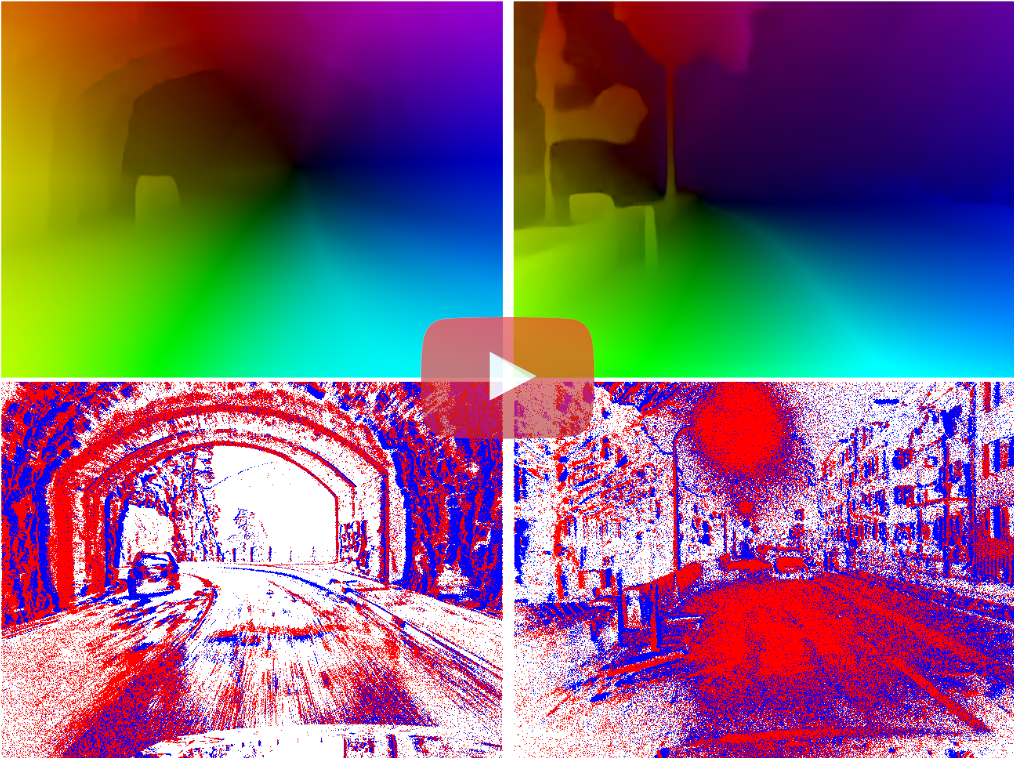
This is the code for the paper E-RAFT: Dense Optical Flow from Event Cameras by Mathias Gehrig, Mario Millhäusler, Daniel Gehrig and Davide Scaramuzza.

We also introduce DSEC-Flow (download here), the optical flow extension of the DSEC dataset. We are also hosting an automatic evaluation server and a public benchmark!

Visit our project webpage or download the paper directly here for more details. If you use any of this code, please cite the following publication:

@InProceedings{Gehrig3dv2021,
  author = {Mathias Gehrig and Mario Millh\"ausler and Daniel Gehrig and Davide Scaramuzza},
  title = {E-RAFT: Dense Optical Flow from Event Cameras},
  booktitle = {International Conference on 3D Vision (3DV)},
  year = {2021}
}

Download

Download the network checkpoints and place them in the folder checkpoints/:

Checkpoint trained on DSEC

Checkpoint trained on MVSEC 20 Hz

Checkpoint trained on MVSEC 45 Hz

Installation

Please install conda. Then, create new conda environment with python3.7 and all dependencies by running

conda env create --file environment.yml

Datasets

DSEC

The DSEC dataset for optical flow can be downloaded here. We prepared a script download_dsec_test.py for your convenience. It downloads the dataset directly into the OUTPUT_DIRECTORY with the expected directory structure.

download_dsec_test.py OUTPUT_DIRECTORY

MVSEC

To use the MVSEC dataset for our approach, it needs to be pre-processed into the right format. For your convenience, we provide the pre-processed dataset here:

MVSEC Outdoor Day 1 for 20 Hz evaluation

MVSEC Outdoor Day 1 for 45 Hz evaluation

Experiments

DSEC Dataset

For the evaluation of our method with warm-starting, execute the following command:

python3 main.py --path 


For the evaluation of our method without warm-starting, execute the following command:

python3 main.py --path 
   
     --type standard


MVSEC Dataset

For the evaluation of our method with warm-starting, trained on 20Hz MVSEC data, execute the following command:

python3 main.py --path 
   
     --dataset mvsec --frequency 20


For the evaluation of our method with warm-starting, trained on 45Hz MVSEC data, execute the following command:

python3 main.py --path 
   
     --dataset mvsec --frequency 45


Arguments

--path : Path where you stored the dataset

--dataset : Which dataset to use: ([dsec]/mvsec)

--type : Evaluation type ([warm_start]/standard)

--frequency : Evaluation frequency of MVSEC dataset ([20]/45) Hz

--visualize : Provide this argument s.t. DSEC results are visualized. MVSEC experiments are always visualized.

--num_workers : How many sub-processes to use for data loading (default=0)

Owner
Robotics and Perception Group
The audio-video synchronization of MKV Container Format is exploited to achieve data hiding

The audio-video synchronization of MKV Container Format is exploited to achieve data hiding, where the hidden data can be utilized for various management purposes, including hyper-linking, annotation

Maxim Zaika 1 Nov 17, 2021
Sample and Computation Redistribution for Efficient Face Detection

Introduction SCRFD is an efficient high accuracy face detection approach which initially described in Arxiv. Performance Precision, flops and infer ti

Sajjad Aemmi 13 Mar 05, 2022
Apply AnimeGAN-v2 across frames of a video clip

title emoji colorFrom colorTo sdk app_file pinned AnimeGAN-v2 For Videos 🔥 blue red gradio app.py false AnimeGAN-v2 For Videos Apply AnimeGAN-v2 acro

Nathan Raw 36 Oct 18, 2022
competitions-v2

Codabench (formerly Codalab Competitions v2) Installation $ cp .env_sample .env $ docker-compose up -d $ docker-compose exec django ./manage.py migrat

CodaLab 21 Dec 02, 2022
Pytorch implementation of CoCon: A Self-Supervised Approach for Controlled Text Generation

COCON_ICLR2021 This is our Pytorch implementation of COCON. CoCon: A Self-Supervised Approach for Controlled Text Generation (ICLR 2021) Alvin Chan, Y

alvinchangw 79 Dec 18, 2022
Neural style transfer as a class in PyTorch

pt-styletransfer Neural style transfer as a class in PyTorch Based on: https://github.com/alexis-jacq/Pytorch-Tutorials Adds: StyleTransferNet as a cl

Tyler Kvochick 31 Jun 27, 2022
Customised to detect objects automatically by a given model file(onnx)

LabelImg LabelImg is a graphical image annotation tool. It is written in Python and uses Qt for its graphical interface. Annotations are saved as XML

Heeone Lee 1 Jun 07, 2022
MPRNet-Cloud-removal: Progressive cloud removal

MPRNet-Cloud-removal Progressive cloud removal Requirements 1.Pytorch = 1.0 2.Python 3 3.NVIDIA GPU + CUDA 9.0 4.Tensorboard Installation 1.Clone the

Semi 95 Dec 18, 2022
chen2020iros: Learning an Overlap-based Observation Model for 3D LiDAR Localization.

Overlap-based 3D LiDAR Monte Carlo Localization This repo contains the code for our IROS2020 paper: Learning an Overlap-based Observation Model for 3D

Photogrammetry & Robotics Bonn 219 Dec 15, 2022
Prototypical python implementation of the trust-region algorithm presented in Sequential Linearization Method for Bound-Constrained Mathematical Programs with Complementarity Constraints by Larson, Leyffer, Kirches, and Manns.

Prototypical python implementation of the trust-region algorithm presented in Sequential Linearization Method for Bound-Constrained Mathematical Programs with Complementarity Constraints by Larson, L

3 Dec 02, 2022
The codes and related files to reproduce the results for Image Similarity Challenge Track 2.

The codes and related files to reproduce the results for Image Similarity Challenge Track 2.

Wenhao Wang 89 Jan 02, 2023
Code for paper "Learning to Reweight Examples for Robust Deep Learning"

learning-to-reweight-examples Code for paper Learning to Reweight Examples for Robust Deep Learning. [arxiv] Environment We tested the code on tensorf

Uber Research 261 Jan 01, 2023
Lolviz - A simple Python data-structure visualization tool for lists of lists, lists, dictionaries; primarily for use in Jupyter notebooks / presentations

lolviz By Terence Parr. See Explained.ai for more stuff. A very nice looking javascript lolviz port with improvements by Adnan M.Sagar. A simple Pytho

Terence Parr 785 Dec 30, 2022
A time series processing library

Timeseria Timeseria is a time series processing library which aims at making it easy to handle time series data and to build statistical and machine l

Stefano Alberto Russo 11 Aug 08, 2022
the code used for the preprint Embedding-based Instance Segmentation of Microscopy Images.

EmbedSeg Introduction This repository hosts the version of the code used for the preprint Embedding-based Instance Segmentation of Microscopy Images.

JugLab 88 Dec 25, 2022
Revisiting Global Statistics Aggregation for Improving Image Restoration

Revisiting Global Statistics Aggregation for Improving Image Restoration Xiaojie Chu, Liangyu Chen, Chengpeng Chen, Xin Lu Paper: https://arxiv.org/pd

MEGVII Research 128 Dec 24, 2022
Unsupervised Pre-training for Person Re-identification (LUPerson)

LUPerson Unsupervised Pre-training for Person Re-identification (LUPerson). The repository is for our CVPR2021 paper Unsupervised Pre-training for Per

143 Dec 24, 2022
PyTorch wrappers for using your model in audacity!

audacitorch This package contains utilities for prepping PyTorch audio models for use in Audacity. More specifically, it provides abstract classes for

Hugo Flores García 130 Dec 14, 2022
Deep Learning Datasets Maker is a QGIS plugin to make datasets creation easier for raster and vector data.

Deep Learning Dataset Maker Deep Learning Datasets Maker is a QGIS plugin to make datasets creation easier for raster and vector data. How to use Down

deepbands 25 Dec 15, 2022
Generating Videos with Scene Dynamics

Generating Videos with Scene Dynamics This repository contains an implementation of Generating Videos with Scene Dynamics by Carl Vondrick, Hamed Pirs

Carl Vondrick 706 Jan 04, 2023