Calling Julia from Python - an experiment on data loading

Overview

Calling Julia from Python - an experiment on data loading

DOI

See the slides.

TLDR

After reading Patrick's blog post, we decided to try to replace C++ with Julia to check:

  • How easy/hard it is
  • How much improvement can be gained with a basic version
  • How much improvement can be gained with an optimized version

A basic version is already an improvement over the pure Python version, and an optimized version was faster than the C++ version.

Reproduction

  • Follow Patrick's blog post to install the C++ part.
  • Install Julia (We've used Julia 1.6.3)
    • I recommend using Jill
    • We'll refer to this Julia as path/to/julia.
  • Install Python
    • Ideally, one dynamically linked to libpython.
    • To test it, use ldd path/to/python and look for libpython3.9. It should exist for the shared version.
    • If you don't have, look into workarounds here
    • Tip: Archlinux's system Python is dynamically linked.
    • We've used Python 3.9.7 from Archlinux.
  • Open Julia and enter the following commands:
    • ENV["PYTHON"] = "path/to/python"
    • using Pkg
    • Pkg.add("PyCall")
    • This will make sure that the packages we are installing use the correct Python version
  • Install juliapy with path/to/python -m pip install julia
  • Run path/to/python and enter
    • import julia
    • julia.install("julia=path/to/julia")
  • Download dataset and store in gen-data folder: Zenodo badge
  • Run scalability_test.py - it should take several hours (over 10) and consume a moderate amount of memory.
  • Run scalability_analysis.py.
You might also like...
Lightweight, Portable, Flexible Distributed/Mobile Deep Learning with Dynamic, Mutation-aware Dataflow Dep Scheduler; for Python, R, Julia, Scala, Go, Javascript and more

Apache MXNet (incubating) for Deep Learning Master Docs License Apache MXNet (incubating) is a deep learning framework designed for both efficiency an

Numba-accelerated Pythonic implementation of MPDATA with examples in Python, Julia and Matlab

PyMPDATA PyMPDATA is a high-performance Numba-accelerated Pythonic implementation of the MPDATA algorithm of Smolarkiewicz et al. used in geophysical

Python and Julia in harmony.

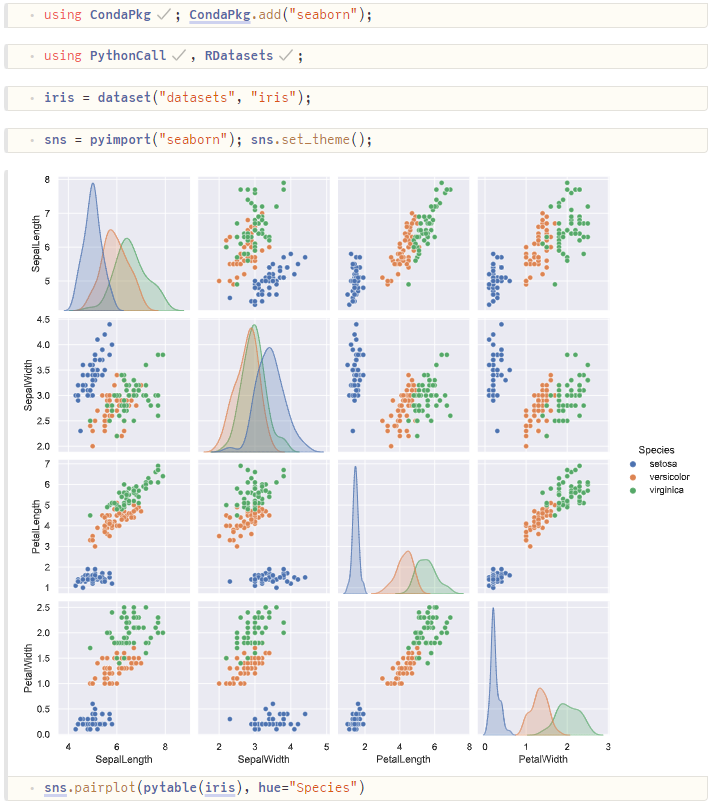
PythonCall & JuliaCall Bringing Python® and Julia together in seamless harmony: Call Python code from Julia and Julia code from Python via a symmetric

Pythonic particle-based (super-droplet) warm-rain/aqueous-chemistry cloud microphysics package with box, parcel & 1D/2D prescribed-flow examples in Python, Julia and Matlab

PySDM PySDM is a package for simulating the dynamics of population of particles. It is intended to serve as a building block for simulation systems mo

QuickAI is a Python library that makes it extremely easy to experiment with state-of-the-art Machine Learning models.

QuickAI is a Python library that makes it extremely easy to experiment with state-of-the-art Machine Learning models.

Small-bets - Ergodic Experiment With Python

Ergodic Experiment Based on this video. Run this experiment with this command: p

Perspective: Julia for Biologists

Perspective: Julia for Biologists 1. Examples Speed: Example 1 - Single cell data and network inference Domain: Single cell data Methodology: Network

MacroTools provides a library of tools for working with Julia code and expressions.

MacroTools.jl MacroTools provides a library of tools for working with Julia code and expressions. This includes a powerful template-matching system an

✔️ Visual, reactive testing library for Julia. Time machine included.

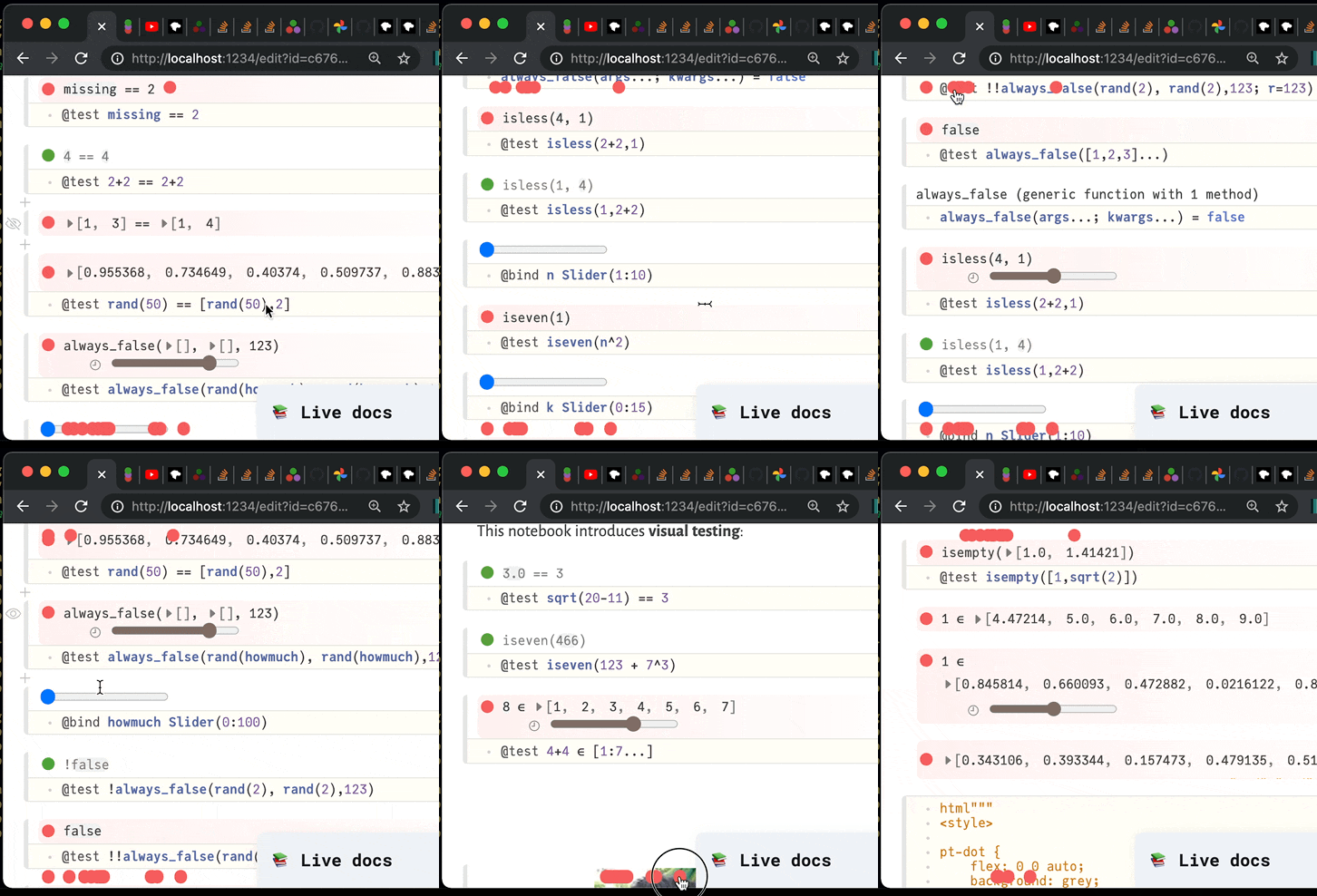
PlutoTest.jl (alpha release) Visual, reactive testing library for Julia A macro @test that you can use to verify your code's correctness. But instead

Comments
  • Fix python versions ~~using poetry~~

    Fix python versions ~~using poetry~~

    To prevent this pull request from becoming too large, I'll merge this and create a new issue to set the python versions.

    Originally posted by @abelsiqueira in https://github.com/abelsiqueira/call-julia-from-python-experiments/issues/1#issuecomment-987970132

    opened by abelsiqueira 1
  • Improve docker-10

    Improve docker-10

    Fixes: #10

    • Changes Ubuntu version to 21.10
    • Adds extra environment variables
    • Removes the Python virtual environment
    • Add make flags to compile the tools faster
    • Remove the downloaded tar files
    • Uninstall dev dependencies
    opened by fdiblen 0
Releases(v0.3.0)
Owner
Abel Siqueira
Abel Siqueira
COVID-Net Open Source Initiative

The COVID-Net models provided here are intended to be used as reference models that can be built upon and enhanced as new data becomes available

Linda Wang 1.1k Dec 26, 2022
PyTorch implementation of MLP-Mixer

PyTorch implementation of MLP-Mixer MLP-Mixer: an all-MLP architecture composed of alternate token-mixing and channel-mixing operations. The token-mix

Duo Li 33 Nov 27, 2022
An Efficient Training Approach for Very Large Scale Face Recognition or F²C for simplicity.

Fast Face Classification (F²C) This is the code of our paper An Efficient Training Approach for Very Large Scale Face Recognition or F²C for simplicit

33 Jun 27, 2021
CoCosNet v2: Full-Resolution Correspondence Learning for Image Translation

CoCosNet v2: Full-Resolution Correspondence Learning for Image Translation (CVPR 2021, oral presentation) CoCosNet v2: Full-Resolution Correspondence

Microsoft 308 Dec 07, 2022
PyTorch implementation of SampleRNN: An Unconditional End-to-End Neural Audio Generation Model

samplernn-pytorch A PyTorch implementation of SampleRNN: An Unconditional End-to-End Neural Audio Generation Model. It's based on the reference implem

DeepSound 261 Dec 14, 2022
deep-table implements various state-of-the-art deep learning and self-supervised learning algorithms for tabular data using PyTorch.

deep-table implements various state-of-the-art deep learning and self-supervised learning algorithms for tabular data using PyTorch.

63 Oct 17, 2022
Coded illumination for improved lensless imaging

CodedCam Coded Illumination for Improved Lensless Imaging Paper | Supplementary results | Data and Code are available. Coded illumination for improved

Computational Sensing and Information Processing Lab 1 Nov 29, 2021
Annealed Flow Transport Monte Carlo

Annealed Flow Transport Monte Carlo Open source implementation accompanying ICML 2021 paper by Michael Arbel*, Alexander G. D. G. Matthews* and Arnaud

DeepMind 30 Nov 21, 2022
A large-image collection explorer and fast classification tool

IMAX: Interactive Multi-image Analysis eXplorer This is an interactive tool for visualize and classify multiple images at a time. It written in Python

Matias Carrasco Kind 23 Dec 16, 2022
Predicting Event Memorability from Contextual Visual Semantics

Predicting Event Memorability from Contextual Visual Semantics

0 Oct 06, 2021
Code for "On the Effects of Batch and Weight Normalization in Generative Adversarial Networks"

Note: this repo has been discontinued, please check code for newer version of the paper here Weight Normalized GAN Code for the paper "On the Effects

Sitao Xiang 182 Sep 06, 2021
Greedy Gaussian Segmentation

GGS Greedy Gaussian Segmentation (GGS) is a Python solver for efficiently segmenting multivariate time series data. For implementation details, please

Stanford University Convex Optimization Group 72 Dec 07, 2022
Framework for joint representation learning, evaluation through multimodal registration and comparison with image translation based approaches

CoMIR: Contrastive Multimodal Image Representation for Registration Framework 🖼 Registration of images in different modalities with Deep Learning 🤖

Methods for Image Data Analysis - MIDA 55 Dec 09, 2022
Code for "Human Pose Regression with Residual Log-likelihood Estimation", ICCV 2021 Oral

Human Pose Regression with Residual Log-likelihood Estimation [Paper] [arXiv] [Project Page] Human Pose Regression with Residual Log-likelihood Estima

JeffLi 347 Dec 24, 2022
PyTorch code for EMNLP 2021 paper: Don't be Contradicted with Anything! CI-ToD: Towards Benchmarking Consistency for Task-oriented Dialogue System

Don’t be Contradicted with Anything!CI-ToD: Towards Benchmarking Consistency for Task-oriented Dialogue System This repository contains the PyTorch im

Libo Qin 25 Sep 06, 2022
Repository sharing code and the model for the paper "Rescoring Sequence-to-Sequence Models for Text Line Recognition with CTC-Prefixes"

Rescoring Sequence-to-Sequence Models for Text Line Recognition with CTC-Prefixes Setup virtualenv -p python3 venv source venv/bin/activate pip instal

Planet AI GmbH 9 May 20, 2022
A repository for the paper "Improved Adversarial Systems for 3D Object Generation and Reconstruction".

Improved Adversarial Systems for 3D Object Generation and Reconstruction: This is a repository for the paper "Improved Adversarial Systems for 3D Obje

Edward Smith 188 Dec 25, 2022
Neural Ensemble Search for Performant and Calibrated Predictions

Neural Ensemble Search Introduction This repo contains the code accompanying the paper: Neural Ensemble Search for Performant and Calibrated Predictio

AutoML-Freiburg-Hannover 26 Dec 12, 2022
PyDeepFakeDet is an integrated and scalable tool for Deepfake detection.

PyDeepFakeDet An integrated and scalable library for Deepfake detection research. Introduction PyDeepFakeDet is an integrated and scalable Deepfake de

Junke, Wang 49 Dec 11, 2022
The official repository for "Revealing unforeseen diagnostic image features with deep learning by detecting cardiovascular diseases from apical four-chamber ultrasounds"

Revealing unforeseen diagnostic image features with deep learning by detecting cardiovascular diseases from apical four-chamber ultrasounds The why Im

3 Mar 29, 2022