Official implementation of "OpenPifPaf: Composite Fields for Semantic Keypoint Detection and Spatio-Temporal Association" in PyTorch.

Overview

openpifpaf

Continuously tested on Linux, MacOS and Windows: Tests deploy-guide Downloads

New 2021 paper:

OpenPifPaf: Composite Fields for Semantic Keypoint Detection and Spatio-Temporal Association
Sven Kreiss, Lorenzo Bertoni, Alexandre Alahi, 2021.

Many image-based perception tasks can be formulated as detecting, associating and tracking semantic keypoints, e.g., human body pose estimation and tracking. In this work, we present a general framework that jointly detects and forms spatio-temporal keypoint associations in a single stage, making this the first real-time pose detection and tracking algorithm. We present a generic neural network architecture that uses Composite Fields to detect and construct a spatio-temporal pose which is a single, connected graph whose nodes are the semantic keypoints (e.g., a person's body joints) in multiple frames. For the temporal associations, we introduce the Temporal Composite Association Field (TCAF) which requires an extended network architecture and training method beyond previous Composite Fields. Our experiments show competitive accuracy while being an order of magnitude faster on multiple publicly available datasets such as COCO, CrowdPose and the PoseTrack 2017 and 2018 datasets. We also show that our method generalizes to any class of semantic keypoints such as car and animal parts to provide a holistic perception framework that is well suited for urban mobility such as self-driving cars and delivery robots.

Previous CVPR 2019 paper.

Guide

Detailed documentation is in our OpenPifPaf Guide. For developers, there is also the DEV Guide which is the same guide but based on the latest code in the main branch.

Examples

example image with overlaid pose predictions

Image credit: "Learning to surf" by fotologic which is licensed under CC-BY-2.0.
Created with:

pip3 install openpifpaf matplotlib
python3 -m openpifpaf.predict docs/coco/000000081988.jpg --image-output

Here is the tutorial for body, foot, face and hand keypoints. Example: example image with overlaid wholebody pose predictions
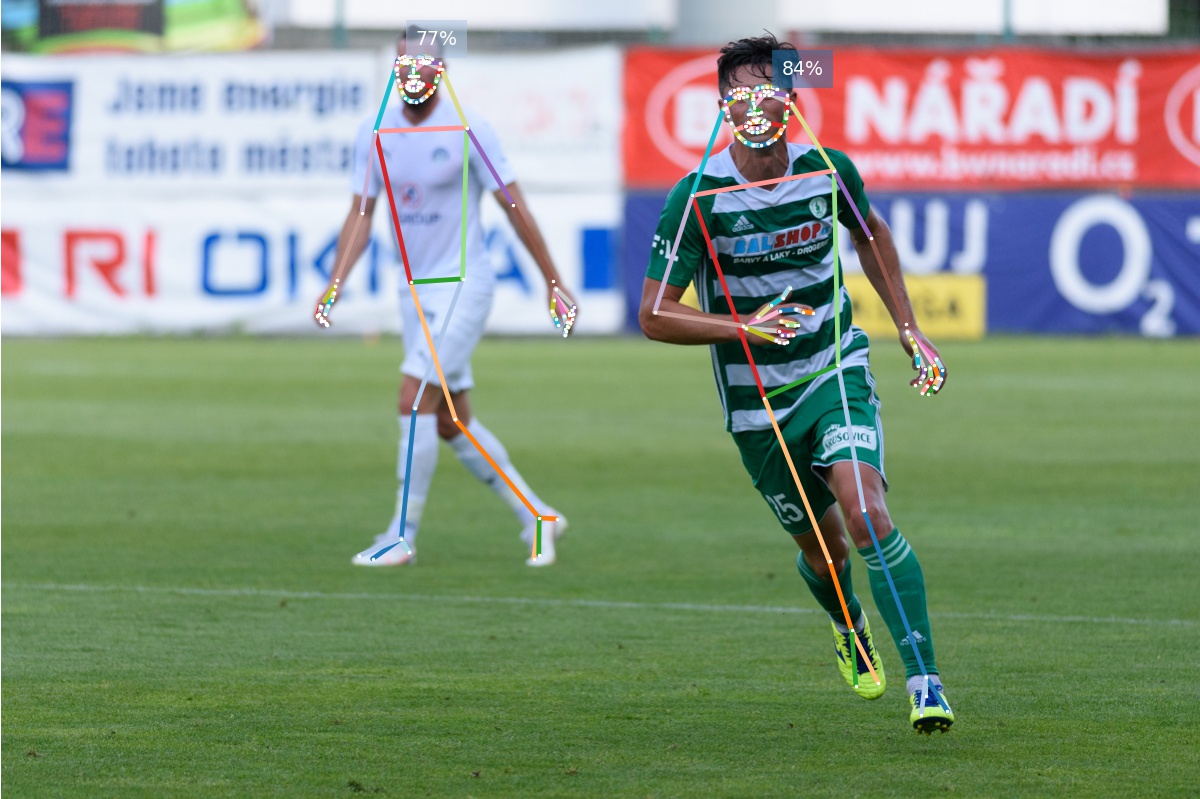
Image credit: Photo by Lokomotive74 which is licensed under CC-BY-4.0.
Created with:

python -m openpifpaf.predict guide/wholebody/soccer.jpeg \
  --checkpoint=shufflenetv2k30-wholebody --line-width=2 --image-output

Here is the tutorial for car keypoints. Example: example image cars

Image credit: Photo by Ninaras which is licensed under CC-BY-SA 4.0.

Created with:

python -m openpifpaf.predict guide/images/peterbourg.jpg \
  --checkpoint shufflenetv2k16-apollo-24 -o images \
  --instance-threshold 0.05 --seed-threshold 0.05 \
  --line-width 4 --font-size 0

Here is the tutorial for animal keypoints (dogs, cats, sheep, horses and cows). Example: example image cars
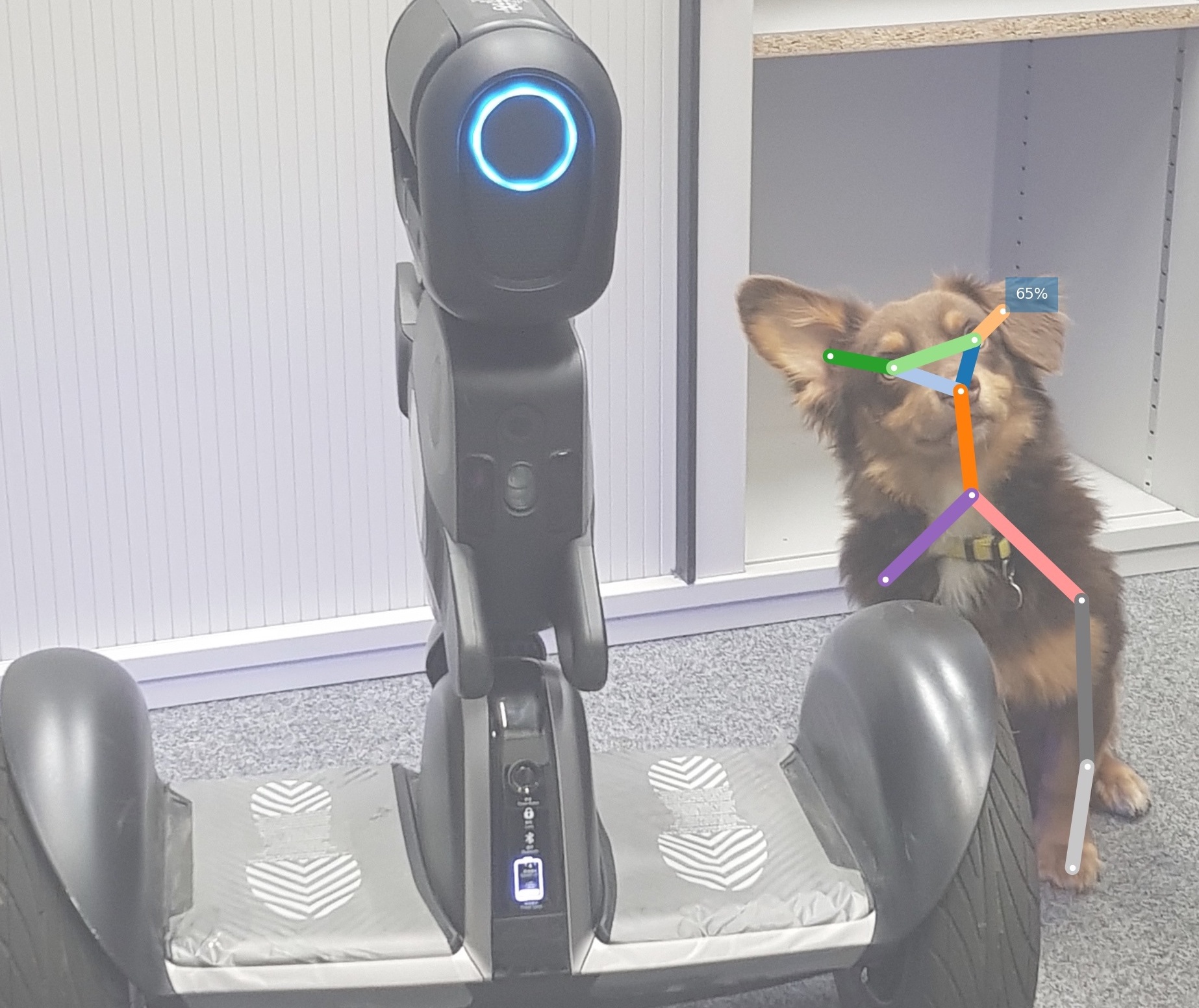
python -m openpifpaf.predict guide/images tappo_loomo.jpg \
  --checkpoint=shufflenetv2k30-animalpose \
  --line-width=6 --font-size=6 --white-overlay=0.3 \
  --long-edge=500

Commercial License

This software is available for licensing via the EPFL Technology Transfer Office (https://tto.epfl.ch/, [email protected]).

You might also like...
This is the official PyTorch implementation of the paper
This is the official PyTorch implementation of the paper "TransFG: A Transformer Architecture for Fine-grained Recognition" (Ju He, Jie-Neng Chen, Shuai Liu, Adam Kortylewski, Cheng Yang, Yutong Bai, Changhu Wang, Alan Yuille).

TransFG: A Transformer Architecture for Fine-grained Recognition Official PyTorch code for the paper: TransFG: A Transformer Architecture for Fine-gra

StyleGAN2-ADA - Official PyTorch implementation

Need Help? If you’re new to StyleGAN2-ADA and looking to get started, please check out this video series from a course Lia Coleman and I taught in Oct

Official PyTorch implementation of
Official PyTorch implementation of "ArtFlow: Unbiased Image Style Transfer via Reversible Neural Flows"

ArtFlow Official PyTorch implementation of the paper: ArtFlow: Unbiased Image Style Transfer via Reversible Neural Flows Jie An*, Siyu Huang*, Yibing

Official PyTorch implementation of RobustNet (CVPR 2021 Oral)

RobustNet (CVPR 2021 Oral): Official Project Webpage Codes and pretrained models will be released soon. This repository provides the official PyTorch

Official PyTorch implementation for Generic Attention-model Explainability for Interpreting Bi-Modal and Encoder-Decoder Transformers, a novel method to visualize any Transformer-based network. Including examples for DETR, VQA.

PyTorch Implementation of Generic Attention-model Explainability for Interpreting Bi-Modal and Encoder-Decoder Transformers 1 Using Colab Please notic

[PyTorch] Official implementation of CVPR2021 paper
[PyTorch] Official implementation of CVPR2021 paper "PointDSC: Robust Point Cloud Registration using Deep Spatial Consistency". https://arxiv.org/abs/2103.05465

PointDSC repository PyTorch implementation of PointDSC for CVPR'2021 paper "PointDSC: Robust Point Cloud Registration using Deep Spatial Consistency",

Official PyTorch implementation of MX-Font (Multiple Heads are Better than One: Few-shot Font Generation with Multiple Localized Experts)

Introduction Pytorch implementation of Multiple Heads are Better than One: Few-shot Font Generation with Multiple Localized Expert. | paper Song Park1

Official Pytorch implementation of 'GOCor: Bringing Globally Optimized Correspondence Volumes into Your Neural Network' (NeurIPS 2020)

Official implementation of GOCor This is the official implementation of our paper : GOCor: Bringing Globally Optimized Correspondence Volumes into You

Official PyTorch Implementation of Hypercorrelation Squeeze for Few-Shot Segmentation, arXiv 2021

Hypercorrelation Squeeze for Few-Shot Segmentation This is the implementation of the paper "Hypercorrelation Squeeze for Few-Shot Segmentation" by Juh

Comments
  • when i try to run v0.14.0 from source code, it raise ImportError.

    when i try to run v0.14.0 from source code, it raise ImportError.

    I clone the source code from github, then i want to run the openpifpaf/src/openpifpaf/predict.py file.And it raise error.I tracked down the issue and found that the error came from cpp_extension.register_ops()

    extfinder = importlib.machinery.FileFinder(lib_dir, loader_details) ext_specs = extfinder.find_spec("_cpp") if ext_specs is None: raise ImportError

    It needs some openpifpaf._cpp files where i found in setup.py. I want to run from the source code, and i do not know how to build this openpifpaf._cpp file,please help!!

    opened by KingArtherTT 1
  • Openpifpaf MPII PlugIn

    Openpifpaf MPII PlugIn

    Train an openpifpaf model with the MPII dataset. Same code as a plugin and reference can be found here: https://github.com/DuncanZauss/openpifpaf_mpii

    opened by DuncanZauss 0
Releases(v0.14.0)
Owner
VITA lab at EPFL
Visual Intelligence for Transportation
VITA lab at EPFL
TalkNet 2: Non-Autoregressive Depth-Wise Separable Convolutional Model for Speech Synthesis with Explicit Pitch and Duration Prediction.

TalkNet 2 [WIP] TalkNet 2: Non-Autoregressive Depth-Wise Separable Convolutional Model for Speech Synthesis with Explicit Pitch and Duration Predictio

Rishikesh (ऋषिकेश) 69 Dec 17, 2022
RetinaFace: Deep Face Detection Library in TensorFlow for Python

RetinaFace is a deep learning based cutting-edge facial detector for Python coming with facial landmarks.

Sefik Ilkin Serengil 512 Dec 29, 2022
An example project demonstrating how the Autonomous Learning Library can be used to build new reinforcement learning agents.

About This repository shows how Autonomous Learning Library can be used to build new reinforcement learning agents. In particular, it contains a model

Chris Nota 5 Aug 30, 2022
Road Crack Detection Using Deep Learning Methods

Road-Crack-Detection-Using-Deep-Learning-Methods This is my Diploma Thesis ¨Road Crack Detection Using Deep Learning Methods¨ under the supervision of

Aggelos Katsaliros 3 May 03, 2022
Sound and Cost-effective Fuzzing of Stripped Binaries by Incremental and Stochastic Rewriting

StochFuzz: A New Solution for Binary-only Fuzzing StochFuzz is a (probabilistically) sound and cost-effective fuzzing technique for stripped binaries.

Zhuo Zhang 164 Dec 05, 2022
PyTorch implementation of EigenGAN

PyTorch Implementation of EigenGAN Train python train.py [image_folder_path] --name [experiment name] Test python test.py [ckpt path] --traverse FFH

62 Nov 12, 2022
A PyTorch Implementation of the Luna: Linear Unified Nested Attention

Unofficial PyTorch implementation of Luna: Linear Unified Nested Attention The quadratic computational and memory complexities of the Transformer’s at

Soohwan Kim 32 Nov 07, 2022
Wafer Fault Detection using MlOps Integration

Wafer Fault Detection using MlOps Integration This is an end to end machine learning project with MlOps integration for predicting the quality of wafe

Sethu Sai Medamallela 0 Mar 11, 2022
SOLOv2 on onnx & tensorRT

SOLOv2.tensorRT: NOTE: code based on WXinlong/SOLO add support to TensorRT inference onnxruntime tensorRT full_dims and dynamic shape postprocess with

47 Nov 26, 2022
Good Semi-Supervised Learning That Requires a Bad GAN

Good Semi-Supervised Learning that Requires a Bad GAN This is the code we used in our paper Good Semi-supervised Learning that Requires a Bad GAN Ziha

Zhilin Yang 177 Dec 12, 2022
Contrastively Disentangled Sequential Variational Audoencoder

Contrastively Disentangled Sequential Variational Audoencoder (C-DSVAE) Overview This is the implementation for our C-DSVAE, a novel self-supervised d

Junwen Bai 35 Dec 24, 2022
Code for Multiple Instance Active Learning for Object Detection, CVPR 2021

MI-AOD Language: 简体中文 | English Introduction This is the code for Multiple Instance Active Learning for Object Detection (The PDF is not available tem

Tianning Yuan 269 Dec 21, 2022
Parallel Latent Tree-Induction for Faster Sequence Encoding

FastTrees This repository contains the experimental code supporting the FastTrees paper by Bill Pung. Software Requirements Python 3.6, NLTK and PyTor

Bill Pung 4 Mar 29, 2022
VolumeGAN - 3D-aware Image Synthesis via Learning Structural and Textural Representations

VolumeGAN - 3D-aware Image Synthesis via Learning Structural and Textural Representations 3D-aware Image Synthesis via Learning Structural and Textura

GenForce: May Generative Force Be with You 116 Dec 26, 2022
This is a code repository for paper OODformer: Out-Of-Distribution Detection Transformer

OODformer: Out-Of-Distribution Detection Transformer This repo is the official the implementation of the OODformer: Out-Of-Distribution Detection Tran

34 Dec 02, 2022
Neural Koopman Lyapunov Control

Neural-Koopman-Lyapunov-Control Code for our paper: Neural Koopman Lyapunov Control Requirements dReal4: v4.19.02.1 PyTorch: 1.2.0 The learning framew

Vrushabh Zinage 6 Dec 24, 2022
The implementation of "Bootstrapping Semantic Segmentation with Regional Contrast".

ReCo - Regional Contrast This repository contains the source code of ReCo and baselines from the paper, Bootstrapping Semantic Segmentation with Regio

Shikun Liu 128 Dec 30, 2022
Face recognition with trained classifiers for detecting objects using OpenCV

Face_Detector Face recognition with trained classifiers for detecting objects using OpenCV Libraries required to be installed using pip Command: cv2 n

Chumui Tripura 0 Oct 31, 2021
Combining Diverse Feature Priors

Combining Diverse Feature Priors This repository contains code for reproducing the results of our paper. Paper: https://arxiv.org/abs/2110.08220 Blog

Madry Lab 5 Nov 12, 2022
Weakly Supervised End-to-End Learning (NeurIPS 2021)

WeaSEL: Weakly Supervised End-to-end Learning This is a PyTorch-Lightning-based framework, based on our End-to-End Weak Supervision paper (NeurIPS 202

Auton Lab, Carnegie Mellon University 131 Jan 06, 2023
