Element selection for functional materials discovery by integrated machine learning of atomic contributions to properties

Overview

Element selection for functional materials discovery by integrated machine learning of atomic contributions to properties

8.11.2021 Andrij Vasylenko

Introduction

At the high level of consideration, the fundamental differences between the materials lie in the differences between the constituent chemical elements. Before the differences are detailed with the stoichiometric ratios and then atomic structures, the materials can be conceptualised at the level of their phase fields – the fields of all possible configurations of the selected chemical elements.

This code, PhaseSelect, classifies the materials at the level of sets of elements with respect to the likelihood to manifest a target functional property, while being synthetically accessible.

Please cite A.Vasylenko et al. 'Element selection for functional materials discovery by integrated machine learning of atomic contributions to properties' arXiv:2202.01051, (2022)

Requirements

python-3.7

pip (version 19.0 or later)

OS:

Ubuntu (version 18.04 or later)

MacOS (Catalina 10.15.6 or later)

Dependencies:

TensorFlow-2.4.1

scikit-learn-0.24.0

numpy-1.19.4

pandas-1.1.4

You might also like...
An end-to-end regression problem of predicting the price of properties in Bangalore.

Bangalore-House-Price-Prediction An end-to-end regression problem of predicting the price of properties in Bangalore. Deployed in Heroku using Flask.

TUPÃ was developed to analyze electric field properties in molecular simulations

TUPÃ: Electric field analyses for molecular simulations What is TUPÃ? TUPÃ (pronounced as tu-pan) is a python algorithm that employs MDAnalysis engine

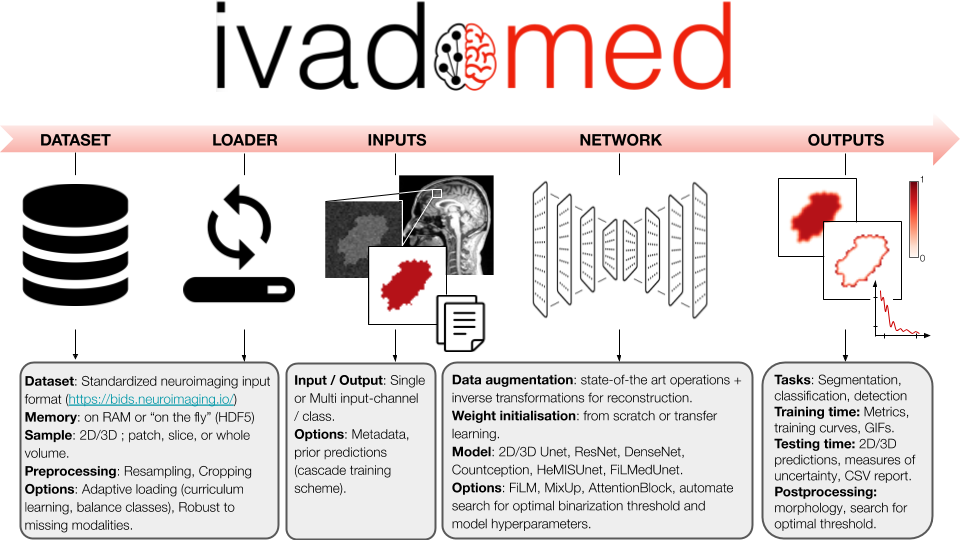
ivadomed is an integrated framework for medical image analysis with deep learning.

Repository on the collaborative IVADO medical imaging project between the Mila and NeuroPoly labs.

All course materials for the Zero to Mastery Deep Learning with TensorFlow course.

All course materials for the Zero to Mastery Deep Learning with TensorFlow course.

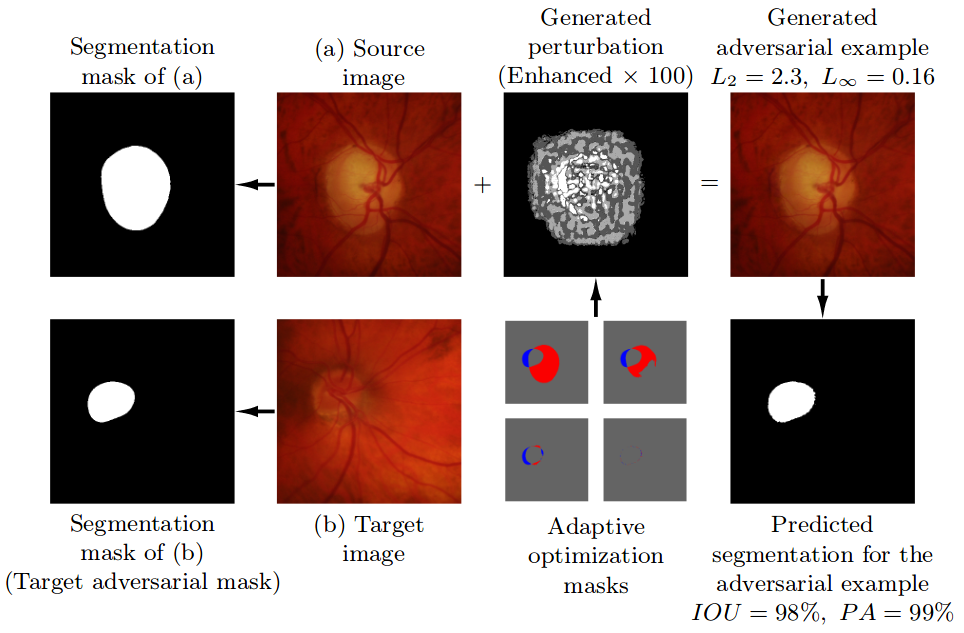
Pre-trained model, code, and materials from the paper
Pre-trained model, code, and materials from the paper "Impact of Adversarial Examples on Deep Learning Models for Biomedical Image Segmentation" (MICCAI 2019).

Adaptive Segmentation Mask Attack This repository contains the implementation of the Adaptive Segmentation Mask Attack (ASMA), a targeted adversarial

Useful materials and tutorials for 110-1 NTU DBME5028 (Application of Deep Learning in Medical Imaging)

Useful materials and tutorials for 110-1 NTU DBME5028 (Application of Deep Learning in Medical Imaging)

The deployment framework aims to provide a simple, lightweight, fast integrated, pipelined deployment framework that ensures reliability, high concurrency and scalability of services.

savior是一个能够进行快速集成算法模块并支持高性能部署的轻量开发框架。能够帮助将团队进行快速想法验证(PoC),避免重复的去github上找模型然后复现模型;能够帮助团队将功能进行流程拆解,很方便的提高分布式执行效率;能够有效减少代码冗余,减少不必要负担。

Discretized Integrated Gradients for Explaining Language Models (EMNLP 2021)

Discretized Integrated Gradients for Explaining Language Models (EMNLP 2021) Overview of paths used in DIG and IG. w is the word being attributed. The

Official PyTorch implementation of "AASIST: Audio Anti-Spoofing using Integrated Spectro-Temporal Graph Attention Networks"

AASIST This repository provides the overall framework for training and evaluating audio anti-spoofing systems proposed in 'AASIST: Audio Anti-Spoofing

Releases(v.1.0.0)
  • v.1.0.0(Dec 20, 2022)

    PhaseSelect focuses on quantitative assessment of materials at the early stages of materials discovery workflow, and assists selection of chemical elements to combine.

    The package enables:

    • Learning elemental features from elemental co-occurrence in all previously studied materials
    • Classification of phase fields (sets of elements) w.r.t. high- and low- performing classes for properties of interest
    • Regression to predict a maximum value of the property of interest within a phase field.
    • Ranking phase fields w.r.t. chemical similarity as a metrics for synthetic accessibility within a phase field.
    Source code(tar.gz)
    Source code(zip)
Owner
Leverhulme Research Centre for Functional Materials Design
Code hosted here has been developed by researchers working with the LRC, hosted at the University of Liverpool
Leverhulme Research Centre for Functional Materials Design
Focal Loss for Dense Rotation Object Detection

Convert ResNets weights from GluonCV to Tensorflow Abstract GluonCV released some new resnet pre-training weights and designed some new resnets (such

17 Nov 24, 2021
Memory efficient transducer loss computation

Introduction This project implements the optimization techniques proposed in Improving RNN Transducer Modeling for End-to-End Speech Recognition to re

Fangjun Kuang 51 Nov 25, 2022
Peek-a-Boo: What (More) is Disguised in a Randomly Weighted Neural Network, and How to Find It Efficiently

Peek-a-Boo: What (More) is Disguised in a Randomly Weighted Neural Network, and How to Find It Efficiently This repository is the official implementat

VITA 4 Dec 20, 2022
Compute FID scores with PyTorch.

FID score for PyTorch This is a port of the official implementation of Fréchet Inception Distance to PyTorch. See https://github.com/bioinf-jku/TTUR f

2.1k Jan 06, 2023
LowRankModels.jl is a julia package for modeling and fitting generalized low rank models.

LowRankModels.jl LowRankModels.jl is a Julia package for modeling and fitting generalized low rank models (GLRMs). GLRMs model a data array by a low r

Madeleine Udell 183 Dec 17, 2022
ZeroVL - The official implementation of ZeroVL

This repository contains source code necessary to reproduce the results presente

31 Nov 04, 2022
Single Image Random Dot Stereogram for Tensorflow

TensorFlow-SIRDS Single Image Random Dot Stereogram for Tensorflow SIRDS is a means to present 3D data in a 2D image. It allows for scientific data di

Greg Peatfield 5 Aug 10, 2022
Dynamic Multi-scale Filters for Semantic Segmentation (DMNet ICCV'2019)

Dynamic Multi-scale Filters for Semantic Segmentation (DMNet ICCV'2019) Introduction Official implementation of Dynamic Multi-scale Filters for Semant

23 Oct 21, 2022
Pre-trained BERT Models for Ancient and Medieval Greek, and associated code for LaTeCH 2021 paper titled - "A Pilot Study for BERT Language Modelling and Morphological Analysis for Ancient and Medieval Greek"

Ancient Greek BERT The first and only available Ancient Greek sub-word BERT model! State-of-the-art post fine-tuning on Part-of-Speech Tagging and Mor

Pranaydeep Singh 22 Dec 08, 2022
Demo for Real-time RGBD-based Extended Body Pose Estimation paper

Real-time RGBD-based Extended Body Pose Estimation This repository is a real-time demo for our paper that was published at WACV 2021 conference The ou

Renat Bashirov 118 Dec 26, 2022
Course about deep learning for computer vision and graphics co-developed by YSDA and Skoltech.

Deep Vision and Graphics This repo supplements course "Deep Vision and Graphics" taught at YSDA @fall'21. The course is the successor of "Deep Learnin

Yandex School of Data Analysis 160 Jan 02, 2023
Algorithmic encoding of protected characteristics and its implications on disparities across subgroups

Algorithmic encoding of protected characteristics and its implications on disparities across subgroups This repository contains the code for the paper

Team MIRA - BioMedIA 15 Oct 24, 2022
An educational tool to introduce AI planning concepts using mobile manipulator robots.

JEDAI Explains Decision-Making AI Virtual Machine Image The recommended way of using JEDAI is to use pre-configured Virtual Machine image that is avai

Autonomous Agents and Intelligent Robots 13 Nov 15, 2022
[ICLR2021] Unlearnable Examples: Making Personal Data Unexploitable

Unlearnable Examples Code for ICLR2021 Spotlight Paper "Unlearnable Examples: Making Personal Data Unexploitable " by Hanxun Huang, Xingjun Ma, Sarah

Hanxun Huang 98 Dec 07, 2022
🍅🍅🍅YOLOv5-Lite: lighter, faster and easier to deploy. Evolved from yolov5 and the size of model is only 1.7M (int8) and 3.3M (fp16). It can reach 10+ FPS on the Raspberry Pi 4B when the input size is 320×320~

YOLOv5-Lite:lighter, faster and easier to deploy Perform a series of ablation experiments on yolov5 to make it lighter (smaller Flops, lower memory, a

pogg 1.5k Jan 05, 2023
Suite of 500 procedurally-generated NLP tasks to study language model adaptability

TaskBench500 The TaskBench500 dataset and code for generating tasks. Data The TaskBench dataset is available under wget http://web.mit.edu/bzl/www/Tas

Belinda Li 20 May 17, 2022
Offical implementation of Shunted Self-Attention via Multi-Scale Token Aggregation

Shunted Transformer This is the offical implementation of Shunted Self-Attention via Multi-Scale Token Aggregation by Sucheng Ren, Daquan Zhou, Shengf

156 Dec 27, 2022
Classify bird species based on their songs using SIamese Networks and 1D dilated convolutions.

The goal is to classify different birds species based on their songs/calls. Spectrograms have been extracted from the audio samples and used as features for classification.

Aditya Dutt 9 Dec 27, 2022
Pure python implementation reverse-mode automatic differentiation

MiniGrad A minimal implementation of reverse-mode automatic differentiation (a.k.a. autograd / backpropagation) in pure Python. Inspired by Andrej Kar

Kenny Song 76 Sep 12, 2022
A minimalist tool to display a network graph.

A tool to get a minimalist view of any architecture This tool has only be tested with the models included in this repo. Therefore, I can't guarantee t

Thibault Castells 1 Feb 11, 2022