The Malmo Collaborative AI Challenge - Team Pig Catcher
Approach
The challenge involves 2 agents who can either cooperate or defect. The optimal policy, based on stag hunt [1], depends on the policy of the other agent. Not knowing the other agent's policy, the optimal solution is then based on modelling the other agent's policy. Similarly, the challenge can be considered a sequential social dilemma [2], as goals could change over time.
By treating the other agent as part of the environment, we can use model-free RL, and simply aim to maximise the reward of our agent. As a baseline we take a DRL algorithm - ACER [3] - and train it against the evaluation agent (which randomly uses a focused or random strategy every episode).
We chose to approach this challenge using hierarchical RL. We assume there are 2 subpolicies, one for each type of partner agent. To do so, we use option heads [4], whereby the agent has shared features, but separate heads for different subpolicies. In this case, ACER with 2 subpolicies has 2 Q-value heads and 2 policy heads. To choose which subpolicy to use at any given time, the agent also has an additional classifier head that is trained (using an oracle) to distinguish which option to use. Therefore, we ask the following questions:
- Can the agent distinguish between the two possible behaviours of the evaluation agent?
- Does the agent learn qualitatively different subpolicies?
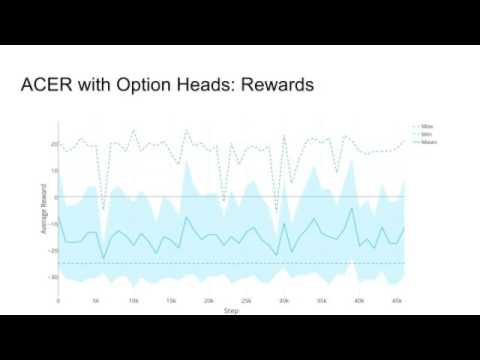
Unfortunately, due to technical difficulties and time restrictions, we were unable to successfully train an agent. Full results and more details can be found in our video.
Design Decisions
For our baseline, we implemented ACER [3] in PyTorch based on reference code [5, 6]. In addition, we augmented the state that the agent receives with the previous action, reward and a step counter [7]. Our challenge entry augments the agent with option heads [4], and we aim to distinguish the different policies of the evaluation agent.
We also introduce a novel contribution - a batch version of ACER - which increases stability. We sample a batch of off-policy trajectories, and then truncate them to match the smallest.
Instructions
Dependencies:
Firstly, build the Malmo Docker image. Secondly, enable running Docker as a non-root user.
Run ACER with OMP_NUM_THREADS=1 python pc_main.py. The code automatically opens up Minecraft (Docker) instances.
Discussion
References
[1] Game Theory of Mind
[2] Multi-agent Reinforcement Learning in Sequential Social Dilemmas
[3] Sample Efficient Actor-Critic with Experience Replay
[4] Classifying Options for Deep Reinforcement Learning
[5] ikostrikov/pytorch-a3c
[6] pfnet/ChainerRL
[7] Learning to Navigate in Complex Environments
This repository contains the task definition and example code for the Malmo Collaborative AI Challenge. This challenge is organized to encourage research in collaborative AI - to work towards AI agents that learn to collaborate to solve problems and achieve goals. You can find additional details, including terms and conditions, prizes and information on how to participate at the Challenge Homepage.


Notes for challenge participants: Once you and your team decide to participate in the challenge, please make sure to register your team at our Registration Page. On the registration form, you need to provide a link to the GitHub repository that will contain your solution. We recommend that you fork this repository (learn how), and provide address of the forked repo. You can then update your submission as you make progress on the challenge task. We will consider the version of the code on branch master at the time of the submission deadline as your challenge submission. Your submission needs to contain code in working order, a 1-page description of your approach, and a 1-minute video that shows off your agent. Please see the challenge terms and conditions for further details.
Jump to:
Installation
Prerequisites
- Python 2.7+ (recommended) or 3.5+
- Project Malmo - we recommend downloading the Malmo-0.21.0 release and installing dependencies for Windows, Linux or MacOS. Test your Malmo installation by launching Minecraft with Malmo and launching an agent.
Minimal installation
pip install -e git+https://github.com/Microsoft/malmo-challenge#egg=malmopy
or
git clone https://github.com/Microsoft/malmo-challenge
cd malmo-challenge
pip install -e .
Optional extensions
Some of the example code uses additional dependencies to provide 'extra' functionality. These can be installed using:
pip install -e '.[extra1, extra2]'
For example to install gym and chainer:
pip install -e '.[gym]'
Or to install all extras:
pip install -e '.[all]'
The following extras are available:
gym: OpenAI Gym is an interface to a wide range of reinforcement learning environments. Installing this extra enables the Atari example agents in samples/atari to train on the gym environments. Note that OpenAI gym atari environments are currently not available on Windows.tensorflow: TensorFlow is a popular deep learning framework developed by Google. In our examples it enables visualizations through TensorBoard.
Getting started
Play the challenge task
The challenge task takes the form of a mini game, called Pig Chase. Learn about the game, and try playing it yourself on our Pig Chase Challenge page.
Run your first experiment
See how to run your first baseline experiment on the Pig Chase Challenge page.
Next steps
Run an experiment in Docker on Azure
Docker is a virtualization platform that makes it easy to deploy software with all its dependencies. We use docker to run experiments locally or in the cloud. Details on how to run an example experiment using docker are in the docker README.

 12 Nov 22, 2022
 287 Jan 04, 2023
 19 Oct 21, 2022
 7 Oct 13, 2022
 4 Nov 27, 2022
 139 Nov 30, 2022
 0 Aug 03, 2021
 42 Dec 31, 2022
 34 Jan 04, 2023
 9 Oct 25, 2022
 249 Dec 04, 2022
 6 Nov 28, 2022
 149 Dec 19, 2022
 1 Dec 03, 2021
 8.4k Jan 03, 2023
 52 Dec 29, 2022
 94 Dec 03, 2022
 318 Dec 20, 2022
 62 Dec 30, 2022
 444 Jan 07, 2023