Abandoning the Bayer-Filter to See in the Dark (CVPR 2022)
Paper: https://arxiv.org/abs/2203.04042 (Arxiv version)
This code includes the training and testing procedures of our network on our Mono-colored raw Paired (MCR) dataset and SID dataset's Sony part.
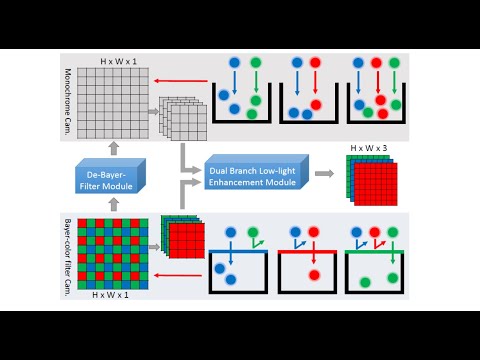
Abstract: Low-light image enhancement - a pervasive but challenging problem, plays a central role in enhancing the visibility of an image captured in a poor illumination environment. Due to the fact that not all photons can pass the Bayer-Filter on the sensor of the color camera, in this work, we first present a De-Bayer-Filter simulator based on deep neural networks to generate a monochrome raw image from the colored raw image. Next, a fully convolutional network is proposed to achieve the low-light image enhancement by fusing colored raw data with synthesized monochrome raw data. Channel-wise attention is also introduced to the fusion process to establish a complementary interaction between features from colored and monochrome raw images. To train the convolutional networks, we propose a dataset with monochrome and color raw pairs named Mono-Colored Raw paired dataset (MCR) collected by using a monochrome camera without Bayer-Filter and a color camera with Bayer-Filter. The proposed pipeline take advantages of the fusion of the virtual monochrome and the color raw images and our extensive experiments indicate that significant improvement can be achieved by leveraging raw sensor data and data-driven learning.

Video demos:
Requirments
This is the Pytorch implementation of our work. The next requirments and some other frequently-used Library will be needed.
- Python >= 3.7
- Pytorch >= 1.7.1
- scikit-image 0.18.1
- imageio 2.9.0
- rawpy 0.17.0
Dataset

We propose the MCR [Google Drive, Baidu Netdisk (Extraction code: 22cv)], a dataset of colored raw and monochrome raw image pairs, captured with the same exposure setting. Each image has a resolution of 1280×1024.
The zip file contain 3 parts:
- Mono_Colored_RAW_Paired_DATASET
- RGB_GT (498 images)
- Mono_GT (498 images)
- Color_RAW_Input (498 × 8 images)
Totally 498 different scenes, each scene has 1 corresponding RGB and Monochrome ground truth and 8 different exposure color Raw inputs.
We assemble the color camera and the monochrome camera up and down, setting the same exposure times and gain in the same scene.
And we choose the monochrome GT and RGB GT under the longest exposure time.
The file name contains the image information. Take the image name:"C00001_48mp_0x8_0x1fff.tif" as an example.
"C" means it is color raw image;
"00001" is the image number;
"48mp" is the master clock frequency 48 MHz;
"0x8" is the hex number of global gain;
"0x1fff" indicate the shutter width of the camera which can calculate the exposure time.
For visual convenience, we convert '.raw' files to '.tif' files which have the same 'RGGB' Bayer-filter pattern as the raw files.
The relationship between shutter width and the exposure time is shown in the table below.

The first 2 rows represent the exposure time settings in the indoor scenes which image number is between 1 and 499, the last 2 rows represent outdoor scenes' exposure time settings.
Alignment
We propose our alignment code for color and monochrome images taken by 2 cameras under the same scene.
Alignment/raw folder contain samples of color and monochrome raw images in one scene.
Firstly,in convert_RAW.py, we reshape the flatten '.raw' files into '1280×1024' and save as '.tif' files, and then we use the 'exiftool.exe' to add the head info 'pbpx_exft_args.txt' and save the images as '.dng' and '.jpg' files.
Secondly, in alignment.py, we choose two '.jpg' images from color and monochrome, and use opencv to calculate the homograph to do the alignment for monochrome images.
Training & Testing
For fully loading our dataset, 36G RAM are needed.
The 'random_path_list' contain the split train&test path lists in our dataset.
We split 3984 pairs of our dataset into train set: 3600 pairs and test set: 384 pairs
We train and test our MCR dataset with train.py and test.py, and we also train our network on SID dataset's Sony part with train_on_SID.py and test_on_SID.py.
The pre-trained models on both datasets can be found at MCR_pretrained_model and SID_pretrained_model
Citation
If you find this project useful in your research, please consider citing:
@inproceedings{Dong2022Abandoning,
	title={Abandoning the Bayer-Filter to See in the Dark},
	author={Dong, Xingbo and Xu, Wanyan and Miao, Zhihui and Ma, Lan and Zhang, Chao and Yang, Jiewen and Jin, Zhe and Teoh, Andrew Beng Jin and Shen, Jiajun},
	booktitle={Proceedings of the IEEE Conference on Computer Vision and Pattern Recognition (CVPR)},
	year={2022}
}
License
This work is licensed under a Creative Commons Attribution-NonCommercial 4.0 International License.


 11 Jul 24, 2022
 28 Aug 03, 2022
 294 Dec 30, 2022
 21 Dec 19, 2022
 58 Oct 26, 2022
 14 Nov 24, 2022
 0 Nov 17, 2021
 70 Dec 22, 2022
 2 Dec 20, 2022
 87 Dec 30, 2022
 18 Dec 21, 2022
 825 Dec 26, 2022
 74 Dec 03, 2022
 87 Dec 12, 2022
 2 Feb 04, 2022
 285 Jan 08, 2023
 45 Nov 23, 2022
 30 Jan 01, 2023
 3.4k Jan 07, 2023
 562 Jan 02, 2023