Physics-informed convolutional-recurrent neural networks for solving spatiotemporal PDEs

Overview

PhyCRNet

Physics-informed convolutional-recurrent neural networks for solving spatiotemporal PDEs

Paper link: [ArXiv]

By: Pu Ren, Chengping Rao, Yang Liu, Jian-Xun Wang and Hao Sun

Highlights

  • Present a Physics-informed discrete learning framework for solving spatiotemporal PDEs without any labeled data
  • Proposed an encoder-decoder convolutional-recurrent scheme for low-dimensional feature extraction
  • Employ hard-encoding of initial and boundary conditions
  • Incorporate autoregressive and residual connections to explicitly simulate the time marching

Training and Extrapolation

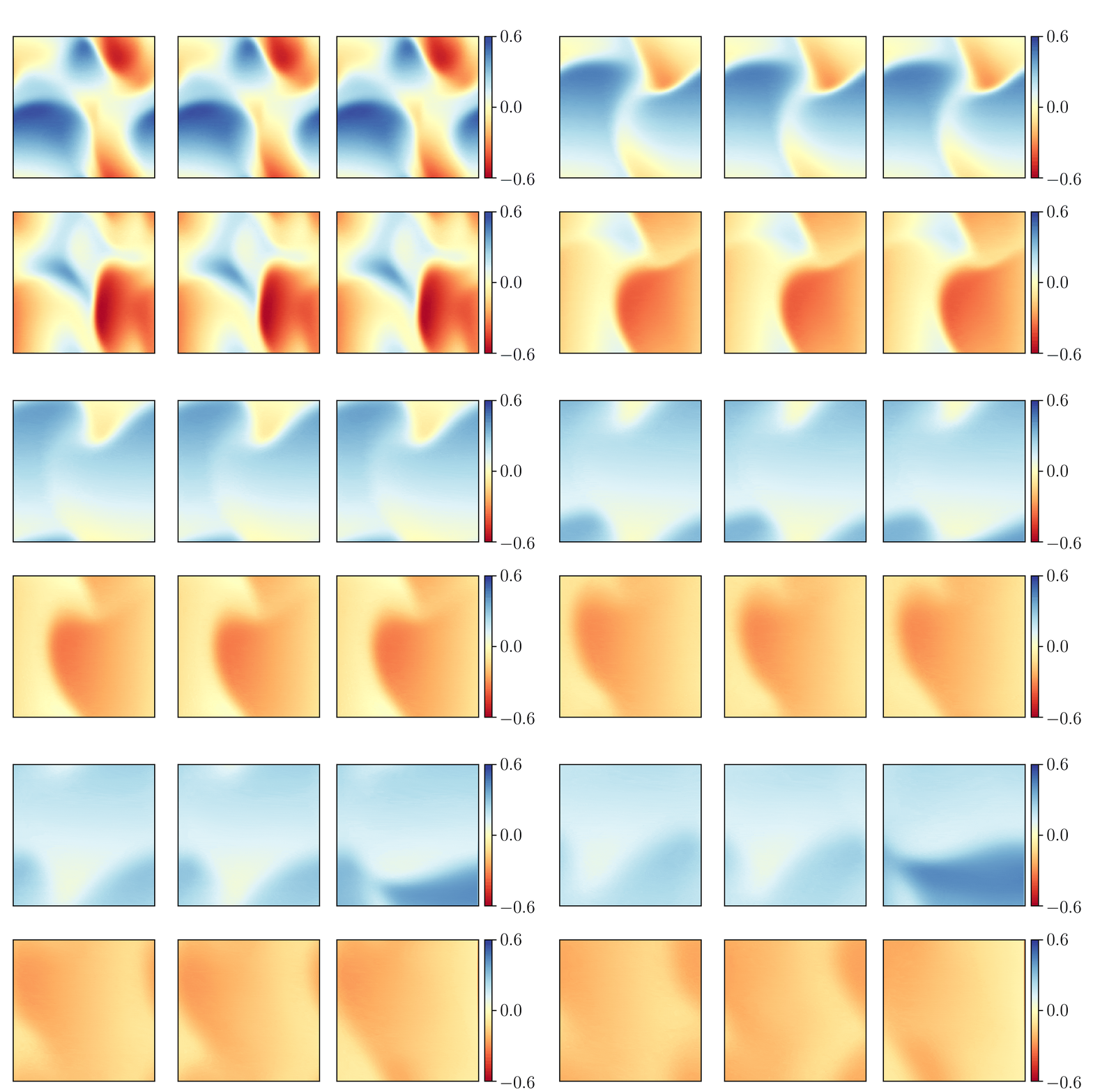
We show the comparison between PhyCRNet and PINN on 2D Burgers' equations below. The left, middle and right figures are the ground truth, the result from our PhyCRNet and the result from PINNs respectively.
Generalization

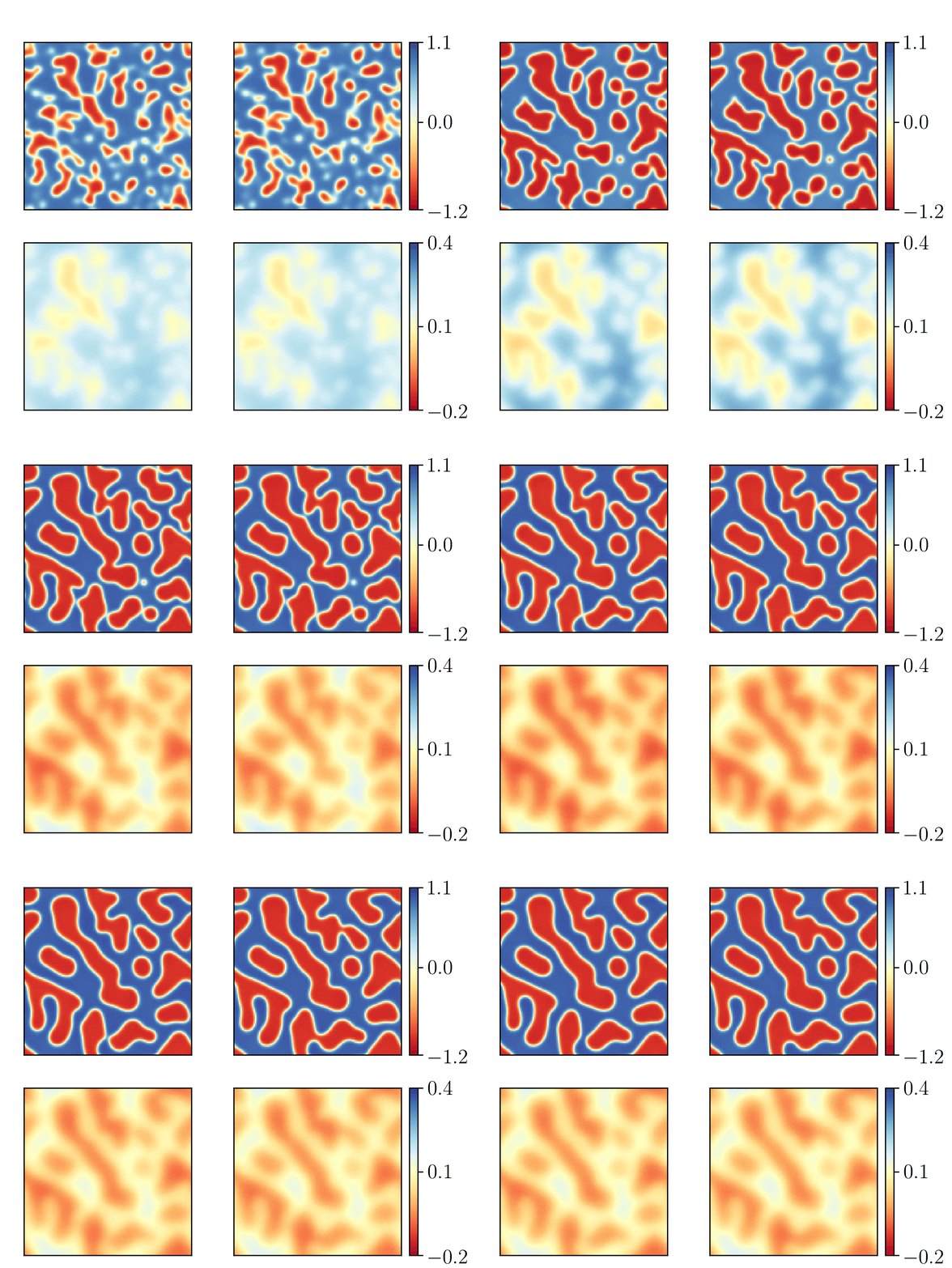
We show the generalization test on FitzHugh-Nagumo reaction-diffusion equations with four different initial conditions. The left and right parts are the ground truth generated with the high-order finite difference method and the results from our PhyCRNet, respectively.

Requirements

  • Python 3.6.13
  • Pytorch 1.6.0
  • Other packages such as Matplotlib, Numpy and Scipy are also used

Datasets

We provide the codes for data generation used in this paper, including 2D Burgers' equations and 2D FitzHugh-Nagumo reaction-diffusion equations. They are coded in the high-order finite difference method. Besides, the code for random field is modified from [Link]. You may find the data solver for λ-ω reaction-diffusion equations in [Link].

The initial conditions tested in this paper are also provided in the folder Datasets.

Codes

The general code of PhyCRNet is provided in the folder Codes, where we use 2D Burgers' equations as a testing example. For other PDE systems, the network setting is similar. You may try modifying the grid sizes and time steps to your own cases.

Citation

If you find our research helpful, please consider citing us with:

@article{ren2021phycrnet,
  title={PhyCRNet: Physics-informed Convolutional-Recurrent Network for Solving Spatiotemporal PDEs},
  author={Ren, Pu and Rao, Chengping and Liu, Yang and Wang, Jianxun and Sun, Hao},
  journal={arXiv preprint arXiv:2106.14103},
  year={2021}
}
Owner
Pu Ren
Pu Ren
GLIP: Grounded Language-Image Pre-training

GLIP: Grounded Language-Image Pre-training Updates 12/06/2021: GLIP paper on arxiv https://arxiv.org/abs/2112.03857. Code and Model are under internal

Microsoft 862 Jan 01, 2023
Myia prototyping

Myia Myia is a new differentiable programming language. It aims to support large scale high performance computations (e.g. linear algebra) and their g

Mila 456 Nov 07, 2022
A PyTorch implementation of "Cluster-GCN: An Efficient Algorithm for Training Deep and Large Graph Convolutional Networks" (KDD 2019).

ClusterGCN ⠀⠀ A PyTorch implementation of "Cluster-GCN: An Efficient Algorithm for Training Deep and Large Graph Convolutional Networks" (KDD 2019). A

Benedek Rozemberczki 697 Dec 27, 2022
《Where am I looking at? Joint Location and Orientation Estimation by Cross-View Matching》(CVPR 2020)

This contains the codes for cross-view geo-localization method described in: Where am I looking at? Joint Location and Orientation Estimation by Cross-View Matching, CVPR2020.

41 Oct 27, 2022
labelpix is a graphical image labeling interface for drawing bounding boxes

Welcome to labelpix 👋 labelpix is a graphical image labeling interface for drawing bounding boxes. 🏠 Homepage Install pip install -r requirements.tx

schissmantics 26 May 24, 2022
Dynamic Bottleneck for Robust Self-Supervised Exploration

Dynamic Bottleneck Introduction This is a TensorFlow based implementation for our paper on "Dynamic Bottleneck for Robust Self-Supervised Exploration"

Bai Chenjia 4 Nov 14, 2022
This is an open source python repository for various python tests

Welcome to Py-tests This is an open source python repository for various python tests. This is in response to the hacktoberfest2021 challenge. It is a

Yada Martins Tisan 3 Oct 31, 2021
SweiNet is an uncertainty-quantifying shear wave speed (SWS) estimator for ultrasound shear wave elasticity (SWE) imaging.

SweiNet SweiNet is an uncertainty-quantifying shear wave speed (SWS) estimator for ultrasound shear wave elasticity (SWE) imaging. SweiNet takes as in

Felix Jin 3 Mar 31, 2022
Official code of paper: MovingFashion: a Benchmark for the Video-to-Shop Challenge

SEAM Match-RCNN Official code of MovingFashion: a Benchmark for the Video-to-Shop Challenge paper Installation Requirements: Pytorch 1.5.1 or more rec

HumaticsLAB 31 Oct 10, 2022
Tensorflow python implementation of "Learning High Fidelity Depths of Dressed Humans by Watching Social Media Dance Videos"

Learning High Fidelity Depths of Dressed Humans by Watching Social Media Dance Videos This repository is the official tensorflow python implementation

Yasamin Jafarian 287 Jan 06, 2023
PyTorch implementation of the cross-modality generative model that synthesizes dance from music.

Dancing to Music PyTorch implementation of the cross-modality generative model that synthesizes dance from music. Paper Hsin-Ying Lee, Xiaodong Yang,

NVIDIA Research Projects 485 Dec 26, 2022
Lucid Sonic Dreams syncs GAN-generated visuals to music.

Lucid Sonic Dreams Lucid Sonic Dreams syncs GAN-generated visuals to music. By default, it uses NVLabs StyleGAN2, with pre-trained models lifted from

731 Jan 02, 2023
This program generates a random 12 digit/character password (upper and lowercase) and stores it in a file along with your username and app/website.

PasswordGeneratorAndVault This program generates a random 12 digit/character password (upper and lowercase) and stores it in a file along with your us

Chris 1 Feb 26, 2022
Image Processing, Image Smoothing, Edge Detection and Transforms

opevcvdl-hw1 This project uses openCV and Qt to achieve the requirements. Version Python 3.7 opencv-contrib-python 3.4.2.17 Matplotlib 3.1.1 pyqt5 5.1

Kenny Cheng 3 Aug 17, 2022
MQBench: Towards Reproducible and Deployable Model Quantization Benchmark

MQBench: Towards Reproducible and Deployable Model Quantization Benchmark We propose a benchmark to evaluate different quantization algorithms on vari

494 Dec 29, 2022
Code for DeepCurrents: Learning Implicit Representations of Shapes with Boundaries

DeepCurrents | Webpage | Paper DeepCurrents: Learning Implicit Representations of Shapes with Boundaries David Palmer*, Dmitriy Smirnov*, Stephanie Wa

Dima Smirnov 36 Dec 08, 2022
Real Time Object Detection and Classification using Yolo Algorithm.

Real time Object detection & Classification using YOLO algorithm. Real Time Object Detection and Classification using Yolo Algorithm. What is Object D

Ketan Chawla 1 Apr 17, 2022
Code for "NeuralRecon: Real-Time Coherent 3D Reconstruction from Monocular Video", CVPR 2021 oral

NeuralRecon: Real-Time Coherent 3D Reconstruction from Monocular Video Project Page | Paper NeuralRecon: Real-Time Coherent 3D Reconstruction from Mon

ZJU3DV 1.4k Dec 30, 2022
A highly modular PyTorch framework with a focus on Neural Architecture Search (NAS).

UniNAS A highly modular PyTorch framework with a focus on Neural Architecture Search (NAS). under development (which happens mostly on our internal Gi

Cognitive Systems Research Group 19 Nov 23, 2022
MoCap-Solver: A Neural Solver for Optical Motion Capture Data

MoCap-Solver is a data-driven-based robust marker denoising method, which takes raw mocap markers as input and outputs corresponding clean markers and skeleton motions.

55 Dec 28, 2022