Voice Conversion by CycleGAN (语音克隆/语音转换):CycleGAN-VC3

Overview

CycleGAN-VC3-PyTorch

standard-readme compliant Donate

中文说明 | English


This code is a PyTorch implementation for paper: CycleGAN-VC3: Examining and Improving CycleGAN-VCs for Mel-spectrogram Conversion, a nice work on Voice-Conversion/Voice Cloning.

  • Dataset
    • VC
  • Usage
    • Training
    • Example
  • Demo
  • Reference

CycleGAN-VC3

Project Page

Non-parallel voice conversion (VC) is a technique for learning mappings between source and target speeches without using a parallel corpus. Recently, CycleGAN-VC [3] and CycleGAN-VC2 [2] have shown promising results regarding this problem and have been widely used as benchmark methods. However, owing to the ambiguity of the effectiveness of CycleGAN-VC/VC2 for mel-spectrogram conversion, they are typically used for mel-cepstrum conversion even when comparative methods employ mel-spectrogram as a conversion target. To address this, we examined the applicability of CycleGAN-VC/VC2 to mel-spectrogram conversion. Through initial experiments, we discovered that their direct applications compromised the time-frequency structure that should be preserved during conversion. To remedy this, we propose CycleGAN-VC3, an improvement of CycleGAN-VC2 that incorporates time-frequency adaptive normalization (TFAN). Using TFAN, we can adjust the scale and bias of the converted features while reflecting the time-frequency structure of the source mel-spectrogram. We evaluated CycleGAN-VC3 on inter-gender and intra-gender non-parallel VC. A subjective evaluation of naturalness and similarity showed that for every VC pair, CycleGAN-VC3 outperforms or is competitive with the two types of CycleGAN-VC2, one of which was applied to mel-cepstrum and the other to mel-spectrogram.
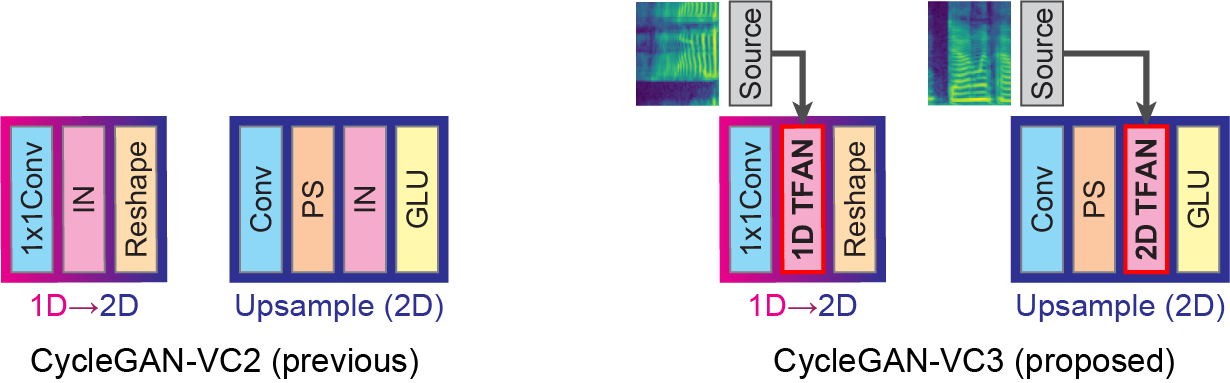
network comparison Figure 1. We developed time-frequency adaptive normalization (TFAN), which extends instance normalization [5] so that the affine parameters become element-dependent and are determined according to an entire input mel-spectrogram.


This repository contains:

  1. TFAN module code which implemented the TFAN module
  2. model code which implemented the model network.
  3. audio preprocessing script you can use to create cache for training data.
  4. training scripts to train the model.

Table of Contents


Requirement

pip install -r requirements.txt

Usage


Reference

  1. CycleGAN-VC3: Examining and Improving CycleGAN-VCs for Mel-spectrogram Conversion. Paper, Project
  2. CycleGAN-VC2: Improved CycleGAN-based Non-parallel Voice Conversion. Paper, Project
  3. Parallel-Data-Free Voice Conversion Using Cycle-Consistent Adversarial Networks. Paper, Project
  4. Unpaired Image-to-Image Translation using Cycle-Consistent Adversarial Networks. Paper, Project, Code
  5. Image-to-Image Translation with Conditional Adversarial Nets. Paper, Project, Code

Donation

If this project help you reduce time to develop, you can give me a cup of coffee :)

AliPay(支付宝)

ali_pay

WechatPay(微信)

wechat_pay

paypal


License

MIT © Kun

Owner
Kun Ma
artizan
Kun Ma
Linear image-to-image translation

Linear (Un)supervised Image-to-Image Translation Examples for linear orthogonal transformations in PCA domain, learned without pairing supervision. Tr

Eitan Richardson 40 Aug 31, 2022
Source code for "FastBERT: a Self-distilling BERT with Adaptive Inference Time".

FastBERT Source code for "FastBERT: a Self-distilling BERT with Adaptive Inference Time". Good News 2021/10/29 - Code: Code of FastPLM is released on

Weijie Liu 584 Jan 02, 2023
Adjusting for Autocorrelated Errors in Neural Networks for Time Series

Adjusting for Autocorrelated Errors in Neural Networks for Time Series This repository is the official implementation of the paper "Adjusting for Auto

Fan-Keng Sun 51 Nov 05, 2022
🌾 PASTIS 🌾 Panoptic Agricultural Satellite TIme Series

🌾 PASTIS 🌾 Panoptic Agricultural Satellite TIme Series (optical and radar) The PASTIS Dataset Dataset presentation PASTIS is a benchmark dataset for

86 Jan 04, 2023
LRBoost is a scikit-learn compatible approach to performing linear residual based stacking/boosting.

LRBoost is a sckit-learn compatible package for linear residual boosting. LRBoost combines a linear estimator and a non-linear estimator to leverage t

Andrew Patton 5 Nov 23, 2022
Transformer model implemented with Pytorch

transformer-pytorch Transformer model implemented with Pytorch Attention is all you need-[Paper] Architecture Self-Attention self_attention.py class

Mingu Kang 12 Sep 03, 2022
Implementation of Research Paper "Learning to Enhance Low-Light Image via Zero-Reference Deep Curve Estimation"

Zero-DCE and Zero-DCE++(Lite architechture for Mobile and edge Devices) Papers Abstract The paper presents a novel method, Zero-Reference Deep Curve E

Tauhid Khan 15 Dec 10, 2022
Fully Connected DenseNet for Image Segmentation

Fully Connected DenseNets for Semantic Segmentation Fully Connected DenseNet for Image Segmentation implementation of the paper The One Hundred Layers

Somshubra Majumdar 84 Oct 31, 2022
Improving Calibration for Long-Tailed Recognition (CVPR2021)

MiSLAS Improving Calibration for Long-Tailed Recognition Authors: Zhisheng Zhong, Jiequan Cui, Shu Liu, Jiaya Jia [arXiv] [slide] [BibTeX] Introductio

DV Lab 116 Dec 20, 2022
Generalized Decision Transformer for Offline Hindsight Information Matching

Generalized Decision Transformer for Offline Hindsight Information Matching [arxiv] If you use this codebase for your research, please cite the paper:

Hiroki Furuta 35 Dec 12, 2022
Code for KiloNeRF: Speeding up Neural Radiance Fields with Thousands of Tiny MLPs

KiloNeRF: Speeding up Neural Radiance Fields with Thousands of Tiny MLPs Check out the paper on arXiv: https://arxiv.org/abs/2103.13744 This repo cont

Christian Reiser 373 Dec 20, 2022
[AAAI 2021] EMLight: Lighting Estimation via Spherical Distribution Approximation and [ICCV 2021] Sparse Needlets for Lighting Estimation with Spherical Transport Loss

EMLight: Lighting Estimation via Spherical Distribution Approximation (AAAI 2021) Update 12/2021: We release our Virtual Object Relighting (VOR) Datas

Fangneng Zhan 144 Jan 06, 2023
QRec: A Python Framework for quick implementation of recommender systems (TensorFlow Based)

Introduction QRec is a Python framework for recommender systems (Supported by Python 3.7.4 and Tensorflow 1.14+) in which a number of influential and

Yu 1.4k Dec 30, 2022
The official implementation of VAENAR-TTS, a VAE based non-autoregressive TTS model.

VAENAR-TTS This repo contains code accompanying the paper "VAENAR-TTS: Variational Auto-Encoder based Non-AutoRegressive Text-to-Speech Synthesis". Sa

THUHCSI 138 Oct 28, 2022
Spatial Contrastive Learning for Few-Shot Classification (SCL)

This repo contains the official implementation of Spatial Contrastive Learning for Few-Shot Classification (SCL), which presents of a novel contrastive learning method applied to few-shot image class

Yassine 34 Dec 25, 2022
A python implementation of Deep-Image-Analogy based on pytorch.

Deep-Image-Analogy This project is a python implementation of Deep Image Analogy.https://arxiv.org/abs/1705.01088. Some results Requirements python 3

Peng Lu 171 Dec 14, 2022
Semantic segmentation models, datasets and losses implemented in PyTorch.

Semantic Segmentation in PyTorch Semantic Segmentation in PyTorch Requirements Main Features Models Datasets Losses Learning rate schedulers Data augm

Yassine 1.3k Jan 07, 2023
Inference code for "StylePeople: A Generative Model of Fullbody Human Avatars" paper. This code is for the part of the paper describing video-based avatars.

NeuralTextures This is repository with inference code for paper "StylePeople: A Generative Model of Fullbody Human Avatars" (CVPR21). This code is for

Visual Understanding Lab @ Samsung AI Center Moscow 18 Oct 06, 2022
Draw like Bob Ross using the power of Neural Networks (With PyTorch)!

Draw like Bob Ross using the power of Neural Networks! (+ Pytorch) Learning Process Visualization Getting started Install dependecies Requires python3

Kendrick Tan 116 Mar 07, 2022
A map update dataset and benchmark

MUNO21 MUNO21 is a dataset and benchmark for machine learning methods that automatically update and maintain digital street map datasets. Previous dat

16 Nov 30, 2022
