PyTorch implementation of the paper Ultra Fast Structure-aware Deep Lane Detection

Overview

Ultra-Fast-Lane-Detection

PyTorch implementation of the paper "Ultra Fast Structure-aware Deep Lane Detection".

[June 28, 2021] Updates: we will release an extended version, which improves 6.3 points of F1 on CULane with the ResNet-18 backbone compared with the ECCV version.

Updates: Our paper has been accepted by ECCV2020.

alt text

The evaluation code is modified from SCNN and Tusimple Benchmark.

Caffe model and prototxt can be found here.

Demo
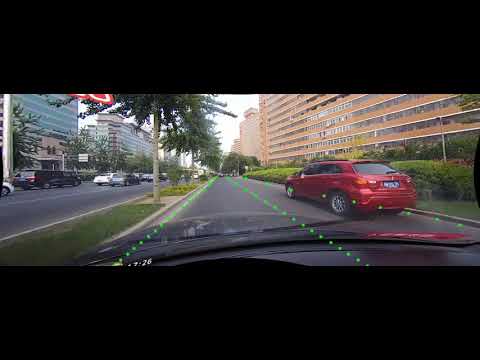
Demo

Install

Please see INSTALL.md

Get started

First of all, please modify data_root and log_path in your configs/culane.py or configs/tusimple.py config according to your environment.

  • data_root is the path of your CULane dataset or Tusimple dataset.
  • log_path is where tensorboard logs, trained models and code backup are stored. It should be placed outside of this project.

For single gpu training, run

python train.py configs/path_to_your_config

For multi-gpu training, run

sh launch_training.sh

or

python -m torch.distributed.launch --nproc_per_node=$NGPUS train.py configs/path_to_your_config

If there is no pretrained torchvision model, multi-gpu training may result in multiple downloading. You can first download the corresponding models manually, and then restart the multi-gpu training.

Since our code has auto backup function which will copy all codes to the log_path according to the gitignore, additional temp file might also be copied if it is not filtered by gitignore, which may block the execution if the temp files are large. So you should keep the working directory clean.


Besides config style settings, we also support command line style one. You can override a setting like

python train.py configs/path_to_your_config --batch_size 8

The batch_size will be set to 8 during training.


To visualize the log with tensorboard, run

tensorboard --logdir log_path --bind_all

Trained models

We provide two trained Res-18 models on CULane and Tusimple.

Dataset Metric paper Metric This repo Avg FPS on GTX 1080Ti Model
Tusimple 95.87 95.82 306 GoogleDrive/BaiduDrive(code:bghd)
CULane 68.4 69.7 324 GoogleDrive/BaiduDrive(code:w9tw)

For evaluation, run

mkdir tmp
# This a bad example, you should put the temp files outside the project.

python test.py configs/culane.py --test_model path_to_culane_18.pth --test_work_dir ./tmp

python test.py configs/tusimple.py --test_model path_to_tusimple_18.pth --test_work_dir ./tmp

Same as training, multi-gpu evaluation is also supported.

Visualization

We provide a script to visualize the detection results. Run the following commands to visualize on the testing set of CULane and Tusimple.

python demo.py configs/culane.py --test_model path_to_culane_18.pth
# or
python demo.py configs/tusimple.py --test_model path_to_tusimple_18.pth

Since the testing set of Tusimple is not ordered, the visualized video might look bad and we do not recommend doing this.

Speed

To test the runtime, please run

python speed_simple.py  
# this will test the speed with a simple protocol and requires no additional dependencies

python speed_real.py
# this will test the speed with real video or camera input

It will loop 100 times and calculate the average runtime and fps in your environment.

Citation

@InProceedings{qin2020ultra,
author = {Qin, Zequn and Wang, Huanyu and Li, Xi},
title = {Ultra Fast Structure-aware Deep Lane Detection},
booktitle = {The European Conference on Computer Vision (ECCV)},
year = {2020}
}

Thanks

Thanks zchrissirhcz for the contribution to the compile tool of CULane, KopiSoftware for contributing to the speed test, and ustclbh for testing on the Windows platform.

A tutorial on training a DarkNet YOLOv4 model for the CrowdHuman dataset

YOLOv4 CrowdHuman Tutorial This is a tutorial demonstrating how to train a YOLOv4 people detector using Darknet and the CrowdHuman dataset. Table of c

JK Jung 118 Nov 10, 2022
Permute Me Softly: Learning Soft Permutations for Graph Representations

Permute Me Softly: Learning Soft Permutations for Graph Representations

Giannis Nikolentzos 7 Jul 10, 2022
Interactive Image Generation via Generative Adversarial Networks

iGAN: Interactive Image Generation via Generative Adversarial Networks Project | Youtube | Paper Recent projects: [pix2pix]: Torch implementation for

Jun-Yan Zhu 3.9k Dec 23, 2022
Using Tensorflow Object Detection API to detect Waymo open dataset

Waymo-2D-Object-Detection Using Tensorflow Object Detection API to detect Waymo open dataset Result CenterNet Training Loss SSD ResNet Training Loss C

76 Dec 12, 2022
TVNet: Temporal Voting Network for Action Localization

TVNet: Temporal Voting Network for Action Localization This repo holds the codes of paper: "TVNet: Temporal Voting Network for Action Localization". P

hywang 5 Jul 26, 2022
Distributed Asynchronous Hyperparameter Optimization in Python

Hyperopt: Distributed Hyperparameter Optimization Hyperopt is a Python library for serial and parallel optimization over awkward search spaces, which

6.5k Jan 01, 2023
[CVPR'21] Locally Aware Piecewise Transformation Fields for 3D Human Mesh Registration

Locally Aware Piecewise Transformation Fields for 3D Human Mesh Registration This repository contains the implementation of our paper Locally Aware Pi

sfwang 70 Dec 19, 2022
SelfRemaster: SSL Speech Restoration

SelfRemaster: Self-Supervised Speech Restoration Official implementation of SelfRemaster: Self-Supervised Speech Restoration with Analysis-by-Synthesi

Takaaki Saeki 46 Jan 07, 2023
Flickr-Faces-HQ (FFHQ) is a high-quality image dataset of human faces, originally created as a benchmark for generative adversarial networks (GAN)

Flickr-Faces-HQ Dataset (FFHQ) Flickr-Faces-HQ (FFHQ) is a high-quality image dataset of human faces, originally created as a benchmark for generative

NVIDIA Research Projects 2.9k Dec 28, 2022
A toolset for creating Qualtrics-based IAT experiments

Qualtrics IAT Tool A web app for generating the Implicit Association Test (IAT) running on Qualtrics Online Web App The app is hosted by Streamlit, a

0 Feb 12, 2022
Rethinking Portrait Matting with Privacy Preserving

Rethinking Portrait Matting with Privacy Preserving This is the official repository of the paper Rethinking Portrait Matting with Privacy Preserving.

184 Jan 03, 2023
DFM: A Performance Baseline for Deep Feature Matching

DFM: A Performance Baseline for Deep Feature Matching Python (Pytorch) and Matlab (MatConvNet) implementations of our paper DFM: A Performance Baselin

143 Jan 02, 2023
Source code for our paper "Do Not Trust Prediction Scores for Membership Inference Attacks"

Do Not Trust Prediction Scores for Membership Inference Attacks Abstract: Membership inference attacks (MIAs) aim to determine whether a specific samp

<a href=[email protected]"> 3 Oct 25, 2022
An implementation of paper `Real-time Convolutional Neural Networks for Emotion and Gender Classification` with PaddlePaddle.

简介 通过PaddlePaddle框架复现了论文 Real-time Convolutional Neural Networks for Emotion and Gender Classification 中提出的两个模型,分别是SimpleCNN和MiniXception。利用 imdb_crop

8 Mar 11, 2022
Adversarial Texture Optimization from RGB-D Scans (CVPR 2020).

AdversarialTexture Adversarial Texture Optimization from RGB-D Scans (CVPR 2020). Scanning Data Download Please refer to data directory for details. B

Jingwei Huang 153 Nov 28, 2022
[ACMMM 2021, Oral] Code release for "Elastic Tactile Simulation Towards Tactile-Visual Perception"

EIP: Elastic Interaction of Particles Code release for "Elastic Tactile Simulation Towards Tactile-Visual Perception", in ACMMM (Oral) 2021. By Yikai

Yikai Wang 37 Dec 20, 2022
SegNet including indices pooling for Semantic Segmentation with tensorflow and keras

SegNet SegNet is a model of semantic segmentation based on Fully Comvolutional Network. This repository contains the implementation of learning and te

Yuta Kamikawa 172 Dec 23, 2022
JAX code for the paper "Control-Oriented Model-Based Reinforcement Learning with Implicit Differentiation"

Optimal Model Design for Reinforcement Learning This repository contains JAX code for the paper Control-Oriented Model-Based Reinforcement Learning wi

Evgenii Nikishin 43 Sep 28, 2022
PyTorch implementation of our ICCV2021 paper: StructDepth: Leveraging the structural regularities for self-supervised indoor depth estimation

StructDepth PyTorch implementation of our ICCV2021 paper: StructDepth: Leveraging the structural regularities for self-supervised indoor depth estimat

SJTU-ViSYS 112 Nov 28, 2022