FNet Implementation with TensorFlow & PyTorch

Overview

FNet Implementation with TensorFlow & PyTorch.

TensorFlow & PyTorch implementation of the paper "FNet: Mixing Tokens with Fourier Transforms".

Overview

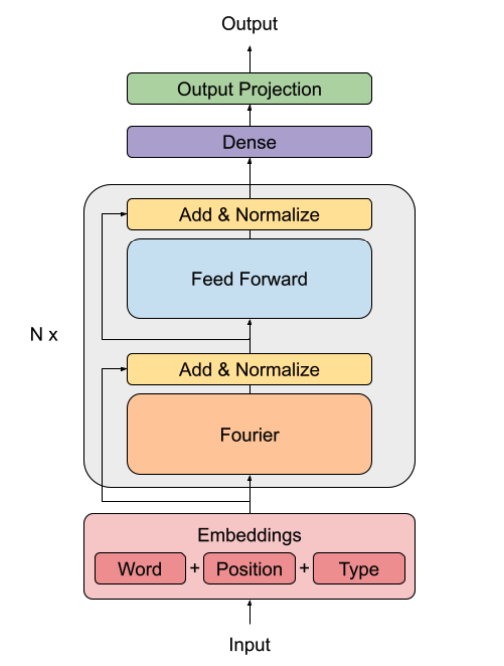
The FNet model was proposed in "FNet: Mixing Tokens with Fourier Transforms" by James Lee-Thorp, Joshua Ainslie, Ilya Eckstein, Santiago Ontanon. The model replaces the self-attention layer in a BERT model with a Fourier transform which returns only the real parts of the transform. The model is significantly faster than the BERT model since it has fewer parameters and is more memory efficient. The model achieves about 92%~97% accuracy of BERT counterparts on the GLUE benchmark and trains much faster than the BERT model. Find the abstract from the paper below.

Abstract

We show that Transformer encoder architectures can be sped up, with limited accuracy costs, by replacing the self-attention sublayers with simple linear transformations that "mix" input tokens. These linear mixers, along with standard nonlinearities in feed-forward layers, prove competent at modeling semantic relationships in several text classification tasks. Most surprisingly, we find that replacing the self-attention sublayer in a Transformer encoder with a standard, unparameterized Fourier Transform achieves 92-97% of the accuracy of BERT counterparts on the GLUE benchmark, but trains 80% faster on GPUs and 70% faster on TPUs at standard 512 input lengths. At longer input lengths, our FNet model is significantly faster: when compared to the "efficient" Transformers on the Long Range Arena benchmark, FNet matches the accuracy of the most accurate models, while outpacing the fastest models across all sequence lengths on GPUs (and across relatively shorter lengths on TPUs). Finally, FNet has a light memory footprint and is particularly efficient at smaller model sizes; for a fixed speed and accuracy budget, small FNet models outperform Transformer counterparts.
Additional Links

Reference

Lee-Thorp, J., Ainslie, J., Eckstein, I., & Ontanon S. (2021). FNet: Mixing Tokens with Fourier Transforms. arXiv preprint arXiv:2105.03824)

Contributing

Github issues and pull requests are welcome. Your feedback is much appreciated!

February 2022, Abdelghani Belgaid

Owner
Abdelghani Belgaid
Abdelghani Belgaid
Training a Resilient Q-Network against Observational Interference, Causal Inference Q-Networks

Obs-Causal-Q-Network AAAI 2022 - Training a Resilient Q-Network against Observational Interference Preprint | Slides | Colab Demo | Environment Setup

23 Nov 21, 2022
links and status of cool gradio demos

awesome-demos This is a list of some wonderful demos & applications built with Gradio. Here's how to contribute yours! 🖊️ Natural language processing

Gradio 96 Dec 30, 2022
Vector Neurons: A General Framework for SO(3)-Equivariant Networks

Vector Neurons: A General Framework for SO(3)-Equivariant Networks Created by Congyue Deng, Or Litany, Yueqi Duan, Adrien Poulenard, Andrea Tagliasacc

Congyue Deng 332 Dec 29, 2022
Official repository of DeMFI (arXiv.)

DeMFI This is the official repository of DeMFI (Deep Joint Deblurring and Multi-Frame Interpolation). [ArXiv_ver.] Coming Soon. Reference Jihyong Oh a

Jihyong Oh 56 Dec 14, 2022
This is the implementation of the paper "Self-supervised Outdoor Scene Relighting"

Self-supervised Outdoor Scene Relighting This is the implementation of the paper "Self-supervised Outdoor Scene Relighting". The model is implemented

Ye Yu 24 Dec 17, 2022
GPU Accelerated Non-rigid ICP for surface registration

GPU Accelerated Non-rigid ICP for surface registration Introduction Preivous Non-rigid ICP algorithm is usually implemented on CPU, and needs to solve

Haozhe Wu 144 Jan 04, 2023
Direct LiDAR Odometry: Fast Localization with Dense Point Clouds

Direct LiDAR Odometry: Fast Localization with Dense Point Clouds DLO is a lightweight and computationally-efficient frontend LiDAR odometry solution w

VECTR at UCLA 369 Dec 30, 2022
[CVPR 2021] Unsupervised Degradation Representation Learning for Blind Super-Resolution

DASR Pytorch implementation of "Unsupervised Degradation Representation Learning for Blind Super-Resolution", CVPR 2021 [arXiv] Overview Requirements

Longguang Wang 318 Dec 24, 2022
FeTaQA: Free-form Table Question Answering

FeTaQA: Free-form Table Question Answering FeTaQA is a Free-form Table Question Answering dataset with 10K Wikipedia-based {table, question, free-form

Language, Information, and Learning at Yale 40 Dec 13, 2022
[ICLR 2021] Heteroskedastic and Imbalanced Deep Learning with Adaptive Regularization

Heteroskedastic and Imbalanced Deep Learning with Adaptive Regularization Kaidi Cao, Yining Chen, Junwei Lu, Nikos Arechiga, Adrien Gaidon, Tengyu Ma

Kaidi Cao 29 Oct 20, 2022
Spearmint Bayesian optimization codebase

Spearmint Spearmint is a software package to perform Bayesian optimization. The Software is designed to automatically run experiments (thus the code n

Formerly: Harvard Intelligent Probabilistic Systems Group -- Now at Princeton 1.5k Dec 29, 2022
[CVPR 2020] 3D Photography using Context-aware Layered Depth Inpainting

[CVPR 2020] 3D Photography using Context-aware Layered Depth Inpainting [Paper] [Project Website] [Google Colab] We propose a method for converting a

Virginia Tech Vision and Learning Lab 6.2k Jan 01, 2023
An LSTM for time-series classification

Update 10-April-2017 And now it works with Python3 and Tensorflow 1.1.0 Update 02-Jan-2017 I updated this repo. Now it works with Tensorflow 0.12. In

Rob Romijnders 391 Dec 27, 2022
*ObjDetApp* deploys a pytorch model for object detection

*ObjDetApp* deploys a pytorch model for object detection

Will Chao 1 Dec 26, 2021
領域を指定し、キーを入力することで画像を保存するツールです。クラス分類用のデータセット作成を想定しています。

image-capture-class-annotation 領域を指定し、キーを入力することで画像を保存するツールです。 クラス分類用のデータセット作成を想定しています。 Requirement OpenCV 3.4.2 or later Usage 実行方法は以下です。 起動後はマウスクリック4

KazuhitoTakahashi 5 May 28, 2021
TensorFlow tutorials and best practices.

Effective TensorFlow 2 Table of Contents Part I: TensorFlow 2 Fundamentals TensorFlow 2 Basics Broadcasting the good and the ugly Take advantage of th

Vahid Kazemi 8.7k Dec 31, 2022
PyTorch code accompanying our paper on Maximum Entropy Generators for Energy-Based Models

Maximum Entropy Generators for Energy-Based Models All experiments have tensorboard visualizations for samples / density / train curves etc. To run th

Rithesh Kumar 135 Oct 27, 2022
Implementation of paper "Graph Condensation for Graph Neural Networks"

GCond A PyTorch implementation of paper "Graph Condensation for Graph Neural Networks" Code will be released soon. Stay tuned :) Abstract We propose a

Wei Jin 66 Dec 04, 2022
Simulate genealogical trees and genomic sequence data using population genetic models

msprime msprime is a population genetics simulator based on tskit. Msprime can simulate random ancestral histories for a sample of individuals (consis

Tskit developers 150 Dec 14, 2022