Fast, general, and tested differentiable structured prediction in PyTorch

Overview

Torch-Struct: Structured Prediction Library

Tests Coverage Status

A library of tested, GPU implementations of core structured prediction algorithms for deep learning applications.

  • HMM / LinearChain-CRF
  • HSMM / SemiMarkov-CRF
  • Dependency Tree-CRF
  • PCFG Binary Tree-CRF
  • ...

Designed to be used as efficient batched layers in other PyTorch code.

Tutorial paper describing methodology.

Getting Started

!pip install -qU git+https://github.com/harvardnlp/pytorch-struct
# Optional CUDA kernels for FastLogSemiring
!pip install -qU git+https://github.com/harvardnlp/genbmm
# For plotting.
!pip install -q matplotlib
import torch
from torch_struct import DependencyCRF, LinearChainCRF
import matplotlib.pyplot as plt
def show(x): plt.imshow(x.detach())
# Make some data.
vals = torch.zeros(2, 10, 10) + 1e-5
vals[:, :5, :5] = torch.rand(5)
vals[:, 5:, 5:] = torch.rand(5) 
dist = DependencyCRF(vals.log())
show(dist.log_potentials[0])

png

# Compute marginals
show(dist.marginals[0])

png

# Compute argmax
show(dist.argmax.detach()[0])

png

# Compute scoring and enumeration (forward / inside)
log_partition = dist.partition
max_score = dist.log_prob(dist.argmax)
# Compute samples 
show(dist.sample((1,)).detach()[0, 0])

png

# Padding/Masking built into library.
dist = DependencyCRF(vals, lengths=torch.tensor([10, 7]))
show(dist.marginals[0])
plt.show()
show(dist.marginals[1])

png

png

# Many other structured prediction approaches
chain = torch.zeros(2, 10, 10, 10) + 1e-5
chain[:, :, :, :] = vals.unsqueeze(-1).exp()
chain[:, :, :, :] += torch.eye(10, 10).view(1, 1, 10, 10) 
chain[:, 0, :, 0] = 1
chain[:, -1,9, :] = 1
chain = chain.log()

dist = LinearChainCRF(chain)
show(dist.marginals.detach()[0].sum(-1))

png

Library

Full docs: http://nlp.seas.harvard.edu/pytorch-struct/

Current distributions implemented:

  • LinearChainCRF
  • SemiMarkovCRF
  • DependencyCRF
  • NonProjectiveDependencyCRF
  • TreeCRF
  • NeuralPCFG / NeuralHMM

Each distribution includes:

  • Argmax, sampling, entropy, partition, masking, log_probs, k-max

Extensions:

  • Integration with torchtext, pytorch-transformers, dgl
  • Adapters for generative structured models (CFG / HMM / HSMM)
  • Common tree structured parameterizations TreeLSTM / SpanLSTM

Low-level API:

Everything implemented through semiring dynamic programming.

  • Log Marginals
  • Max and MAP computation
  • Sampling through specialized backprop
  • Entropy and first-order semirings.

Examples
Citation

@misc{alex2020torchstruct,
    title={Torch-Struct: Deep Structured Prediction Library},
    author={Alexander M. Rush},
    year={2020},
    eprint={2002.00876},
    archivePrefix={arXiv},
    primaryClass={cs.CL}
}
Comments
  • add tests for CKY

    add tests for CKY

    This PR fixes several bugs in k-best parsing with dist.topk() and includes a simple test to test the function.

    I made incremental changes so that existing modules relying on the CKY will not be affected.

    opened by zhaoyanpeng 8
  • 1st order cky implementation

    1st order cky implementation

    Hi,

    I'd like to contribute this implementation of a first-order cky-style crf with anchored rule potentials: $\phi[i,j,k,A,B,C] := \phi(A_{i,j} \rightarrow B_{i,k}, C{k+1,j})$.

    I also added code to the _Struct class that allows calculating marginals even if input tensors don't require a gradient (i.e., after model.eval())

    Please let me know if you'd like to see any changes.

    Thanks, Tom

    opened by teffland 6
  • Mini-batch setting with Semi Markov CRF

    Mini-batch setting with Semi Markov CRF

    I encounter learning instability when using a batch size > 1 with the semi-markovian CRF (loss goes to very large negative number), even when explicitly providing "lengths". I think the bug comes from the masking. The model train well when setting batch size 1.

    opened by urchade 5
  • Release on PyPI?

    Release on PyPI?

    Is there any interest on releasing pytorch-struct (and genbmm) on the official Python Package Index?

    I ran into this because I distribute my constituency parser on PyPI, and I just recently pushed a new version that depends on pytorch-struct: https://pypi.org/project/benepar/0.2.0a0/

    It turns out that packages on PyPI aren't allowed to depend on packages only hosted on github, so users of my parser can't just pip install benepar and have it work right away.

    opened by nikitakit 5
  • up sweep and down sweep

    up sweep and down sweep

    I'm interested in the parallel scan algorithm for the linear-chain CRF.

    I read the related paper in the tutorial and found that there are two steps: up sweep and down sweep in order to obtain all-prefix-sum.

    I think in this case, we use that algorithm to obtain all Z(x) with different lengths in a batch. But seems I couldn't find out the down sweep code in the repo. Can you point me out there?

    opened by allanj 5
  • [Bug] Implementation of Eisner's algorithm does not restrict the root number to 1

    [Bug] Implementation of Eisner's algorithm does not restrict the root number to 1

    Hey, I found that your implementation of Eisner's algorithm admits arbitrary root number, which is a very severe bug since dependency parsing usually has only one root token.

    In your DepTree.dp() method, you make a conversion to let the root token as the first token in the sentence. Imagine that the root x{0} attacks word x_{i}, I_{0,0} + C_{1, i} = I_{0, i} and I_{0, i} + C_{i,j} = C_{0, j} for some j < L where L is the length of sentence. Now complete span C_{0, j} still have opportunity to attach a new word x_{k} for j< k<=L, making multiple root attachment possible.

    Fortunately, I made some changes to your codes to restrict the root number to 1.

    ` def _dp(self, arc_scores_in, lengths=None, force_grad=False, cache=True): if arc_scores_in.dim() not in (3, 4): raise ValueError("potentials must have dim of 3 (unlabeled) or 4 (labeled)")

        labeled = arc_scores_in.dim() == 4
        semiring = self.semiring
        # arc_scores_in = _convert(arc_scores_in)
        arc_scores_in, batch, N, lengths = self._check_potentials(
            arc_scores_in, lengths
        )
        arc_scores_in.requires_grad_(True)
        arc_scores = semiring.sum(arc_scores_in) if labeled else arc_scores_in
        alpha = [
            [
                [
                    Chart((batch, N, N), arc_scores, semiring, cache=cache)
                    for _ in range(2)
                ]
                for _ in range(2)
            ]
            for _ in range(2)
        ]
    
        semiring.one_(alpha[A][C][L].data[:, :, :, 0].data)
        semiring.one_(alpha[A][C][R].data[:, :, :, 0].data)
        semiring.one_(alpha[B][C][L].data[:, :, :, -1].data)
        semiring.one_(alpha[B][C][R].data[:, :, :, -1].data)
    
    
        for k in range(1, N):
            f = torch.arange(N - k), torch.arange(k, N)
            ACL = alpha[A][C][L][: N - k, :k]
            ACR = alpha[A][C][R][: N - k, :k]
            BCL = alpha[B][C][L][k:, N - k :]
            BCR = alpha[B][C][R][k:, N - k :]
            x = semiring.dot(ACR, BCL)
            arcs_l = semiring.times(x, arc_scores[:, :, f[1], f[0]])
            alpha[A][I][L][: N - k, k] = arcs_l
            alpha[B][I][L][k:N, N - k - 1] = arcs_l
            arcs_r = semiring.times(x, arc_scores[:, :, f[0], f[1]])
            alpha[A][I][R][:N - k, k] = arcs_r
            alpha[B][I][R][k:N, N - k - 1] = arcs_r
            AIR = alpha[A][I][R][: N - k, 1 : k + 1]
            BIL = alpha[B][I][L][k:, N - k - 1 : N - 1]
            new = semiring.dot(ACL, BIL)
            alpha[A][C][L][: N - k, k] = new
            alpha[B][C][L][k:N, N - k - 1] = new
            new = semiring.dot(AIR, BCR)
            alpha[A][C][R][: N - k, k] = new
            alpha[B][C][R][k:N, N - k - 1] = new
    
        root_incomplete_span = semiring.times(alpha[A][C][L][0, :], arc_scores[:, :, torch.arange(N), torch.arange(N)])
        root =  [ Chart((batch,), arc_scores, semiring, cache=cache) for _ in range(N)]
        for k in range(N):
            AIR = root_incomplete_span[:, :, :k+1]
            BCR = alpha[B][C][R][k, N - (k+1):]
            root[k] = semiring.dot(AIR, BCR)
        v = torch.stack([root[l-1][:,i] for i, l in enumerate(lengths)], dim=1)
        return v, [arc_scores_in], alpha
    

    `

    Basically, I don't treat the first token as root anymore. I handle the root token just after the for-loop, so you may need handle the length variable. (length = length-1, root no longer be treated as part of sentence) . I tested the modified code and found it bug-free

    opened by sustcsonglin 4
  • Inference for the HMM model

    Inference for the HMM model

    Hello! I was playing with the HMM distribution and I obtained some results that I don't really understand. More precisely, I've set the following parameters

    t = torch.tensor([[0.99, 0.01], [0.01, 0.99]]).log()
    e = torch.tensor([[0.50, 0.50], [0.50, 0.50]]).log()
    i = torch.tensor(np.array([0.99, 0.01])).log()
    x = torch.randint(0, 2, size=(1, 8))
    

    and I was expecting the model to stay in the hidden state 0 regardless of the observed data x – it starts in state 0 and the transition matrix makes it very likely to maintain it. But when plotting the argmax, it appears that the model jumps from one state to the other:

    def show_chain(chain):
        plt.imshow(chain.detach().sum(-1).transpose(0, 1))
    
    dist = torch_struct.HMM(t, e, i, x)
    show_chain(dist.argmax[0])
    

    image

    I must be missing something obvious; but shouldn't dist.argmax correspond to argmax_z p(z | x, Θ)? Thank you!

    opened by danoneata 4
  • DependencyCRF partition function broken

    DependencyCRF partition function broken

    Getting the following in-place operation error when using the DependencyCRF:

    B,N = 3,50
    phi = torch.randn(B,N,N)
    DependencyCRF(phi).partition
    
    /usr/local/lib/python3.7/dist-packages/torch_struct/deptree.py in _check_potentials(self, arc_scores, lengths)
        121         arc_scores = semiring.convert(arc_scores)
        122         for b in range(batch):
    --> 123             semiring.zero_(arc_scores[:, b, lengths[b] + 1 :, :])
        124             semiring.zero_(arc_scores[:, b, :, lengths[b] + 1 :])
        125 
    
    /usr/local/lib/python3.7/dist-packages/torch_struct/semirings/semirings.py in zero_(xs)
        124     @staticmethod
        125     def zero_(xs):
    --> 126         return xs.fill_(-1e5)
        127 
        128     @staticmethod
    
    RuntimeError: a view of a leaf Variable that requires grad is being used in an in-place operation.
    
    opened by teffland 3
  • [Question] How to compute a marginal probability over a (contiguous) set of nodes?

    [Question] How to compute a marginal probability over a (contiguous) set of nodes?

    Hi.

    Thank you for the great library. I have one question that I hope you could help with.

    How can I compute a marginal probability over a (contiguous) set of nodes? Right now, I am using your LinearChain-CRF to do NER. In addition to the best sequence itself, I also need to compute the model’s confidence in its predicted labeling over a segment of input. For example, what is the probability that a span of tokens constitute a person name?

    I read your example and see how you get the marginal prob for each individual node. But I was not quite sure how to compute the marginal prob over a subset of nodes. If you could give any hint, it would be great.

    Thank you.

    opened by kimdev95 3
  • Get the score of dist.topk()

    Get the score of dist.topk()

    The topk() function returns top k predictions from the distribution, how to easily get the corresponding score of each prediction?

    By the way, when sentence lengths are short and the k value of topk is large, how to know the number of predictions that are valid? For the example in DependencyCRF, when sentence length is 2 and k is 5, only the top 3 predictions are valid I think.

    opened by wangxinyu0922 3
  • Labeled projective dependency CRF

    Labeled projective dependency CRF

    This is work in progress and isn't ready to merge yet.

    This seems to work for partition, but argmax and marginals don't return as I expect. Both return tensor of shape (B, N, N); I'd expect them to return (B, N, N, L) tensors instead. Any advice?

    opened by kmkurn 3
  • [Question] How to apply pytorch-struct for 2 dimensional data?

    [Question] How to apply pytorch-struct for 2 dimensional data?

    I could find examples of pytorch struct usage for 1d sequence data like text or video frame. But I'm trying to parse tables structure in pdf documents.

    Could you provide some hints where to start?

    opened by YuriyPryyma 4
  • end_class support for Autoregressive

    end_class support for Autoregressive

    end_class is not used for the Autoregressive module: https://github.com/harvardnlp/pytorch-struct/blob/7146de5659ff17ad7be53023c025ffd099866412/torch_struct/autoregressive.py#L49

    opened by urchade 1
  • Update examples to use newer torchtext APIs

    Update examples to use newer torchtext APIs

    opened by erip 2
  • Instable learning with SemiMarkov CRF

    Instable learning with SemiMarkov CRF

    HI,

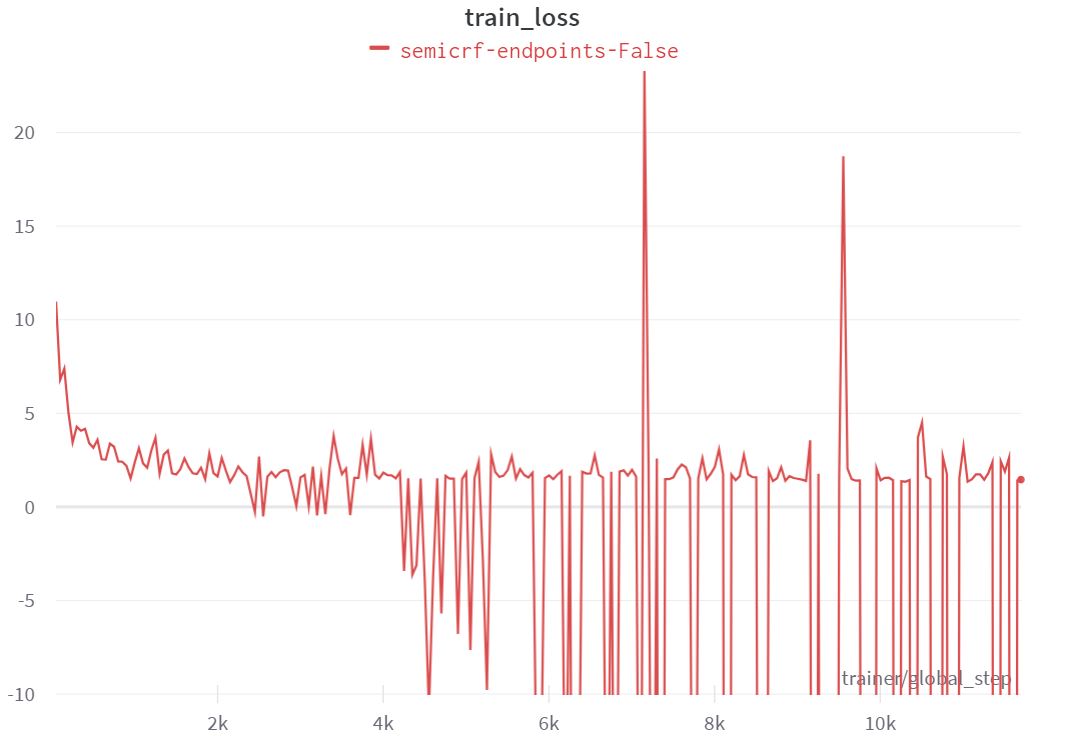
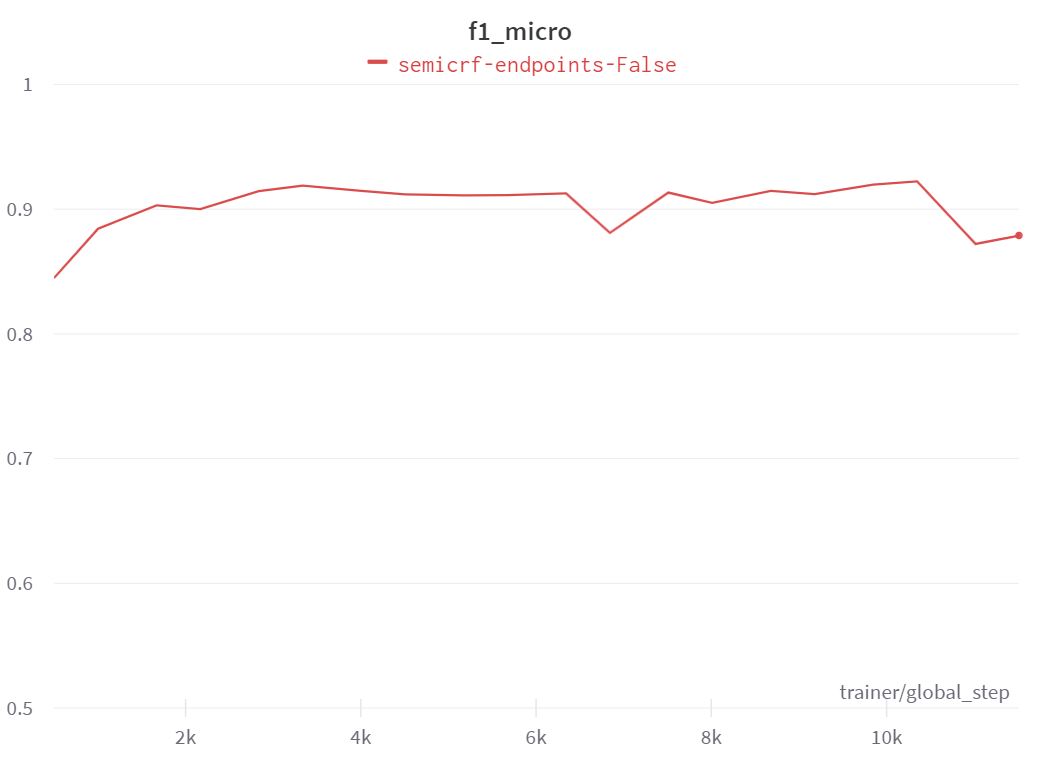
    First, thank you for fixing #110 (@da03), the SemiCRF works better now, I was able to get good results on span extraction tasks. However, I still encounter a learning instability where the loss (neg logprob) gets negative after several steps (and the accuracy starts to drop). The same problem occurs with batch_size = 1. Below I put the learning curve (f1_score and log loss).

    (Maybe the bug comes from the masking of spans where (length, length + span_with) and length + span_with > length, but I am not sure.)

    Edit: I created a test and it seems that the masking is good. Maybe the log_prob computation or the to_parts function ?

    train_loss score

    opened by urchade 0
  • fix bug- missing assignment of spans from sentCFG in documentation

    fix bug- missing assignment of spans from sentCFG in documentation

    Noticed a small bug in the documentation and example of SentCFG. The return of dist.argmax is (terms, rules, init, spans), but example in documentation only assigns (term, rules, init) and gives dim mismatch. As such when running the example it breaks. This fix resolves this issue.

    opened by jdegange 0
Releases(v0.5)
text to speech toolkit. 好用的中文语音合成工具箱,包含语音编码器、语音合成器、声码器和可视化模块。

ttskit Text To Speech Toolkit: 语音合成工具箱。 安装 pip install -U ttskit 注意 可能需另外安装的依赖包:torch,版本要求torch=1.6.0,=1.7.1,根据自己的实际环境安装合适cuda或cpu版本的torch。 ttskit的

KDD 483 Jan 04, 2023
Clone a voice in 5 seconds to generate arbitrary speech in real-time

This repository is forked from Real-Time-Voice-Cloning which only support English. English | 中文 Features 🌍 Chinese supported mandarin and tested with

Weijia Chen 25.6k Jan 06, 2023
Simple, hackable offline speech to text - using the VOSK-API.

Simple, hackable offline speech to text - using the VOSK-API.

Campbell Barton 844 Jan 07, 2023
Interpretable Models for NLP using PyTorch

This repo is deprecated. Please find the updated package here. https://github.com/EdGENetworks/anuvada Anuvada: Interpretable Models for NLP using PyT

Sandeep Tammu 19 Dec 17, 2022
[AAAI 21] Curriculum Labeling: Revisiting Pseudo-Labeling for Semi-Supervised Learning

◥ Curriculum Labeling ◣ Revisiting Pseudo-Labeling for Semi-Supervised Learning Paola Cascante-Bonilla, Fuwen Tan, Yanjun Qi, Vicente Ordonez. In the

UVA Computer Vision 113 Dec 15, 2022
Code for hyperboloid embeddings for knowledge graph entities

Implementation for the papers: Self-Supervised Hyperboloid Representations from Logical Queries over Knowledge Graphs, Nurendra Choudhary, Nikhil Rao,

30 Dec 10, 2022
Extract rooms type, door, neibour rooms, rooms corners nad bounding boxes, and generate graph from rplan dataset

Housegan-data-reader House-GAN++ (data-reader) Code and instructions for converting rplan dataset (raster images) to housegan++ data format. House-GAN

Sepid Hosseini 13 Nov 24, 2022
A complete NLP guideline for enthusiasts

NLP-NINJA A complete guide for Natural Language Processing in Python Table of Contents S.No. Topic Level Meaning 1 Tokenization 🤍 Beginner 2 Stemming

MAINAK CHAUDHURI 22 Dec 27, 2022
Generating new names based on trends in data using GPT2 (Transformer network)

MLOpsNameGenerator Overall Goal The goal of the project is to develop a model that is capable of creating Pokémon names based on its description, usin

Gustav Lang Moesmand 2 Jan 10, 2022
تولید اسم های رندوم فینگیلیش

karafs کرفس تولید اسم های رندوم فینگیلیش installation ➜ pip install karafs usage دو زبانه ➜ karafs -n 10 توت فرنگی بی ناموس toot farangi-ye bi_namoos

Vaheed NÆINI (9E) 36 Nov 24, 2022
Py65 65816 - Add support for the 65C816 to py65

Add support for the 65C816 to py65 Py65 (https://github.com/mnaberez/py65) is a

4 Jan 04, 2023
Binaural Speech Synthesis

Binaural Speech Synthesis This repository contains code to train a mono-to-binaural neural sound renderer. If you use this code or the provided datase

Facebook Research 135 Dec 18, 2022
Blender addon - Scrub timeline from viewport with a shortcut

Viewport scrub timeline Move in the timeline directly in viewport and snap to nearest keyframe Note : This standalone feature will be added in the nat

Samuel Bernou 40 Nov 07, 2022
pyupbit 라이브러리를 활용하여 upbit에서 비트코인을 자동매매하는 코드입니다. 조코딩 유튜브 채널에서 자세한 강의 영상을 보실 수 있습니다.

파이썬 비트코인 투자 자동화 강의 코드 by 유튜브 조코딩 채널 pyupbit 라이브러리를 활용하여 upbit 거래소에서 비트코인 자동매매를 하는 코드입니다. 파일 구성 test.py : 잔고 조회 (1강) backtest.py : 백테스팅 코드 (2강) bestK.p

조코딩 JoCoding 186 Dec 29, 2022
Search for documents in a domain through Google. The objective is to extract metadata

MetaFinder - Metadata search through Google _____ __ ___________ .__ .___ / \

Josué Encinar 85 Dec 16, 2022
An extensive UI tool built using new data scraped from BBC News

BBC-News-Analyzer An extensive UI tool built using new data scraped from BBC New

Antoreep Jana 1 Dec 31, 2021
Transformation spoken text to written text

Transformation spoken text to written text This model is used for formatting raw asr text output from spoken text to written text (Eg. date, number, i

Nguyen Binh 16 Dec 28, 2022
Reading Wikipedia to Answer Open-Domain Questions

DrQA This is a PyTorch implementation of the DrQA system described in the ACL 2017 paper Reading Wikipedia to Answer Open-Domain Questions. Quick Link

Facebook Research 4.3k Jan 01, 2023
BERT-based Financial Question Answering System

BERT-based Financial Question Answering System In this example, we use Jina, PyTorch, and Hugging Face transformers to build a production-ready BERT-b

Bithiah Yuan 61 Sep 18, 2022
Must-read papers on improving efficiency for pre-trained language models.

Must-read papers on improving efficiency for pre-trained language models.

Tobias Lee 89 Jan 03, 2023