A Momentumized, Adaptive, Dual Averaged Gradient Method for Stochastic Optimization

Related tags

Deep Learningmadgrad
Overview

MADGRAD Optimization Method

A Momentumized, Adaptive, Dual Averaged Gradient Method for Stochastic Optimization

pip install madgrad

Try it out! A best-of-both-worlds optimizer with the generalization performance of SGD and at least as fast convergence as that of Adam, often faster. A drop-in torch.optim implementation madgrad.MADGRAD is provided, as well as a FairSeq wrapped instance. For FairSeq, just import madgrad anywhere in your project files and use the --optimizer madgrad command line option, together with --weight-decay, --momentum, and optionally --madgrad_eps.

The madgrad.py file containing the optimizer can be directly dropped into any PyTorch project if you don't want to install via pip. If you are using fairseq, you need the acompanying fairseq_madgrad.py file as well.

Documentation availiable at https://madgrad.readthedocs.io/en/latest/.

Things to note:

  • You may need to use a lower weight decay than you are accustomed to. Often 0.
  • You should do a full learning rate sweep as the optimal learning rate will be different from SGD or Adam. Best LR values we found were 2.5e-4 for 152 layer PreActResNet on CIFAR10, 0.001 for ResNet-50 on ImageNet, 0.025 for IWSLT14 using transformer_iwslt_de_en and 0.005 for RoBERTa training on BookWiki using BERT_BASE. On NLP models gradient clipping also helped.

Tech Report

Adaptivity without Compromise: A Momentumized, Adaptive, Dual Averaged Gradient Method for Stochastic Optimization

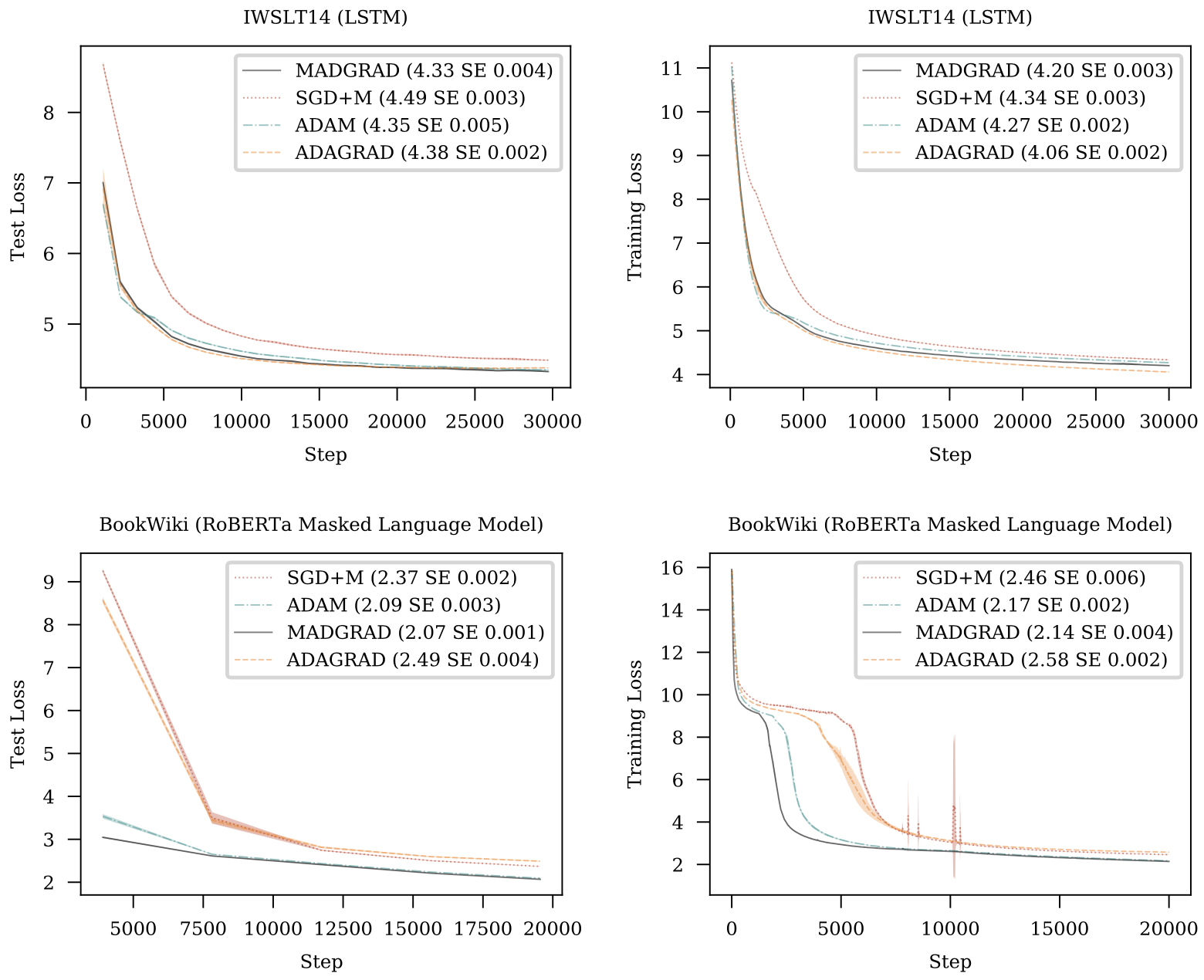
We introduce MADGRAD, a novel optimization method in the family of AdaGrad adaptive gradient methods. MADGRAD shows excellent performance on deep learning optimization problems from multiple fields, including classification and image-to-image tasks in vision, and recurrent and bidirectionally-masked models in natural language processing. For each of these tasks, MADGRAD matches or outperforms both SGD and ADAM in test set performance, even on problems for which adaptive methods normally perform poorly.

@misc{defazio2021adaptivity,
      title={Adaptivity without Compromise: A Momentumized, Adaptive, Dual Averaged Gradient Method for Stochastic Optimization}, 
      author={Aaron Defazio and Samy Jelassi},
      year={2021},
      eprint={2101.11075},
      archivePrefix={arXiv},
      primaryClass={cs.LG}
}

Results

vision nlp

License

MADGRAD is licensed under the MIT License.

Owner
Meta Research
Meta Research
How will electric vehicles affect traffic congestion and energy consumption: an integrated modelling approach

EV-charging-impact This repository contains the code that has been used for the Queue modelling for the paper "How will electric vehicles affect traff

7 Nov 30, 2022
KE-Dialogue: Injecting knowledge graph into a fully end-to-end dialogue system.

Learning Knowledge Bases with Parameters for Task-Oriented Dialogue Systems This is the implementation of the paper: Learning Knowledge Bases with Par

CAiRE 42 Nov 10, 2022
Code for the Active Speakers in Context Paper (CVPR2020)

Active Speakers in Context This repo contains the official code and models for the "Active Speakers in Context" CVPR 2020 paper. Before Training The c

43 Oct 14, 2022
Source Code of NeurIPS21 paper: Recognizing Vector Graphics without Rasterization

YOLaT-VectorGraphicsRecognition This repository is the official PyTorch implementation of our NeurIPS-2021 paper: Recognizing Vector Graphics without

Microsoft 49 Dec 20, 2022
PyTorch reimplementation of the paper Involution: Inverting the Inherence of Convolution for Visual Recognition [CVPR 2021].

Involution: Inverting the Inherence of Convolution for Visual Recognition Unofficial PyTorch reimplementation of the paper Involution: Inverting the I

Christoph Reich 100 Dec 01, 2022
DLWP: Deep Learning Weather Prediction

DLWP: Deep Learning Weather Prediction DLWP is a Python project containing data-

Kushal Shingote 3 Aug 14, 2022
A graph-to-sequence model for one-step retrosynthesis and reaction outcome prediction.

Graph2SMILES A graph-to-sequence model for one-step retrosynthesis and reaction outcome prediction. 1. Environmental setup System requirements Ubuntu:

29 Nov 18, 2022
RETRO-pytorch - Implementation of RETRO, Deepmind's Retrieval based Attention net, in Pytorch

RETRO - Pytorch (wip) Implementation of RETRO, Deepmind's Retrieval based Attent

Phil Wang 556 Jan 04, 2023
[NeurIPS'21] Projected GANs Converge Faster

[Project] [PDF] [Supplementary] [Talk] This repository contains the code for our NeurIPS 2021 paper "Projected GANs Converge Faster" by Axel Sauer, Ka

798 Jan 04, 2023
Scenarios, tutorials and demos for Autonomous Driving

The Autonomous Driving Cookbook (Preview) NOTE: This project is developed and being maintained by Project Road Runner at Microsoft Garage. This is cur

Microsoft 2.1k Jan 02, 2023
Code and real data for the paper "Counterfactual Temporal Point Processes", available at arXiv.

counterfactual-tpp This is a repository containing code and real data for the paper Counterfactual Temporal Point Processes. Pre-requisites This code

Networks Learning 11 Dec 09, 2022
Source Code for ICSE 2022 Paper - ``Can We Achieve Fairness Using Semi-Supervised Learning?''

Fair-SSL Source Code for ICSE 2022 Paper - Can We Achieve Fairness Using Semi-Supervised Learning? Ethical bias in machine learning models has become

1 Dec 18, 2021
Pytorch implementation of TailCalibX : Feature Generation for Long-tail Classification

TailCalibX : Feature Generation for Long-tail Classification by Rahul Vigneswaran, Marc T. Law, Vineeth N. Balasubramanian, Makarand Tapaswi [arXiv] [

Rahul Vigneswaran 34 Jan 02, 2023
A symbolic-model-guided fuzzer for TLS

tlspuffin TLS Protocol Under FuzzINg A symbolic-model-guided fuzzer for TLS Master Thesis | Thesis Presentation | Documentation Disclaimer: The term "

69 Dec 20, 2022
Hierarchical Few-Shot Generative Models

Hierarchical Few-Shot Generative Models Giorgio Giannone, Ole Winther This repo contains code and experiments for the paper Hierarchical Few-Shot Gene

Giorgio Giannone 6 Dec 12, 2022
Select, weight and analyze complex sample data

Sample Analytics In large-scale surveys, often complex random mechanisms are used to select samples. Estimates derived from such samples must reflect

samplics 37 Dec 15, 2022
Fibonacci Method Gradient Descent

An implementation of the Fibonacci method for gradient descent, featuring a TKinter GUI for inputting the function / parameters to be examined and a matplotlib plot of the function and results.

Emma 1 Jan 28, 2022
Using LSTM to detect spoofing attacks in an Air-Ground network

Using LSTM to detect spoofing attacks in an Air-Ground network Specifications IDE: Spider Packages: Tensorflow 2.1.0 Keras NumPy Scikit-learn Matplotl

Tiep M. H. 1 Nov 20, 2021
Exploring Image Deblurring via Blur Kernel Space (CVPR'21)

Exploring Image Deblurring via Encoded Blur Kernel Space About the project We introduce a method to encode the blur operators of an arbitrary dataset

VinAI Research 118 Dec 19, 2022
Joint Learning of 3D Shape Retrieval and Deformation, CVPR 2021

Joint Learning of 3D Shape Retrieval and Deformation Joint Learning of 3D Shape Retrieval and Deformation Mikaela Angelina Uy, Vladimir G. Kim, Minhyu

Mikaela Uy 38 Oct 18, 2022