Pytorch cuda extension of grid_sample1d

Overview

Grid Sample 1d

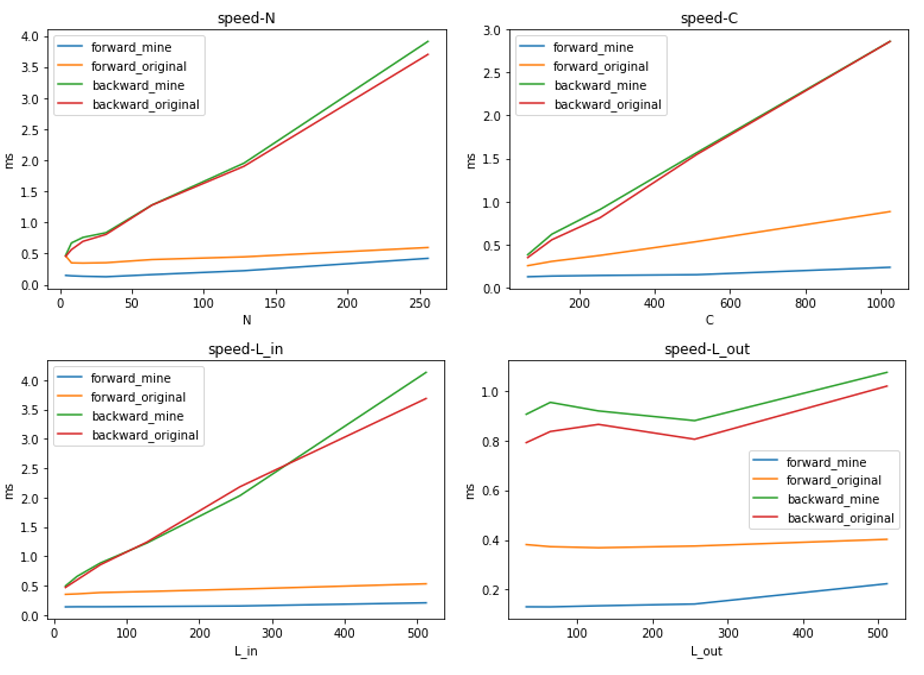
pytorch cuda extension of grid sample 1d. Since pytorch only supports grid sample 2d/3d, I extend the 1d version for efficiency. The forward pass is 2~3x faster than pytorch grid sample.

setup

  • Pytorch == 1.7.1
  • CUDA == 10.1

Other versions of pytorch or cuda may work but I haven't test.

you can choose to manually build it or use JIT

Build

python setup.py install

JIT

comment import grid_sample1d_cuda as grid_sample1d in op.py

uncomment

grid_sample1d = load(
    'grid_sample1d_cuda', ['grid_sample1d_cuda.cpp', 'grid_sample1d_cuda_kernel.cu'], verbose=True)

in op.py

Usage

import torch
from grid_sample1d import GridSample1d

grid_sample1d = GridSample1d(padding_mode=True, align_corners=True)
N = 16
C = 256
L_in = 64
L_out = 128
input = torch.randn((N, C, L_in)).cuda()
grids = torch.randn((N, L_out)).cuda()
output = grid_sample1d(input, grids)

Options are

  • padding_mode: True for border padding, False for zero padding
  • align_corners: same with align_corners in torch.nn.functional.grid_sample

difference

In forward pass, calculation on the channel dim C is parallel, which is serial in torch.nn.functional.grid_sample. Parallel calculation on C may cause round off error in backward. But for now, I found it doesn't influence the forward pass.

Test

Accuracy Test

Since grid sample 1d is a special case of grid sample 2d in most cases (not true when padding_mode & align_corners are both False). I test the accuracy of the implemented grid sample based on torch.nn.functional.grid_sample.

import torch
import torch.nn.functional as F


def gridsample1d_by2d(input, grid, padding_mode, align_corners):
    shape = grid.shape
    input = input.unsqueeze(-1)  # batch_size * C * L_in * 1
    grid = grid.unsqueeze(1)  # batch_size * 1 * L_out
    grid = torch.stack([-torch.ones_like(grid), grid], dim=-1)
    z = F.grid_sample(input, grid, padding_mode=padding_mode, align_corners=align_corners)
    C = input.shape[1]
    out_shape = [shape[0], C, shape[1]]
    z = z.view(*out_shape)  # batch_size * C * L_out
    return z

It is recommended to test on your computer because I only test it on CUDA 10.1 GTX 1080Ti

python test/acc_benchmark.py

Both the forward and the backward results are identical except for align_corners=True, padding_mode=False. It may be caused by round off error when we sum series float numbers in different orders.

Deterministic Test

It is very important to do deterministic test since the associative law is no more applied for the calculation of float numbers on computers.

python test/check_deterministic.py

Note

When padding_mode & align_corners are both False, we cannot regard grid sample 1d as a special case of grid sample 2d in pytorch. I have checked the cuda kernel of grid_sample in Pytorch. When padding_mode & align_corners are both False, the output of torch.nn.functional.grid_sample will be half of the expected. Hope it can be fixed one day.

CPU support

Too lazy to support

speed & memory cost

Here are the speed test results on different size of input
references

Owner
lyricpoem
lyricpoem
VolumeGAN - 3D-aware Image Synthesis via Learning Structural and Textural Representations

VolumeGAN - 3D-aware Image Synthesis via Learning Structural and Textural Representations 3D-aware Image Synthesis via Learning Structural and Textura

GenForce: May Generative Force Be with You 116 Dec 26, 2022
This code is for eCaReNet: explainable Cancer Relapse Prediction Network.

eCaReNet This code is for eCaReNet: explainable Cancer Relapse Prediction Network. (Towards Explainable End-to-End Prostate Cancer Relapse Prediction

Institute of Medical Systems Biology 2 Jul 28, 2022
Implement the Pareto Optimizer and pcgrad to make a self-adaptive loss for multi-task

multi-task_losses_optimizer Implement the Pareto Optimizer and pcgrad to make a self-adaptive loss for multi-task 已经实验过了,不会有cuda out of memory情况 ##Par

14 Dec 25, 2022
This repository contains the code for "Self-Diagnosis and Self-Debiasing: A Proposal for Reducing Corpus-Based Bias in NLP".

Self-Diagnosis and Self-Debiasing This repository contains the source code for Self-Diagnosis and Self-Debiasing: A Proposal for Reducing Corpus-Based

Timo Schick 62 Dec 12, 2022
This repository is the code of the paper "Sparse Spatial Transformers for Few-Shot Learning".

🌟 Sparse Spatial Transformers for Few-Shot Learning This code implements the Sparse Spatial Transformers for Few-Shot Learning(SSFormers). Our code i

chx_nju 38 Dec 13, 2022
Quantile Regression DQN a Minimal Working Example, Distributional Reinforcement Learning with Quantile Regression

Quantile Regression DQN Quantile Regression DQN a Minimal Working Example, Distributional Reinforcement Learning with Quantile Regression (https://arx

Arsenii Senya Ashukha 80 Sep 17, 2022
Invariant Causal Prediction for Block MDPs

MISA Abstract Generalization across environments is critical to the successful application of reinforcement learning algorithms to real-world challeng

Meta Research 41 Sep 17, 2022
Akshat Surolia 2 May 11, 2022
UnFlow: Unsupervised Learning of Optical Flow with a Bidirectional Census Loss

UnFlow: Unsupervised Learning of Optical Flow with a Bidirectional Census Loss This repository contains the TensorFlow implementation of the paper UnF

Simon Meister 270 Nov 06, 2022
Code for the paper Relation Prediction as an Auxiliary Training Objective for Improving Multi-Relational Graph Representations (AKBC 2021).

Relation Prediction as an Auxiliary Training Objective for Knowledge Base Completion This repo provides the code for the paper Relation Prediction as

Facebook Research 85 Jan 02, 2023
Playable Video Generation

Playable Video Generation Playable Video Generation Willi Menapace, Stéphane Lathuilière, Sergey Tulyakov, Aliaksandr Siarohin, Elisa Ricci Paper: ArX

Willi Menapace 136 Dec 31, 2022
Implements VQGAN+CLIP for image and video generation, and style transfers, based on text and image prompts. Emphasis on ease-of-use, documentation, and smooth video creation.

VQGAN-CLIP-GENERATOR Overview This is a package (with available notebook) for running VQGAN+CLIP locally, with a focus on ease of use, good documentat

Ryan Hamilton 98 Dec 30, 2022
Multi-Scale Vision Longformer: A New Vision Transformer for High-Resolution Image Encoding

Vision Longformer This project provides the source code for the vision longformer paper. Multi-Scale Vision Longformer: A New Vision Transformer for H

Microsoft 209 Dec 30, 2022
This MVP data web app uses the Streamlit framework and Facebook's Prophet forecasting package to generate a dynamic forecast from your own data.

📈 Automated Time Series Forecasting Background: This MVP data web app uses the Streamlit framework and Facebook's Prophet forecasting package to gene

Zach Renwick 42 Jan 04, 2023
🔅 Shapash makes Machine Learning models transparent and understandable by everyone

🎉 What's new ? Version New Feature Description Tutorial 1.6.x Explainability Quality Metrics To help increase confidence in explainability methods, y

MAIF 2.1k Dec 27, 2022
Trans-Encoder: Unsupervised sentence-pair modelling through self- and mutual-distillations

Trans-Encoder: Unsupervised sentence-pair modelling through self- and mutual-distillations Code repo for paper Trans-Encoder: Unsupervised sentence-pa

Amazon 101 Dec 29, 2022
Massively parallel Monte Carlo diffusion MR simulator written in Python.

Disimpy Disimpy is a Python package for generating simulated diffusion-weighted MR signals that can be useful in the development and validation of dat

Leevi 16 Nov 11, 2022
An onlinel learning to rank python codebase.

OLTR Online learning to rank python codebase. The code related to Pairwise Differentiable Gradient Descent (ranker/PDGDLinearRanker.py) is copied from

ielab 5 Jul 18, 2022
[CVPR 2022] Pytorch implementation of "Templates for 3D Object Pose Estimation Revisited: Generalization to New objects and Robustness to Occlusions" paper

template-pose Pytorch implementation of "Templates for 3D Object Pose Estimation Revisited: Generalization to New objects and Robustness to Occlusions

Van Nguyen Nguyen 92 Dec 28, 2022
STEAL - Learning Semantic Boundaries from Noisy Annotations (CVPR 2019)

STEAL This is the official inference code for: Devil Is in the Edges: Learning Semantic Boundaries from Noisy Annotations David Acuna, Amlan Kar, Sanj

469 Dec 26, 2022