GPT-2 Model for Leetcode Questions in python

Overview

Leetcode using AI 🤖

GPT-2 Model for Leetcode Questions in python New demo here: https://huggingface.co/spaces/gagan3012/project-code-py

Note: the Answers might not make sense in some cases because of the bias in GPT-2 Current accuracy is capped at 90%.

Contribtuions: If you would like to make the model/UI better contributions (Issues/PRs) are welcome Check out CONTRIBUTIONS

How I built this : Linkedin

📢 Favour:

It would be highly motivating, if you can STAR this repo if you find it helpful. New improvements incoming!

Model

Two models have been developed for different use cases and they can be found at https://huggingface.co/gagan3012

The model weights can be found here: GPT-2 and DistilGPT-2

The model has been trained using Weights and Biases (Wandb) and PyTorch

GPT Neo model: https://huggingface.co/gagan3012/project-code-py-neo

Example usage:

from transformers import AutoTokenizer, AutoModelWithLMHead

tokenizer = AutoTokenizer.from_pretrained("gagan3012/project-code-py")

model = AutoModelWithLMHead.from_pretrained("gagan3012/project-code-py")

Demo

Streamlit App

A streamlit webapp has been setup to use the model: https://share.streamlit.io/gagan3012/project-code-py/app.py
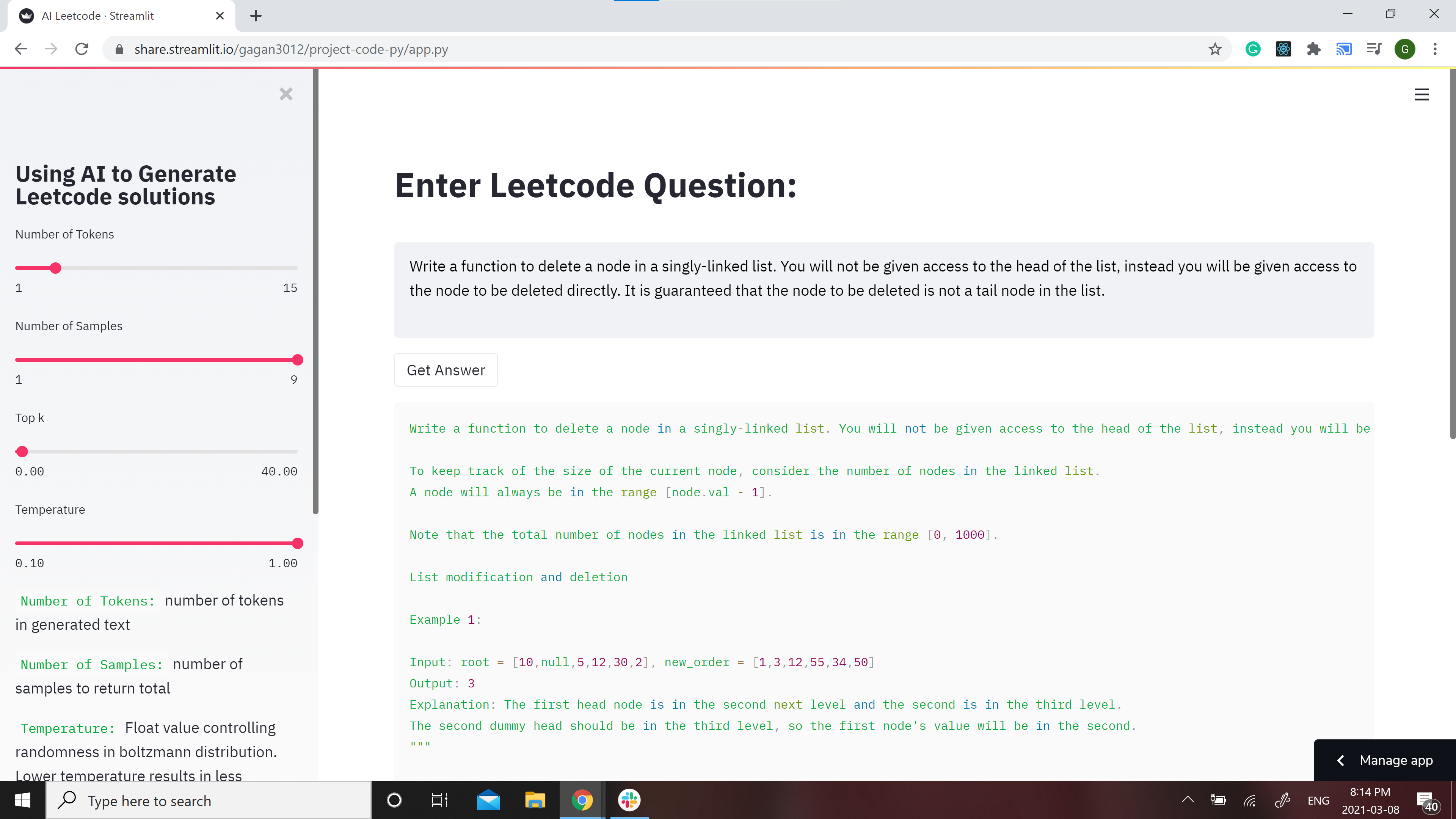
image

Please create an issue in this repo if the demo is not working

Example results:

Question:

Write a function to delete a node in a singly-linked list. You will not be given access to the head of the list, instead you will be given access to the node to be deleted directly. It is guaranteed that the node to be deleted is not a tail node in the list.

Answer:

2->3 b = 3->1->2 t = ListNode(-1, 1) Note: The lexicographic ordering of the nodes in a tree matters. Do not assign values to nodes in a tree. Example 1: Input: [1,2,3] Output: 1->2->5 Explanation: 1->2->3->3->4, then 1->2->5[2] and then 5->1->3->4. Note: The length of a linked list will be in the range [1, 1000]. Node.val must be a valid LinkedListNode type. Both the length and the value of the nodes in a linked list will be in the range [-1000, 1000]. All nodes are distinct. """ # Definition for singly-linked list. # class ListNode: # def __init__(self, x): # self.val = x # self.next = None class Solution: def deleteNode(self, head: ListNode, val: int) -> None: """ BFS Linked List :param head: ListNode :param val: int :return: ListNode """ if head is not None: return head dummy = ListNode(-1, 1) dummy.next = head dummy.next.val = val dummy.next.next = head dummy.val = "" s1 = Solution() print(s1.deleteNode(head)) print(s1.deleteNode(-1)) print(s1.deleteNode(-1)) ">
""" Write a function to delete a node in a singly-linked list. You will not be given access to the head of the list, instead you will be given access to the node to be deleted directly. It is guaranteed that the node to be deleted is not a tail node in the list.

For example,
a = 1->2->3
b = 3->1->2
t = ListNode(-1, 1)

Note: The lexicographic ordering of the nodes in a tree matters. Do not assign values to nodes in a tree.
Example 1:

Input: [1,2,3]
Output: 1->2->5
Explanation: 1->2->3->3->4, then 1->2->5[2] and then 5->1->3->4.


Note:

The length of a linked list will be in the range [1, 1000].
Node.val must be a valid LinkedListNode type.
Both the length and the value of the nodes in a linked list will be in the range [-1000, 1000].
All nodes are distinct.
"""
# Definition for singly-linked list.
# class ListNode:
#     def __init__(self, x):
#         self.val = x
#         self.next = None

class Solution:
    def deleteNode(self, head: ListNode, val: int) -> None:
        """
        BFS
        Linked List
        :param head: ListNode
        :param val: int
        :return: ListNode
        """
        if head is not None:
            return head
        dummy = ListNode(-1, 1)
        dummy.next = head
        dummy.next.val = val
        dummy.next.next = head
        dummy.val = ""


s1 = Solution()
print(s1.deleteNode(head))
print(s1.deleteNode(-1))
Owner
Gagan Bhatia
Software Developer | Machine Learning Enthusiast
Gagan Bhatia
CoSENT 比Sentence-BERT更有效的句向量方案

CoSENT 比Sentence-BERT更有效的句向量方案

苏剑林(Jianlin Su) 201 Dec 12, 2022
An Open-Source Package for Neural Relation Extraction (NRE)

OpenNRE We have a DEMO website (http://opennre.thunlp.ai/). Try it out! OpenNRE is an open-source and extensible toolkit that provides a unified frame

THUNLP 3.9k Jan 03, 2023
Implementation of the Hybrid Perception Block and Dual-Pruned Self-Attention block from the ITTR paper for Image to Image Translation using Transformers

ITTR - Pytorch Implementation of the Hybrid Perception Block (HPB) and Dual-Pruned Self-Attention (DPSA) block from the ITTR paper for Image to Image

Phil Wang 17 Dec 23, 2022
Topic Inference with Zeroshot models

zeroshot_topics Table of Contents Installation Usage License Installation zeroshot_topics is distributed on PyPI as a universal wheel and is available

Rita Anjana 55 Nov 28, 2022
This is the offline-training-pipeline for our project.

offline-training-pipeline This is the offline-training-pipeline for our project. We adopt the offline training and online prediction Machine Learning

0 Apr 22, 2022
Search for documents in a domain through Google. The objective is to extract metadata

MetaFinder - Metadata search through Google _____ __ ___________ .__ .___ / \

Josué Encinar 85 Dec 16, 2022
Simplified diarization pipeline using some pretrained models - audio file to diarized segments in a few lines of code

simple_diarizer Simplified diarization pipeline using some pretrained models. Made to be a simple as possible to go from an input audio file to diariz

Chau 65 Dec 30, 2022
Code for paper Multitask-Finetuning of Zero-shot Vision-Language Models

Code for paper Multitask-Finetuning of Zero-shot Vision-Language Models

Zhenhailong Wang 2 Jul 15, 2022
An implementation of model parallel GPT-3-like models on GPUs, based on the DeepSpeed library. Designed to be able to train models in the hundreds of billions of parameters or larger.

GPT-NeoX An implementation of model parallel GPT-3-like models on GPUs, based on the DeepSpeed library. Designed to be able to train models in the hun

EleutherAI 3.1k Jan 08, 2023
一个基于Nonebot2和go-cqhttp的娱乐性qq机器人

Takker - 一个普通的QQ机器人 此项目为基于 Nonebot2 和 go-cqhttp 开发,以 Sqlite 作为数据库的QQ群娱乐机器人 关于 纯兴趣开发,部分功能借鉴了大佬们的代码,作为Q群的娱乐+功能性Bot 声明 此项目仅用于学习交流,请勿用于非法用途 这是开发者的第一个Pytho

风屿 79 Dec 29, 2022
Mlcode - Continuous ML API Integrations

mlcode Basic APIs for ML applications. Django REST Application Contains REST API

Sujith S 1 Jan 01, 2022
Smart discord chatbot integrated with Dialogflow

academic-NLP-chatbot Smart discord chatbot integrated with Dialogflow to interact with students naturally and manage different classes in a school. De

Tom Huynh 5 Oct 24, 2022
Code for the paper "BERT Loses Patience: Fast and Robust Inference with Early Exit".

Patience-based Early Exit Code for the paper "BERT Loses Patience: Fast and Robust Inference with Early Exit". NEWS: We now have a better and tidier i

Kevin Canwen Xu 54 Jan 04, 2023
A very simple framework for state-of-the-art Natural Language Processing (NLP)

A very simple framework for state-of-the-art NLP. Developed by Humboldt University of Berlin and friends. IMPORTANT: (30.08.2020) We moved our models

flair 12.3k Dec 31, 2022
Phrase-BERT: Improved Phrase Embeddings from BERT with an Application to Corpus Exploration

Phrase-BERT: Improved Phrase Embeddings from BERT with an Application to Corpus Exploration This is the official repository for the EMNLP 2021 long pa

70 Dec 11, 2022
GrammarTagger — A Neural Multilingual Grammar Profiler for Language Learning

GrammarTagger — A Neural Multilingual Grammar Profiler for Language Learning GrammarTagger is an open-source toolkit for grammatical profiling for lan

Octanove Labs 27 Jan 05, 2023
Trained T5 and T5-large model for creating keywords from text

text to keywords Trained T5-base and T5-large model for creating keywords from text. Supported languages: ru Pretraining Large version | Pretraining B

Danil 61 Nov 24, 2022
Nmt - TensorFlow Neural Machine Translation Tutorial

Neural Machine Translation (seq2seq) Tutorial Authors: Thang Luong, Eugene Brevdo, Rui Zhao (Google Research Blogpost, Github) This version of the tut

6.1k Dec 29, 2022
To create a deep learning model which can explain the content of an image in the form of speech through caption generation with attention mechanism on Flickr8K dataset.

To create a deep learning model which can explain the content of an image in the form of speech through caption generation with attention mechanism on Flickr8K dataset.

Ragesh Hajela 0 Feb 08, 2022